University of Westminster, United Kingdom.
London School of Hygiene and Tropical Medicine, United Kingdom.
Accid Anal Prev. 2018 Aug;117:75-84. doi: 10.1016/j.aap.2018.03.003. Epub 2018 Apr 13.
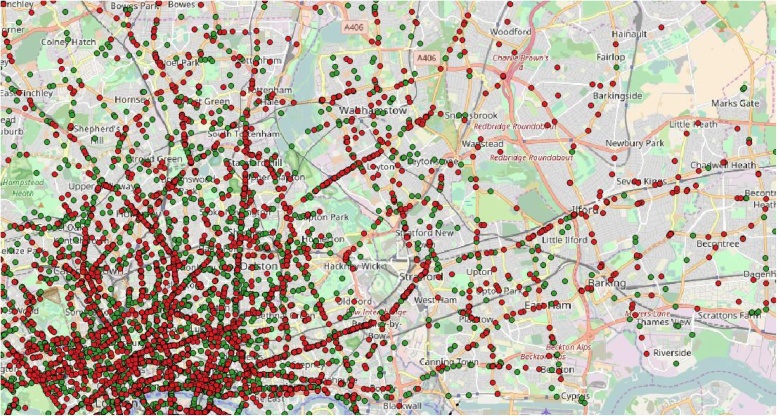
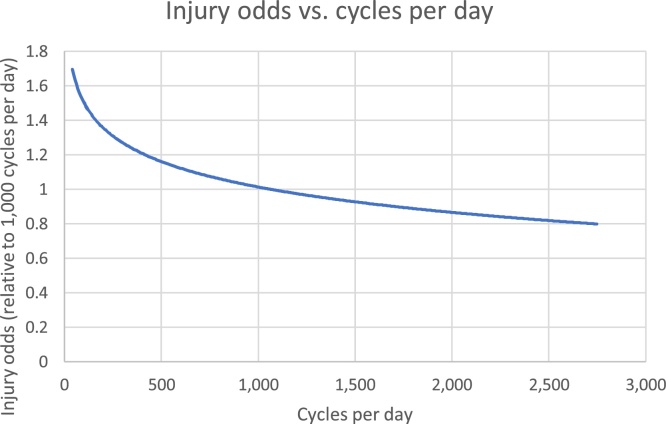
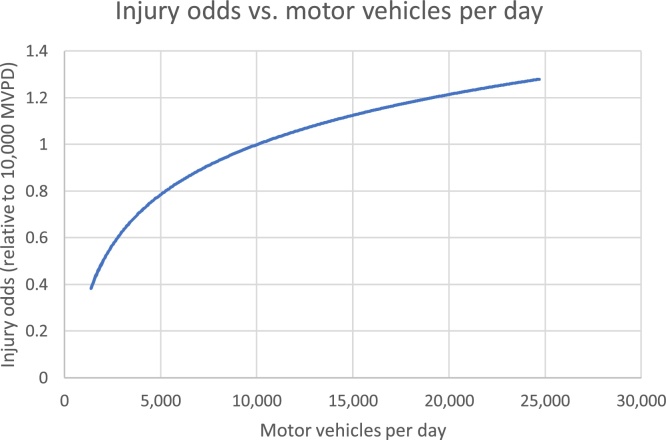
Cycling injury risk is an important topic, but few studies explore cycling risk in relation to exposure. This is largely because of a lack of exposure data, in other words how much cycling is done at different locations. This paper helps to fill this gap. It reports a case-control study of cycling injuries in London in 2013-2014, using modelled cyclist flow data alongside datasets covering some characteristics of the London route network. A multilevel binary logistic regression model is used to investigate factors associated with injury risk, comparing injury sites with control sites selected using the modelled flow data. Findings provide support for 'safety in numbers': for each increase of a natural logarithmic unit (2.71828) in cycling flows, an 18% decrease in injury odds was found. Conversely, increased motor traffic volume is associated with higher odds of cycling injury, with one logarithmic unit increase associated with a 31% increase in injury odds. Twenty-mile per hour compared with 30mph speed limits were associated with 21% lower injury odds. Residential streets were associated with reduced injury odds, and junctions with substantially higher injury odds. Bus lanes do not affect injury odds once other factors are controlled for. These data suggest that speed limits of 20 mph may reduce cycling injury risk, as may motor traffic reduction. Further, building cycle routes that generate new cycle trips should generate 'safety in numbers' benefits.
自行车损伤风险是一个重要的课题,但很少有研究探讨与暴露相关的自行车风险。这在很大程度上是因为缺乏暴露数据,换句话说,就是不知道在不同地点骑行的次数。本文有助于填补这一空白。它报告了 2013-2014 年伦敦自行车损伤的病例对照研究,使用了模型化的自行车流量数据以及涵盖伦敦路线网络一些特征的数据集。采用多水平二项逻辑回归模型,根据模型化流量数据选择的损伤部位和对照部位,研究了与损伤风险相关的因素。研究结果支持“人多安全”的观点:自行车流量每增加一个自然对数单位(2.71828),损伤几率就会降低 18%。相反,机动车交通量的增加与自行车损伤几率的增加有关,每增加一个对数单位,损伤几率就会增加 31%。与 30 英里/小时的限速相比,20 英里/小时的限速与损伤几率降低 21%有关。与其他因素相比,居民区街道与较低的损伤几率有关,而交叉口的损伤几率则明显较高。公共汽车专用道不会影响损伤几率。这些数据表明,20 英里/小时的限速可能会降低自行车损伤风险,减少机动车交通量也可能会降低风险。此外,建设新的自行车道以产生新的自行车出行,应会产生“人多安全”的好处。