Hori Yasutomo, Iguchi Masayuki, Heishima Yasuhiro, Yamashita Yohei, Nakamura Kensuke, Hirakawa Atsushi, Kitade Akihito, Ibaragi Toshiki, Katagi Michio, Sawada Tamotsu, Yuki Masashi, Kanno Nobuyuki, Inaba Haruki, Isayama Noriko, Onodera Hideyuki, Iwasa Naoki, Kino Mikio, Narukawa Mikihiro, Uchida Syuhei
School of Veterinary Medicine, Rakuno Gakuen University, 582 Midori-machi, Bunkyodai, Ebetsu, Hokkaido, Japan.
Iguchi Animal Hospital, 6-2-34 Kamijima, Naka ward, Hamamatsu, Shizuoka, Japan.
J Vet Intern Med. 2018 May;32(3):922-929. doi: 10.1111/jvim.15131. Epub 2018 Apr 16.
Cardiac troponin I (cTnI) is useful for assessing hypertrophic cardiomyopathy (HCM) in cats.
To measure plasma cTnI concentrations in healthy cats and evaluate the clinical utility of cTnI in determining the severity of HCM.
Clinically healthy cats (n = 88) and cats with HCM (n = 93).
Multicenter prospective study. Cats with HCM, including hypertrophic obstructive cardiomyopathy at various stages, were diagnosed using echocardiography. Plasma cTnI concentrations were analyzed by a commercial laboratory. Receiver-operating characteristic curve analysis was used to evaluate the accuracy of plasma cTnI concentrations to detect HCM.
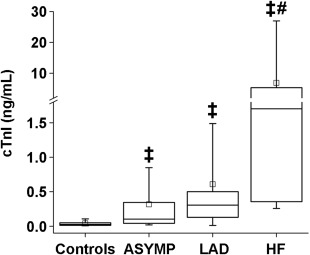
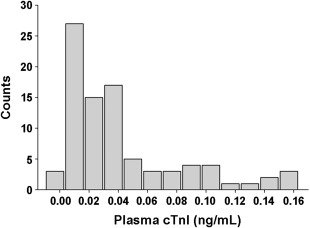
The median cTnI concentration was 0.027 ng/mL (interquartile range, 0.012-0.048 ng/mL) in healthy cats. Concentrations were significantly higher in diseased cats than in healthy controls, and concentrations were significantly higher in cats with heart failure than in asymptomatic cats. A plasma cTnI concentration of 0.163 ng/mL had a sensitivity of 62.0% and specificity of 100% when used to distinguish normal cats from asymptomatic HCM cats without left atrial dilatation. A cutoff of 0.234 ng/mL had high sensitivity (95.0%) and specificity (77.8%) for assessing heart failure. The areas under the receiver-operating characteristic curves were 0.85 and 0.93, respectively.
Increased cTnI concentrations reflect the severity of HCM. If other causes of cardiac injury are ruled out, plasma cTnI concentration may be useful for predicting the severity of HCM in cats.
心肌肌钙蛋白I(cTnI)有助于评估猫的肥厚型心肌病(HCM)。
测量健康猫的血浆cTnI浓度,并评估cTnI在确定HCM严重程度方面的临床效用。
临床健康猫(n = 88)和患有HCM的猫(n = 93)。
多中心前瞻性研究。使用超声心动图诊断患有HCM的猫,包括不同阶段的肥厚性梗阻性心肌病。血浆cTnI浓度由商业实验室进行分析。采用受试者工作特征曲线分析来评估血浆cTnI浓度检测HCM的准确性。
健康猫的cTnI浓度中位数为0.027 ng/mL(四分位间距,0.012 - 0.048 ng/mL)。患病猫的浓度显著高于健康对照,心力衰竭猫的浓度显著高于无症状猫。当用于区分正常猫和无左心房扩张的无症状HCM猫时,血浆cTnI浓度为0.163 ng/mL时,敏感性为62.0%,特异性为100%。截断值为0.234 ng/mL时,评估心力衰竭具有高敏感性(95.0%)和特异性(77.8%)。受试者工作特征曲线下面积分别为0.85和0.93。
cTnI浓度升高反映了HCM的严重程度。如果排除其他心脏损伤原因,血浆cTnI浓度可能有助于预测猫HCM的严重程度。