Obesity Center CGG, Erasmus MC, University Medical Center Rotterdam, Room D-428, P.O. Box 2040, 3000 CA, Rotterdam, The Netherlands.
Department of Internal Medicine, division of Endocrinology, Erasmus MC, University Medical Center Rotterdam, Rotterdam, The Netherlands.
Curr Obes Rep. 2018 Jun;7(2):193-203. doi: 10.1007/s13679-018-0306-y.
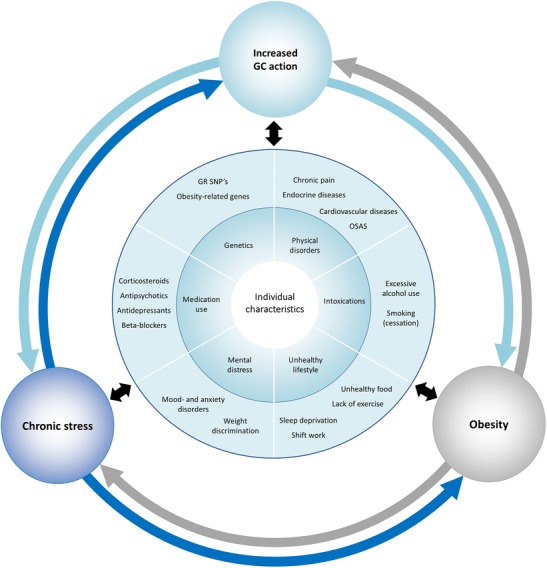
Stress has long been suspected to be interrelated to (abdominal) obesity. However, interindividual differences in this complex relationship exist. We suggest that the extent of glucocorticoid action partly explains these interindividual differences. We provide latest insights with respect to multiple types of stressors.
Increased long-term cortisol levels, as measured in scalp hair, are strongly related to abdominal obesity and to specific mental disorders. However, not all obese patients have elevated cortisol levels. Possibly, the interindividual variation in glucocorticoid sensitivity, which is partly genetically determined, may lead to higher vulnerability to mental or physical stressors. Other evidence for the important role for increased glucocorticoid action is provided by recent studies investigating associations between body composition and local and systemic corticosteroids. Stress may play a major role in the development and maintenance of obesity in individuals who have an increased glucocorticoid exposure or sensitivity. These insights may lead to more effective and individualized obesity treatment strategies.
长期以来,压力被认为与(腹部)肥胖有关。然而,这种复杂关系在个体间存在差异。我们认为,糖皮质激素作用的程度部分解释了这些个体间的差异。我们就多种类型的应激源提供了最新的见解。
头皮头发中测得的长期皮质醇水平升高与腹部肥胖和特定的精神障碍密切相关。然而,并非所有肥胖患者的皮质醇水平都升高。皮质醇敏感性的个体间差异可能部分由遗传决定,这可能导致对精神或身体应激源的更高易感性。最近的研究调查了身体成分与局部和全身皮质类固醇之间的关系,为增强糖皮质激素作用的重要作用提供了其他证据。在糖皮质激素暴露或敏感性增加的个体中,压力可能在肥胖的发生和维持中起主要作用。这些见解可能导致更有效和个体化的肥胖治疗策略。