Optum, 1301 Atwood Avenue, Suite 311N, Johnston, RI, 02919, USA.
Qual Life Res. 2018 Jul;27(7):1757-1767. doi: 10.1007/s11136-018-1851-2. Epub 2018 Apr 16.
Patient-reported outcome (PRO) measures originally developed for paper administration are increasingly being administered electronically in clinical trials and other health research studies. Three published meta-analyses of measurement equivalence among paper and electronic modes aggregated findings across hundreds of PROs, but there has not been a similar meta-analysis that addresses a single PRO, partly because there are not enough published measurement equivalence studies using the same PRO. Because the SF-36 Health Survey (SF-36) is a widely used PRO, the aim of this study was to conduct a meta-analysis of measurement equivalence studies of this survey.
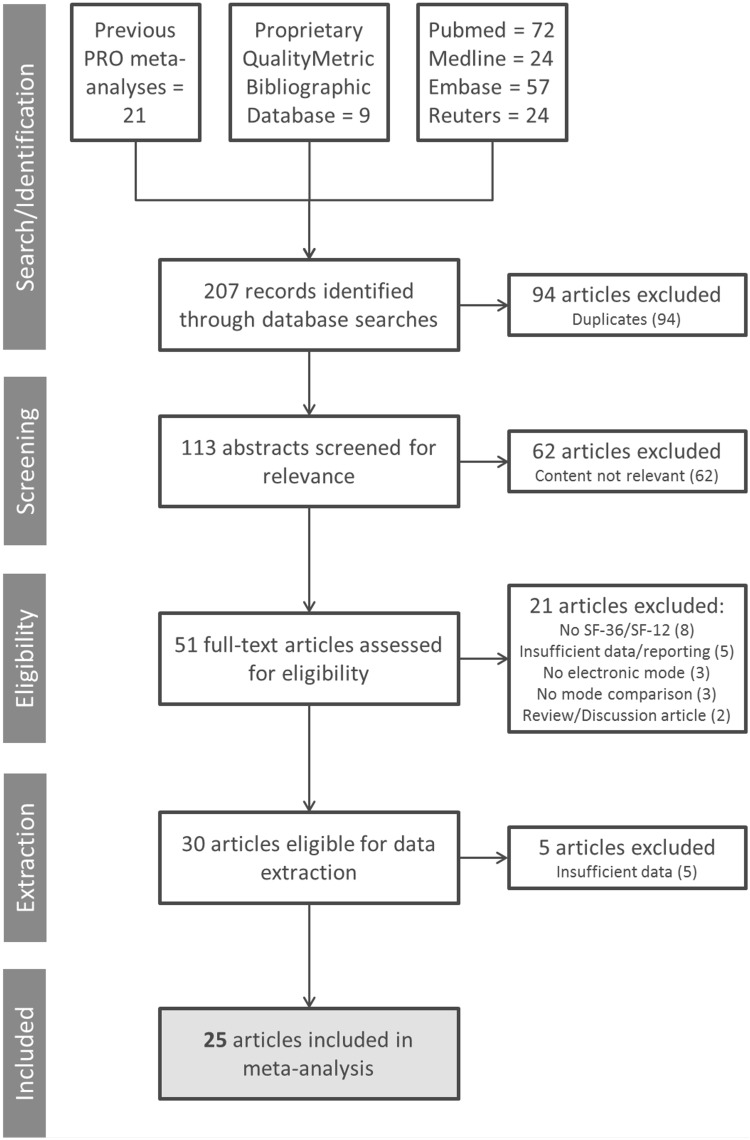
A literature search of several medical databases used search terms for variations of "SF-36" or "SF-12" and "equivalence" in the title or abstract of English language publications. The eight scale scores and two summary measures of the SF-36 and SF-12 were transformed to norm-based scores (NBS) using developer guidelines. A threshold of within ± 2 NBS points was set as the margin of equivalence. Comprehensive meta-analysis software was used.
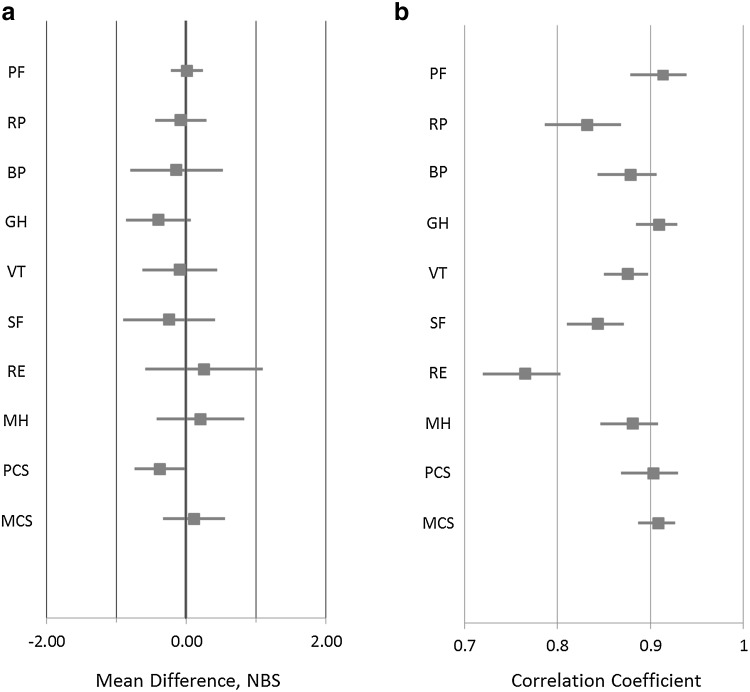
Twenty-five studies were included in the meta-analysis. Results indicated that mean differences across domains and summary scores ranged from 0.01 to 0.39 while estimates of agreement ranged from 0.76 to 0.91, all well within the equivalence threshold. Moderator analyses showed that time between administration, survey language, and type of electronic device did not influence equivalence.
The results of the meta-analysis support equivalence of paper-based and electronic versions of the SF-36 and SF-12 across a variety of disease populations, countries, and electronic modes.
最初为纸质管理开发的患者报告结局(PRO)测量工具,在临床试验和其他健康研究中越来越多地以电子方式进行管理。三篇已发表的关于纸质和电子模式之间测量等效性的荟萃分析汇总了数百个 PRO 的结果,但没有类似的荟萃分析针对单个 PRO,部分原因是使用相同 PRO 的测量等效性研究发表的数量不够。由于 SF-36 健康调查(SF-36)是一种广泛使用的 PRO,因此本研究旨在对该调查的测量等效性研究进行荟萃分析。
使用几种医学数据库进行文献检索,使用“SF-36”或“SF-12”和标题或摘要中“等效性”的变体的搜索词,检索英文出版物。SF-36 和 SF-12 的八个量表得分和两个综合测量值根据开发者指南转换为基于标准的得分(NBS)。设定±2 NBS 点的差值作为等效性边界。使用综合荟萃分析软件进行分析。
荟萃分析纳入了 25 项研究。结果表明,各领域和综合得分的平均差异范围为 0.01 至 0.39,而一致性估计值范围为 0.76 至 0.91,均在等效性阈值内。荟萃分析结果表明,管理之间的时间、调查语言和电子设备类型均不影响等效性。
荟萃分析的结果支持在各种疾病人群、国家和电子模式下,纸质版和电子版 SF-36 和 SF-12 的等效性。