Department of Food, Bioprocessing and Nutrition Sciences, North Carolina State University, Raleigh, North Carolina, USA.
Division of Microbiology, Center for Food Safety and Applied Nutrition, Food and Drug Administration, College Park, Maryland, USA.
mBio. 2018 Apr 17;9(2):e00396-18. doi: 10.1128/mBio.00396-18.
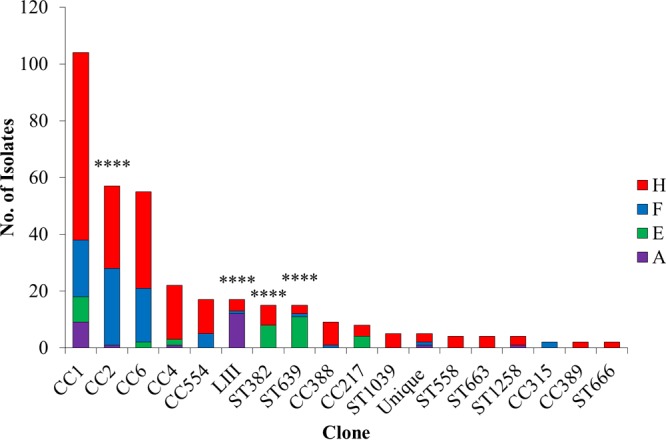
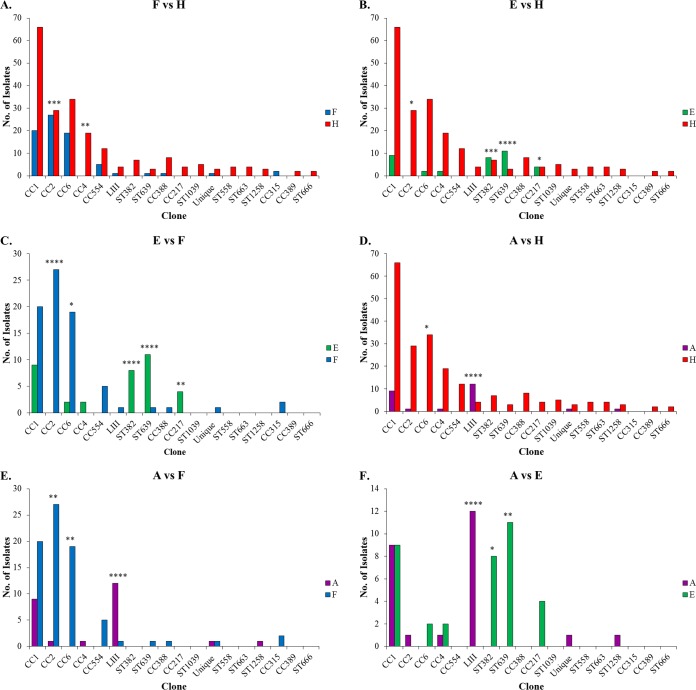
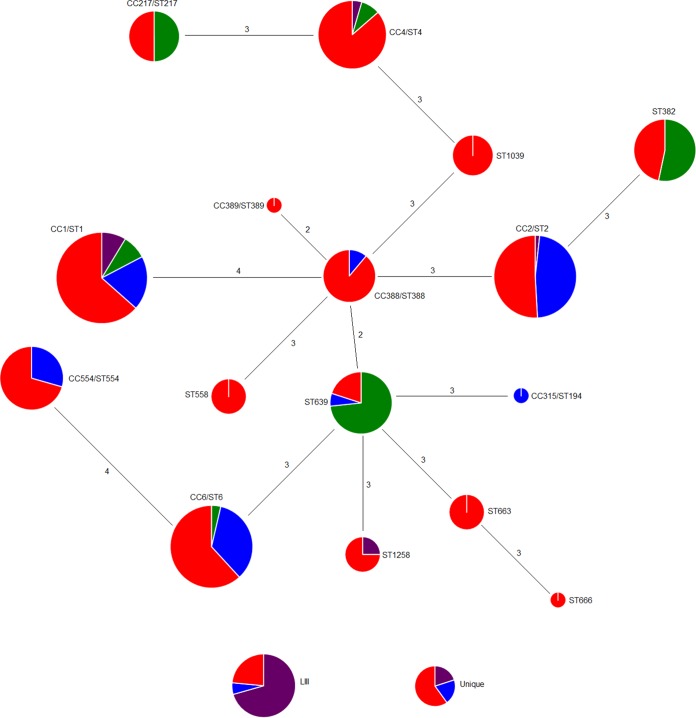
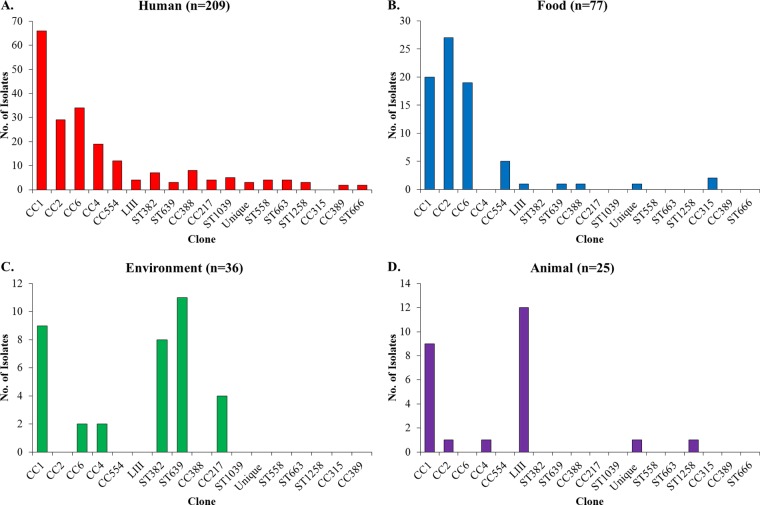
Biodiversity analysis of the foodborne pathogen recently revealed four serotype 4b major hypervirulent clonal complexes (CCs), i.e., CC1, CC2, CC4, and CC6. Hypervirulence was indicated by overrepresentation of these clones, and serotype 4b as a whole, among human clinical isolates in comparison to food. However, data on potential source-dependent partitioning among serotype 4b clones in diverse regions are sparse. We analyzed a panel of 347 serotype 4b isolates, primarily from North America, to determine the distribution of clones in humans, other animals, food, and water. CC1, CC2, CC4, and CC6 predominated, but surprisingly, only three clones, i.e., CC2 and the singleton sequence types (STs) ST382 and ST639, exhibited significant source-dependent associations, with higher propensity for food (CC2) or water (ST382 and ST639) than other sources. Pairwise comparisons between human and food isolates identified CC4 as the only serotype 4b clone significantly overrepresented among human isolates. Our analysis also revealed several serotype 4b clones emerging in North America. Two such emerging clones, ST382 (implicated in several outbreaks since 2014) and ST639, were primarily encountered among human and water isolates. Findings suggest that in spite of the ubiquity of CC1, CC2, CC4, and CC6, regional heterogeneity in serotype 4b is substantially larger than previously surmised. Analysis of even large strain panels from one region may not adequately predict clones unique to, and emerging in, other areas. Serotype 4b clonal complexes may differ in ecological niche preference, suggesting the need to further elucidate reservoirs and vehicles, especially for emerging clones. In , serotype 4b strains are leading contributors to human disease, but intraserotype distributions among different sources and regions remain poorly elucidated. Analysis of 347 serotype 4b isolates from four different sources, mostly from North America, confirmed the overall predominance of the major clones CC1, CC2, CC4, and CC6 but found that only CC4 was significantly associated with human disease, while CC2 was significantly associated with food. Remarkably, several emerging clones were identified among human isolates from North America, with some of these also exhibiting a propensity for surface water. The latter included the singleton clones ST382, implicated in several outbreaks in the United States since 2014, and ST639. These clones were noticeably underrepresented among much larger panels from other regions. Though associated with North America for the time being, they may eventually become globally disseminated through the food trade or other venues.
食源性致病菌生物多样性分析最近揭示了四个血清型 4b 主要高毒力克隆群(CC),即 CC1、CC2、CC4 和 CC6。通过与食物相比,这些克隆和血清型 4b 整体在人类临床分离株中的过度表现表明了高毒力。然而,关于不同地区血清型 4b 克隆之间潜在的源依赖性分配的数据仍然很少。我们分析了一组 347 株血清型 4b 分离株,主要来自北美,以确定克隆在人类、其他动物、食物和水中的分布。CC1、CC2、CC4 和 CC6 占主导地位,但令人惊讶的是,只有三个克隆,即 CC2 和单型序列类型(ST)ST382 和 ST639,表现出明显的源依赖性关联,与食物(CC2)或水(ST382 和 ST639)的相关性高于其他来源。人类和食物分离株之间的成对比较确定 CC4 是唯一在人类分离株中显著过度表达的血清型 4b 克隆。我们的分析还揭示了北美的几个新兴血清型 4b 克隆。两个新兴克隆 ST382(自 2014 年以来涉及几次暴发)和 ST639,主要在人类和水中分离株中发现。研究结果表明,尽管 CC1、CC2、CC4 和 CC6 无处不在,但血清型 4b 的区域异质性比之前推测的要大得多。即使从一个地区分析大型菌株面板也可能无法充分预测其他地区特有的和新兴的克隆。血清型 4b 克隆群在生态位偏好上可能存在差异,这表明需要进一步阐明储存库和载体,特别是对于新兴克隆。在北美,血清型 4b 菌株是导致人类疾病的主要因素,但不同来源和地区之间的血清型 4b 分布仍不清楚。对来自四个不同来源(主要来自北美)的 347 株血清型 4b 分离株进行分析,证实了主要克隆 CC1、CC2、CC4 和 CC6 的总体优势,但发现只有 CC4 与人类疾病显著相关,而 CC2 与食物显著相关。值得注意的是,在北美的人类分离株中发现了几个新兴克隆,其中一些克隆也表现出对地表水的倾向。后者包括在美国自 2014 年以来几次暴发中涉及的单型克隆 ST382 和 ST639。这些克隆在来自其他地区的更大面板中明显代表性不足。尽管目前与北美有关,但它们最终可能通过食品贸易或其他途径在全球传播。