Khairat Saif, Marc David, Crosby William, Al Sanousi Ali
Carolina Health Informatics Program, University of North Carolina at Chapel Hill, Chapel Hill, NC, United States.
School of Nursing, University of North Carolina at Chapel Hill, Chapel Hill, NC, United States.
JMIR Med Inform. 2018 Apr 18;6(2):e24. doi: 10.2196/medinform.8912.
Clinical decision support systems (CDSSs) are an integral component of today's health information technologies. They assist with interpretation, diagnosis, and treatment. A CDSS can be embedded throughout the patient safety continuum providing reminders, recommendations, and alerts to health care providers. Although CDSSs have been shown to reduce medical errors and improve patient outcomes, they have fallen short of their full potential. User acceptance has been identified as one of the potential reasons for this shortfall.
The purpose of this paper was to conduct a critical review and task analysis of CDSS research and to develop a new framework for CDSS design in order to achieve user acceptance.
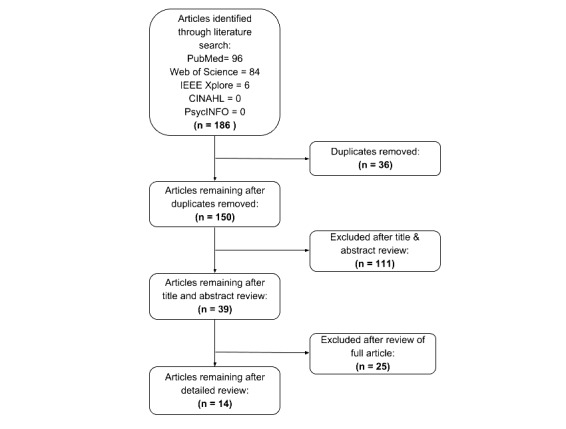
A critical review of CDSS papers was conducted with a focus on user acceptance. To gain a greater understanding of the problems associated with CDSS acceptance, we conducted a task analysis to identify and describe the goals, user input, system output, knowledge requirements, and constraints from two different perspectives: the machine (ie, the CDSS engine) and the user (ie, the physician).
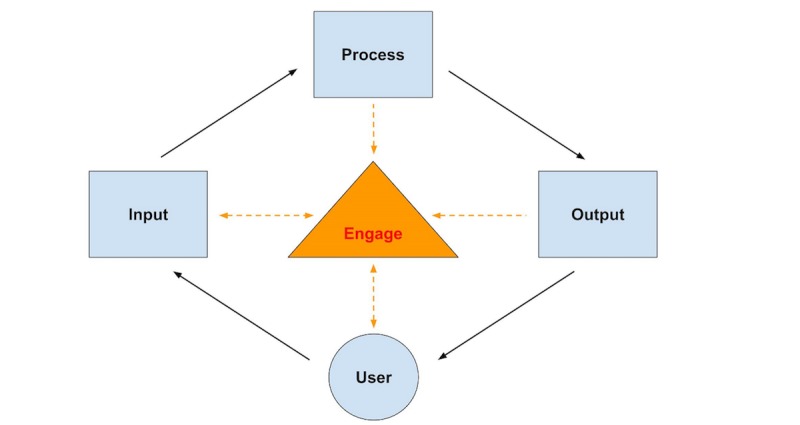
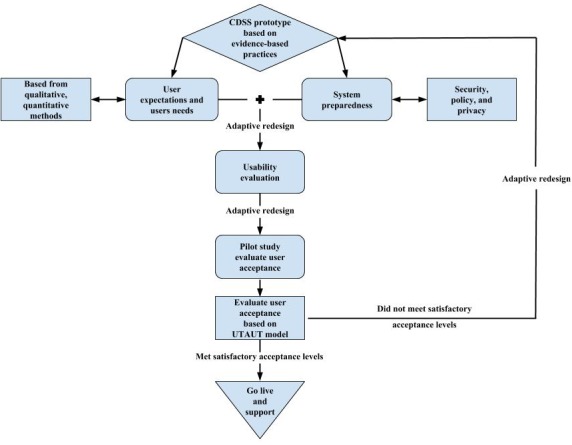
Favorability of CDSSs was based on user acceptance of clinical guidelines, reminders, alerts, and diagnostic suggestions. We propose two models: (1) the user acceptance and system adaptation design model, which includes optimizing CDSS design based on user needs/expectations, and (2) the input-process-output-engagemodel, which reveals to users the processes that govern CDSS outputs.
This research demonstrates that the incorporation of the proposed models will improve user acceptance to support the beneficial effects of CDSSs adoption. Ultimately, if a user does not accept technology, this not only poses a threat to the use of the technology but can also pose a threat to the health and well-being of patients.
临床决策支持系统(CDSS)是当今健康信息技术的一个重要组成部分。它们有助于解释、诊断和治疗。CDSS可以嵌入到整个患者安全连续过程中,为医疗保健提供者提供提醒、建议和警报。尽管CDSS已被证明可减少医疗差错并改善患者预后,但它们尚未充分发挥其潜力。用户接受度被认为是造成这种不足的潜在原因之一。
本文旨在对CDSS研究进行批判性综述和任务分析,并开发一个用于CDSS设计的新框架,以实现用户接受度。
对CDSS相关论文进行批判性综述,重点关注用户接受度。为了更深入地了解与CDSS接受度相关的问题,我们从机器(即CDSS引擎)和用户(即医生)两个不同角度进行了任务分析,以识别和描述目标、用户输入、系统输出、知识要求和限制。
CDSS的受欢迎程度基于用户对临床指南、提醒、警报和诊断建议的接受程度。我们提出了两种模型:(1)用户接受和系统适应设计模型,包括根据用户需求/期望优化CDSS设计;(2)输入-过程-输出-参与模型,向用户揭示控制CDSS输出的过程。
本研究表明,纳入所提出的模型将提高用户接受度,以支持采用CDSS的有益效果。最终,如果用户不接受某项技术,这不仅对该技术的使用构成威胁,还可能对患者的健康和福祉构成威胁。