Department of Anesthesiology, China-Japan Friendship Hospital, Beijing 100029, China.
Mediators Inflamm. 2018 Feb 18;2018:6215350. doi: 10.1155/2018/6215350. eCollection 2018.
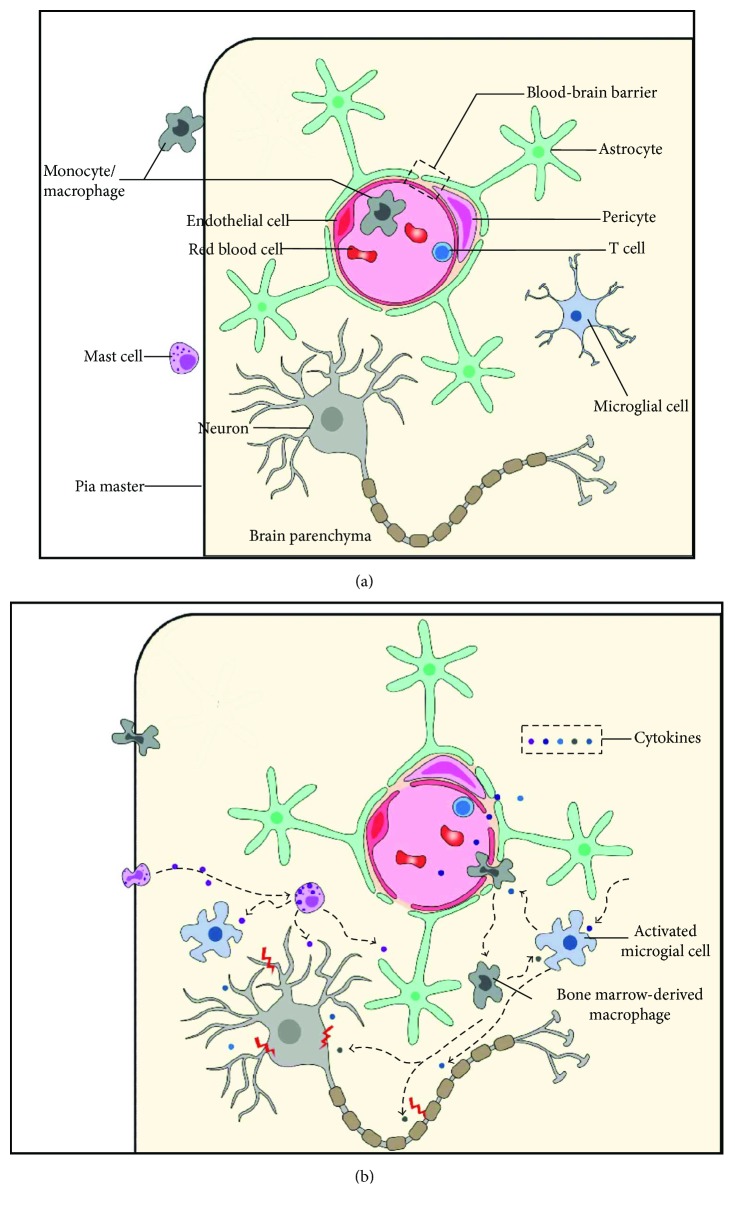
Postoperative cognitive dysfunction (POCD), a long-lasting cognitive decline after surgery, is currently a major clinical problem with no clear pathophysiological mechanism or effective therapy. Accumulating evidence suggests that neuroinflammation plays a critical role in POCD. After surgery, alarmins are leaked from the injury sites and proinflammatory cytokines are increased in the peripheral circulation. Neurons in the hippocampus, which is responsible for learning and memory, can be damaged by cytokines transmitted to the brain parenchyma. Microglia, bone marrow-derived macrophages, mast cells, and T cells in the central nervous system (CNS) can be activated to secrete more cytokines, further aggravating neuroinflammation after surgery. Conversely, blocking the inflammation network between these immune cells and related cytokines alleviates POCD in experimental animals. Thus, a deeper understanding of the roles of immune cells and the crosstalk between them in POCD may uncover promising therapeutic targets for POCD treatment and prevention. Here, we reviewed several major immune cells and discussed their functional roles in POCD.
术后认知功能障碍(POCD)是手术后长期认知衰退的一种现象,目前是一个主要的临床问题,其病理生理机制尚不清楚,也没有有效的治疗方法。越来越多的证据表明,神经炎症在 POCD 中起着关键作用。手术后,警报素从损伤部位泄漏,外周循环中促炎细胞因子增加。负责学习和记忆的海马神经元会受到传递到脑实质的细胞因子的损伤。中枢神经系统(CNS)中的小胶质细胞、骨髓来源的巨噬细胞、肥大细胞和 T 细胞可被激活,分泌更多的细胞因子,进一步加重手术后的神经炎症。相反,阻断这些免疫细胞之间的炎症网络及其相关细胞因子可减轻实验动物的 POCD。因此,深入了解免疫细胞及其在 POCD 中的相互作用可能为 POCD 的治疗和预防提供有希望的治疗靶点。在这里,我们综述了几种主要的免疫细胞,并讨论了它们在 POCD 中的功能作用。