Darr Emily, Meyer S Craig, Whang Peter G, Kovalsky Don, Frank Clay, Lockstadt Harry, Limoni Robert, Redmond Andy, Ploska Philip, Oh Michael Y, Cher Daniel, Chowdhary Abhineet
Orthopaedics and Physical Medicine, Medical University of South Carolina, Charleston, SC, USA.
Columbia Orthopaedic Medical Group, Columbia, MO, USA.
Med Devices (Auckl). 2018 Apr 9;11:113-121. doi: 10.2147/MDER.S160989. eCollection 2018.
Minimally invasive sacroiliac joint fusion (SIJF) has become an increasingly accepted surgical option for chronic sacroiliac (SI) joint dysfunction, a prevalent cause of unremitting low back/buttock pain.
The objective of this study was to report clinical and functional outcomes of SIJF using triangular titanium implants (TTI) in the treatment of chronic SI joint dysfunction due to degenerative sacroiliitis or sacroiliac joint (SIJ) disruption at 3 years postoperatively.
A total of 103 subjects with SIJ dysfunction at 12 centers were treated with TTI in two prospective clinical trials (NCT01640353 and NCT01681004) and enrolled in this long-term follow-up study (NCT02270203). Subjects were evaluated in study clinics at study start and again at 3, 4, and 5 years.
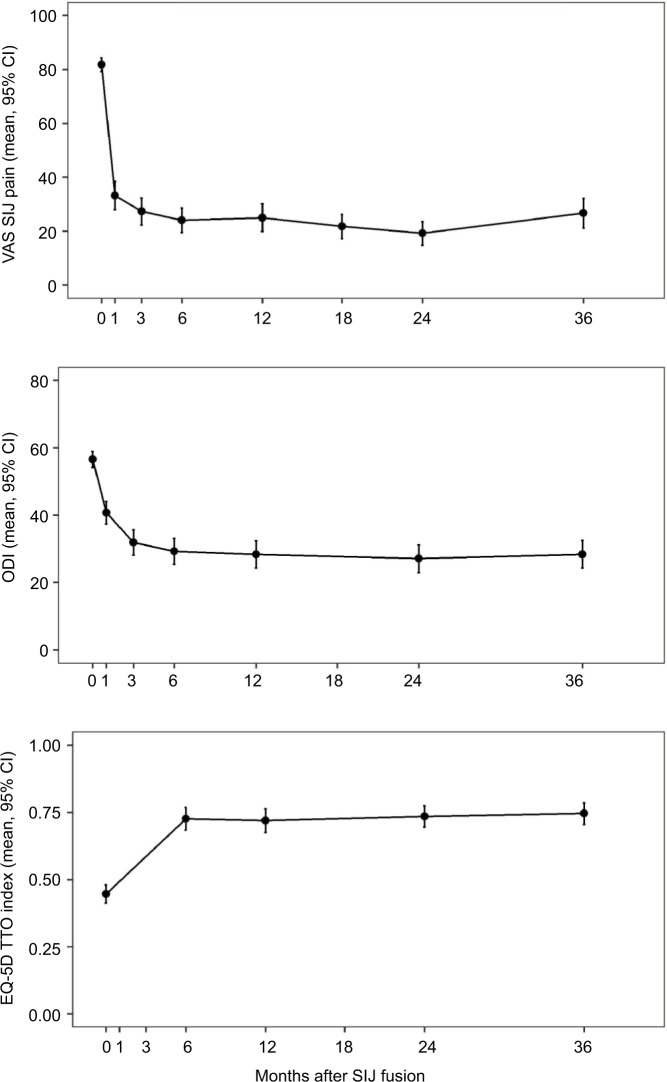
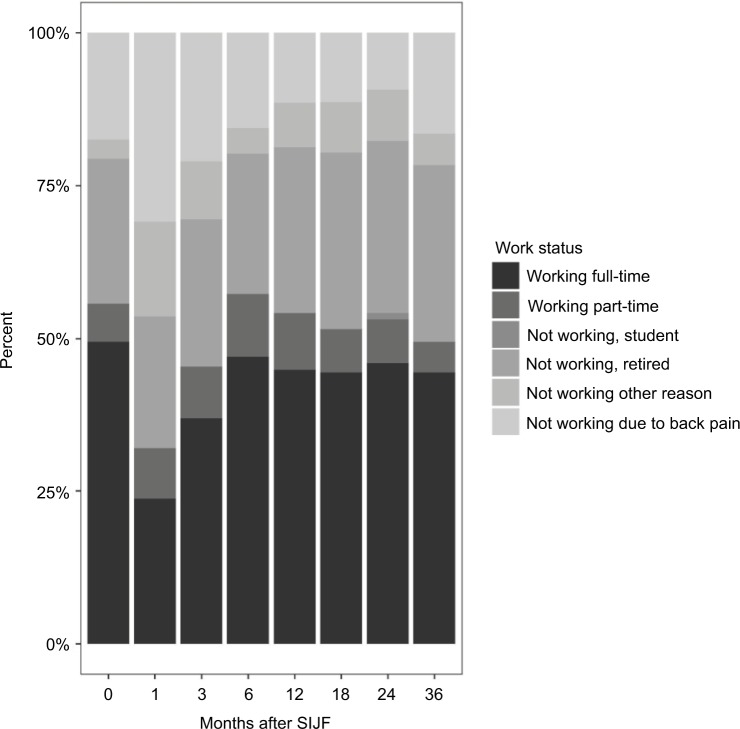
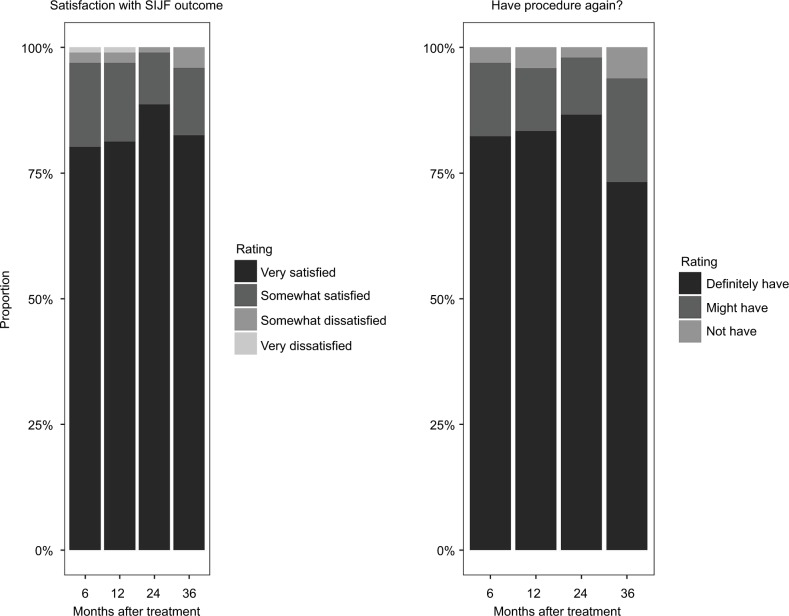
Mean (SD) preoperative SIJ pain score was 81.5, and mean preoperative Oswestry Disability Index (ODI) was 56.3. At 3 years, mean pain SIJ pain score decreased to 26.2 (a 55-point improvement from baseline, <0.0001). At 3 years, mean ODI was 28.2 (a 28-point improvement from baseline, <0.0001). In all, 82% of subjects were very satisfied with the procedure at 3 years. EuroQol-5D (EQ-5D) time trade-off index improved by 0.30 points (<0.0001). No adverse events definitely related to the study device or procedure were reported; one subject underwent revision surgery at year 3.7. SIJ pain contralateral to the originally treated side occurred in 15 subjects of whom four underwent contralateral SIJF. The proportion of subjects who were employed outside the home full- or part-time at 3 years decreased somewhat from baseline (=0.1814), and the proportion of subjects who would have the procedure again was lower at 3 years compared to earlier time points.
In long-term (3-year) follow-up, minimally invasive trans-iliac SIJF with TTI was associated with improved pain, disability, and quality of life with relatively high satisfaction rates.
Level II.
SIJF with TTI.
微创骶髂关节融合术(SIJF)已成为治疗慢性骶髂(SI)关节功能障碍越来越被接受的手术选择,慢性骶髂关节功能障碍是导致持续腰/臀部疼痛的常见原因。
本研究的目的是报告使用三角形钛植入物(TTI)进行SIJF治疗退行性骶髂关节炎或骶髂关节(SIJ)破坏所致慢性SI关节功能障碍术后3年的临床和功能结果。
在两项前瞻性临床试验(NCT01640353和NCT01681004)中,12个中心的103例SIJ功能障碍患者接受了TTI治疗,并纳入了这项长期随访研究(NCT02270203)。在研究开始时以及3年、4年和5年时,在研究诊所对患者进行评估。
术前SIJ疼痛评分平均(标准差)为81.5,术前Oswestry功能障碍指数(ODI)平均为56.3。3年时,SIJ疼痛评分平均降至26.2(较基线改善55分,<0.0001)。3年时,平均ODI为28.2(较基线改善28分,<0.0001)。总体而言,82%的患者在3年时对该手术非常满意。欧洲五维健康量表(EQ-5D)时间权衡指数改善了0.30分(<0.0001)。未报告与研究器械或手术明确相关的不良事件;1例患者在3.7年时接受了翻修手术。15例患者在最初治疗侧的对侧出现SIJ疼痛,其中4例接受了对侧SIJF。3年时全职或兼职外出工作的患者比例较基线有所下降(=0.1814),与早期时间点相比,3年时愿意再次接受该手术的患者比例较低。
在长期(3年)随访中,采用TTI的微创经髂骨SIJF与疼痛减轻、功能障碍改善和生活质量提高相关,满意度相对较高。
二级。
采用TTI的SIJF。