Eo Wan Kyu, Kim Ki Hyung, Park Eun Joo, Kim Heung Yeol, Kim Hong-Bae, Koh Suk Bong, Namkung Jeong
Department of Internal Medicine, College of Medicine, Kyung Hee University, Seoul, Korea.
Department of Obstetrics and Gynecology, Pusan National University School of Medicine; Biomedical Research Institute, Pusan National University Hospital, Busan, Korea.
J Cancer. 2018 Mar 8;9(7):1165-1172. doi: 10.7150/jca.23606. eCollection 2018.
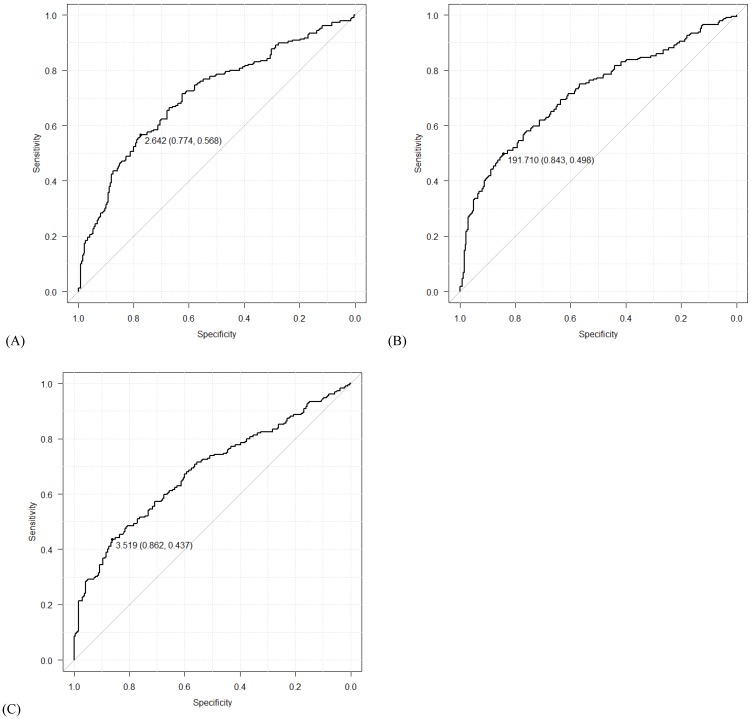
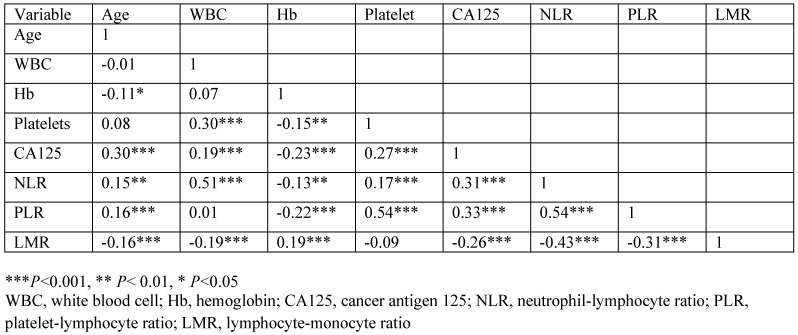
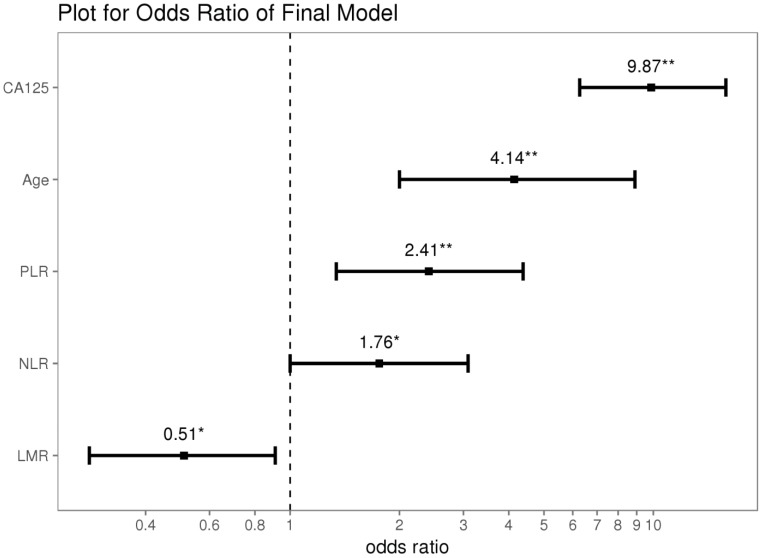
: To evaluate the role of inflammatory markers for distinguishing malignant and benign ovarian masses. : Preoperative demographic, clinicopathologic, and laboratory variables were reviewed in patients with an ovarian mass that was subsequently diagnosed as either epithelial ovarian cancer (EOC) or a benign ovarian mass on histologic analysis. The differences between variables of the two groups were further evaluated. Logistic regression analysis was applied to evaluate variables to predict the presence of EOC. : According to the analysis of 229 patients with EOC, 120 (52.4%) patients had serous adenocarcinoma. Of the 229 patients, 110 (48.1%) patients had stage I or II disease and 119 (52.0%) had stage III or IV disease. There was a significant difference between EOC and benign ovarian mass in median values of variables such as age, white blood cell (WBC) count, hemoglobin concentration, platelet count, cancer antigen 125 (CA125) levels, neutrophil-to-lymphocyte ratio (NLR), platelet-to-lymphocyte ratio (PLR), and lymphocyte-to-monocyte ratio (LMR) (all < 0.001, except for WBC count [ = 0.009]). In addition, there was significant difference in median values of these continuous variables among early-stage EOC, advanced-stage EOC, and benign ovarian mass ( < 0.001 for all variables). On multivariate logistic regression analysis, age (odds ratio [OR] = 4.14, < 0.001), CA125 levels (OR = 9.87, < 0.001), NLR (OR = 1.76, = 0.049), PLR (OR = 2.41, = 0.004), and LMR (OR = 0.51, = 0.024) were found to significantly predict the presence of EOC. : The three LMR, NLR, and PLR markers were found to be predictors for the presence of EOC. Further prospective studies to assess these markers as screening tools for the presence of EOC are required.
评估炎症标志物在鉴别卵巢良恶性肿块中的作用。对卵巢肿块患者术前的人口统计学、临床病理和实验室变量进行回顾,这些患者的卵巢肿块随后经组织学分析诊断为上皮性卵巢癌(EOC)或良性卵巢肿块。进一步评估两组变量之间的差异。应用逻辑回归分析评估变量以预测EOC的存在。根据对229例EOC患者的分析,120例(52.4%)患者患有浆液性腺癌。在这229例患者中,110例(48.1%)患者处于I期或II期疾病,119例(52.0%)患者处于III期或IV期疾病。EOC与良性卵巢肿块在年龄、白细胞(WBC)计数、血红蛋白浓度、血小板计数、癌抗原125(CA125)水平、中性粒细胞与淋巴细胞比值(NLR)、血小板与淋巴细胞比值(PLR)以及淋巴细胞与单核细胞比值(LMR)等变量的中位数方面存在显著差异(除WBC计数外,所有差异均<0.001,WBC计数差异为[ = 0.009])。此外,这些连续变量在早期EOC、晚期EOC和良性卵巢肿块之间的中位数也存在显著差异(所有变量差异均<0.001)。在多因素逻辑回归分析中,发现年龄(比值比[OR]=4.14,<0.001)、CA125水平(OR = 9.87,<0.001)、NLR(OR = 1.76,= 0.049)、PLR(OR = 2.41,= 0.004)和LMR(OR = 0.51,= 0.024)可显著预测EOC的存在。发现LMR、NLR和PLR这三种标志物可预测EOC的存在。需要进一步进行前瞻性研究以评估这些标志物作为EOC存在的筛查工具。