Guang'anmen Hospital, China Academy of Chinese Medical Sciences, Beijing, 100053, China.
Wangjing Hospital, China Academy of Chinese Medical Sciences, Beijing, 100102, China.
J Ovarian Res. 2023 Feb 9;16(1):36. doi: 10.1186/s13048-023-01116-2.
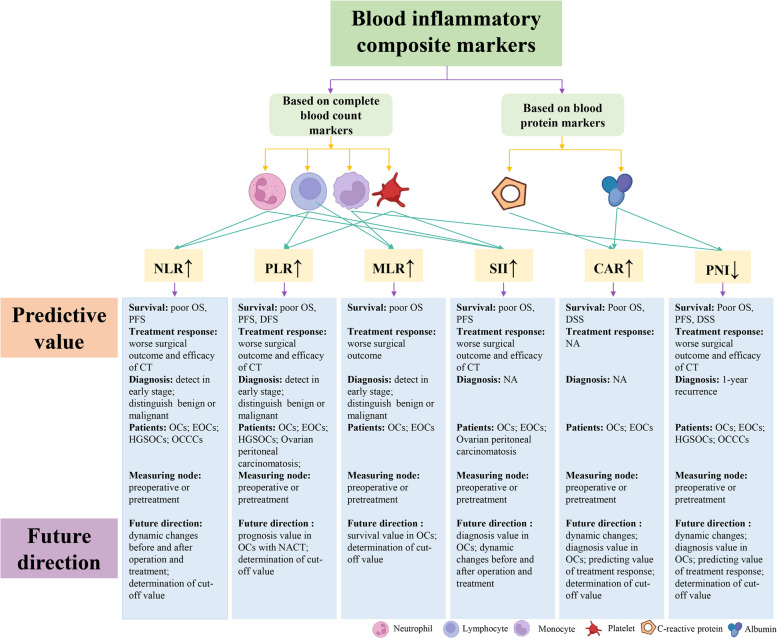
Ovarian cancer (OC) is one of the deadliest malignant tumors affecting women worldwide. The predictive value of some blood inflammatory composite markers in OC has been extensively reported. They can be used for early detection and differential diagnosis of OC and can be used for predicting survival, treatment response, and recurrence in the affected patients. Here, we reviewed the predictive values of composite inflammatory markers based on complete blood count, namely neutrophil-to-lymphocyte ratio (NLR), platelet-to-lymphocyte ratio (PLR), monocyte-to-lymphocyte ratio, and systemic inflammation index and markers based on blood protein, namely C-reactive protein-to-albumin ratio and prognostic nutritional index in OC, with a focus on NLR and PLR. We referred to the clinical studies on these six markers, reviewed the patient population, and summarized the marker cut-off values, significance, and limitations of these studies. All these studies were retrospective and most of them were single-center clinical studies with small sample sizes. We found that the cut-off values of these markers have not been unified, and methods used to determine these values varied among studies. The predictive value of these markers on survival was mainly reflected in the postoperative patients of multiple subtypes of ovarian cancer including epithelial OC, high-grade serous ovarian carcinoma, and ovarian clear cell carcinoma. We focused on NLR and PLR and calculated their pooled hazard ratios. NLR and PLR were reliable in predicting overall and progression-free survivals in patients with OC. Therefore, it is necessary to adjust important confounding factors and conduct a long-term follow-up prospective cohort study to further clarify the cut-off values of NLR and PLR and their clinical applications.
卵巢癌 (OC) 是全球范围内女性致死率最高的恶性肿瘤之一。一些血液炎症复合标志物在 OC 中的预测价值已被广泛报道。它们可用于 OC 的早期检测和鉴别诊断,可用于预测患者的生存、治疗反应和复发。在这里,我们回顾了基于全血细胞计数的复合炎症标志物(中性粒细胞与淋巴细胞比值 NLR、血小板与淋巴细胞比值 PLR、单核细胞与淋巴细胞比值)和基于血液蛋白的标志物(C 反应蛋白与白蛋白比值、预后营养指数)的预测价值,重点关注 NLR 和 PLR。我们查阅了这些六种标志物的临床研究,回顾了患者人群,并总结了这些研究中标志物的临界值、意义和局限性。所有这些研究都是回顾性的,大多数是小样本量的单中心临床研究。我们发现这些标志物的临界值尚未统一,并且研究之间确定这些值的方法也有所不同。这些标志物对生存的预测价值主要反映在多种卵巢癌亚型(包括上皮性 OC、高级别浆液性卵巢癌和卵巢透明细胞癌)的术后患者中。我们重点关注 NLR 和 PLR,并计算了它们的合并危险比。NLR 和 PLR 可可靠地预测 OC 患者的总生存期和无进展生存期。因此,有必要调整重要的混杂因素并进行长期随访的前瞻性队列研究,以进一步阐明 NLR 和 PLR 的临界值及其临床应用。