Department of Ophthalmology, University of Tokyo Graduate School of Medicine, Tokyo, Japan.
Shiley Eye Institute Hamilton Glaucoma Center, University of California, San Diego, La Jolla, California, United States.
Invest Ophthalmol Vis Sci. 2018 Apr 1;59(5):1897-1904. doi: 10.1167/iovs.17-22907.
To validate the prediction accuracy of variational Bayes linear regression (VBLR) with two datasets external to the training dataset.
The training dataset consisted of 7268 eyes of 4278 subjects from the University of Tokyo Hospital. The Japanese Archive of Multicentral Databases in Glaucoma (JAMDIG) dataset consisted of 271 eyes of 177 patients, and the Diagnostic Innovations in Glaucoma Study (DIGS) dataset includes 248 eyes of 173 patients, which were used for validation. Prediction accuracy was compared between the VBLR and ordinary least squared linear regression (OLSLR). First, OLSLR and VBLR were carried out using total deviation (TD) values at each of the 52 test points from the second to fourth visual fields (VFs) (VF2-4) to 2nd to 10th VF (VF2-10) of each patient in JAMDIG and DIGS datasets, and the TD values of the 11th VF test were predicted every time. The predictive accuracy of each method was compared through the root mean squared error (RMSE) statistic.
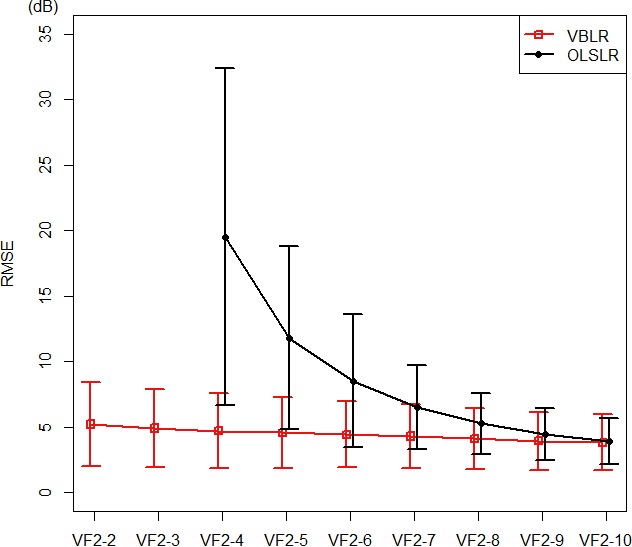
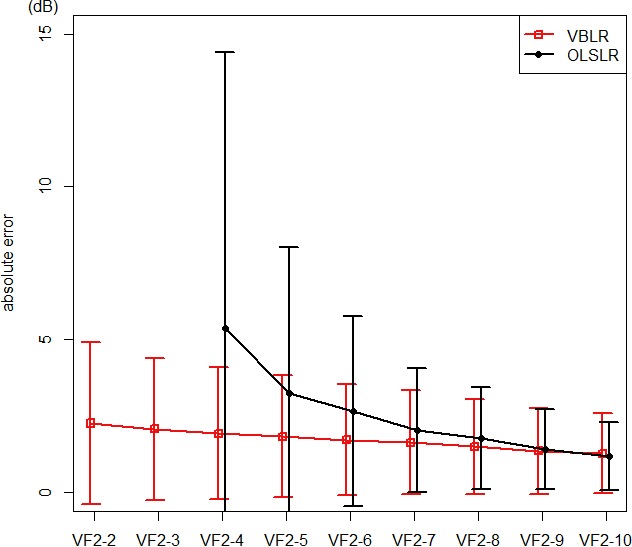
OLSLR RMSEs with the JAMDIG and DIGS datasets were between 31 and 4.3 dB, and between 19.5 and 3.9 dB. On the other hand, VBLR RMSEs with JAMDIG and DIGS datasets were between 5.0 and 3.7, and between 4.6 and 3.6 dB. There was statistically significant difference between VBLR and OLSLR for both datasets at every series (VF2-4 to VF2-10) (P < 0.01 for all tests). However, there was no statistically significant difference in VBLR RMSEs between JAMDIG and DIGS datasets at any series of VFs (VF2-2 to VF2-10) (P > 0.05).
VBLR outperformed OLSLR to predict future VF progression, and the VBLR has a potential to be a helpful tool at clinical settings.
使用两个独立于训练数据集的外部数据集验证变分贝叶斯线性回归(VBLR)的预测准确性。
训练数据集由来自东京大学医院的 4278 名受试者的 7268 只眼组成。日本多中心青光眼数据库档案(JAMDIG)数据集由 177 名患者的 271 只眼组成,诊断创新在青光眼研究(DIGS)数据集包括 173 名患者的 248 只眼,用于验证。比较了 VBLR 和普通最小二乘线性回归(OLSLR)之间的预测准确性。首先,在 JAMDIG 和 DIGS 数据集中,对每位患者的第 2 至第 4 视野(VF2-4)至第 2 至第 10 视野(VF2-10)的 52 个测试点的总偏差(TD)值进行 OLSLR 和 VBLR 处理,然后每次预测第 11 个 VF 测试的 TD 值。通过均方根误差(RMSE)统计比较每种方法的预测准确性。
JAMDIG 和 DIGS 数据集的 OLSLR RMSE 分别在 31 到 4.3dB 之间,19.5 到 3.9dB 之间。另一方面,JAMDIG 和 DIGS 数据集的 VBLR RMSE 分别在 5.0 到 3.7dB 之间,4.6 到 3.6dB 之间。在每一系列(VF2-4 至 VF2-10)中,VBLR 和 OLSLR 之间的差异均具有统计学意义(所有测试均 P<0.01)。然而,在任何 VF 系列(VF2-2 至 VF2-10)中,JAMDIG 和 DIGS 数据集的 VBLR RMSE 之间均无统计学差异(P>0.05)。
VBLR 优于 OLSLR 预测未来的 VF 进展,并且 VBLR 有可能成为临床环境中的一种有用工具。