Sir William Dunn School of Pathology, University of Oxford, South Parks Road, Oxford OX1 3RE, UK; Central Oxford Structural and Molecular Imaging Centre, South Parks Road, Oxford OX1 3RE, UK; Structural Studies Division, MRC Laboratory of Molecular Biology, Francis Crick Avenue, Cambridge CB2 0QH, UK.
Cell Biology Division, MRC Laboratory of Molecular Biology, Francis Crick Avenue, Cambridge CB2 0QH, UK.
Structure. 2018 Jun 5;26(6):879-886.e3. doi: 10.1016/j.str.2018.03.015. Epub 2018 Apr 19.
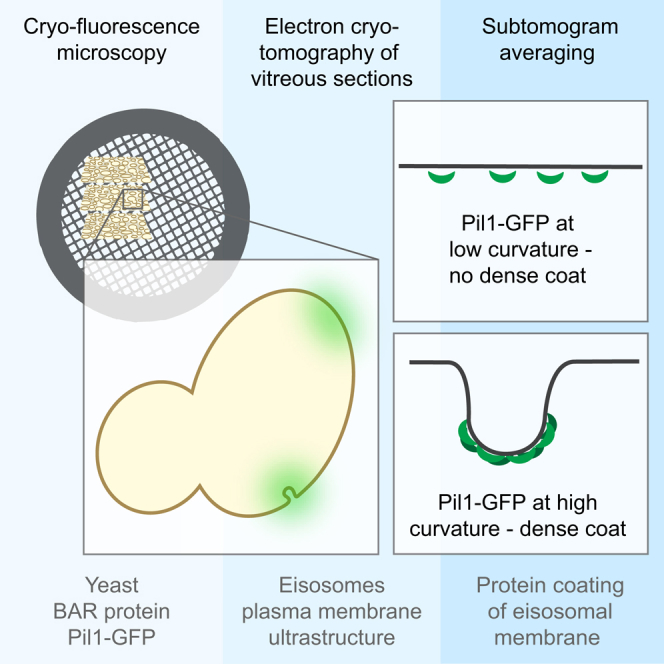
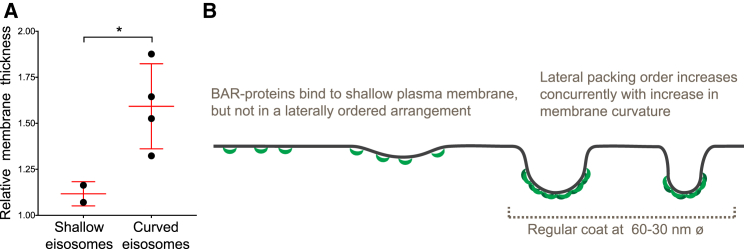
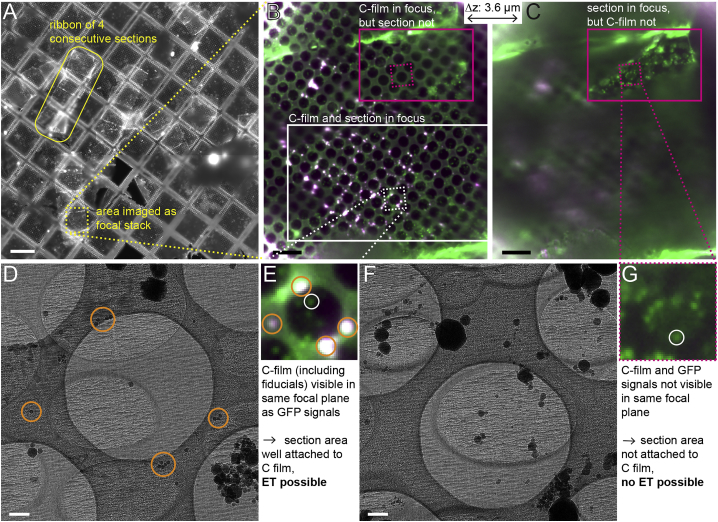
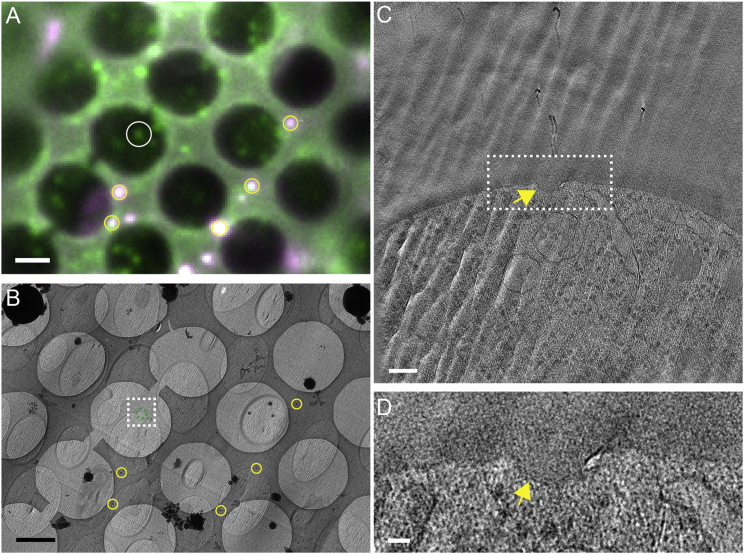
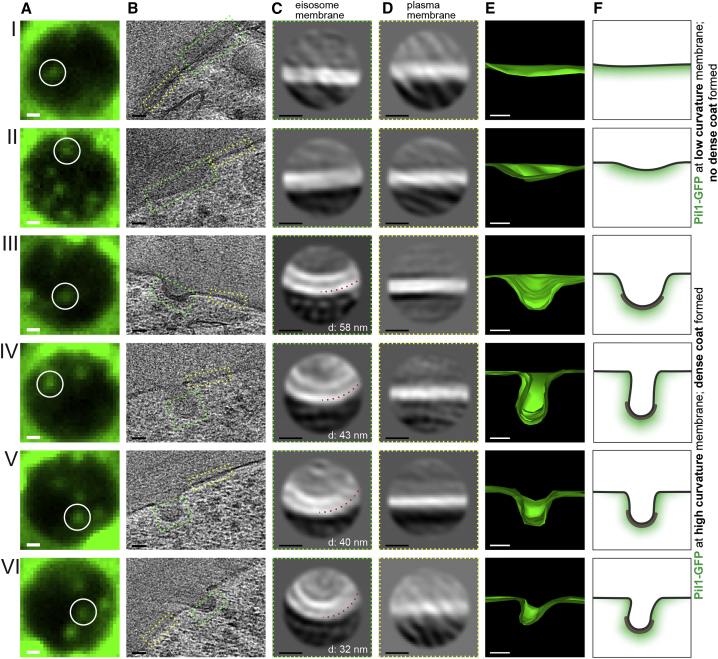
Electron microscopy imaging of macromolecular complexes in their native cellular context is limited by the inherent difficulty to acquire high-resolution tomographic data from thick cells and to specifically identify elusive structures within crowded cellular environments. Here, we combined cryo-fluorescence microscopy with electron cryo-tomography of vitreous sections into a coherent correlative microscopy workflow, ideal for detection and structural analysis of elusive protein assemblies in situ. We used this workflow to address an open question on BAR-domain coating of yeast plasma membrane compartments known as eisosomes. BAR domains can sense or induce membrane curvature, and form scaffold-like membrane coats in vitro. Our results demonstrate that in cells, the BAR protein Pil1 localizes to eisosomes of varying membrane curvature. Sub-tomogram analysis revealed a dense protein coat on curved eisosomes, which was not present on shallow eisosomes, indicating that while BAR domains can assemble at shallow membranes in vivo, scaffold formation is tightly coupled to curvature generation.
在天然细胞环境中对大分子复合物进行电子显微镜成像受到固有困难的限制,难以从厚细胞中获取高分辨率的断层扫描数据,并且难以在拥挤的细胞环境中特异性识别难以捉摸的结构。在这里,我们将冷冻荧光显微镜与玻璃切片的电子冷冻断层扫描结合到一个连贯的相关显微镜工作流程中,非常适合用于原位检测和分析难以捉摸的蛋白质组装体。我们使用该工作流程解决了关于酵母质膜隔室(称为芽殖后体)的 BAR 域涂层的一个悬而未决的问题。BAR 结构域可以感知或诱导膜曲率,并在体外形成支架样膜涂层。我们的结果表明,在细胞中,BAR 蛋白 Pil1 定位于具有不同膜曲率的芽殖后体上。子断层分析显示,在弯曲的芽殖后体上存在密集的蛋白质涂层,而在浅的芽殖后体上不存在,这表明尽管 BAR 结构域可以在体内组装在浅膜上,但支架形成与曲率生成紧密相关。