Yim Mi-Jin, Lee Jeong Min, Choi Grace, Lee Dae-Sung, Park Won Sun, Jung Won-Kyo, Park Saegwang, Seo Su-Kil, Park Jungik, Choi Il-Whan, Ma Sun Young
National Marine Biodiversity Institute of Korea, Seocheon 33662, Republic of Korea.
Department of Physiology, Kangwon National University School of Medicine, Chuncheon 24341, Republic of Korea.
Evid Based Complement Alternat Med. 2018 Feb 26;2018:6914514. doi: 10.1155/2018/6914514. eCollection 2018.
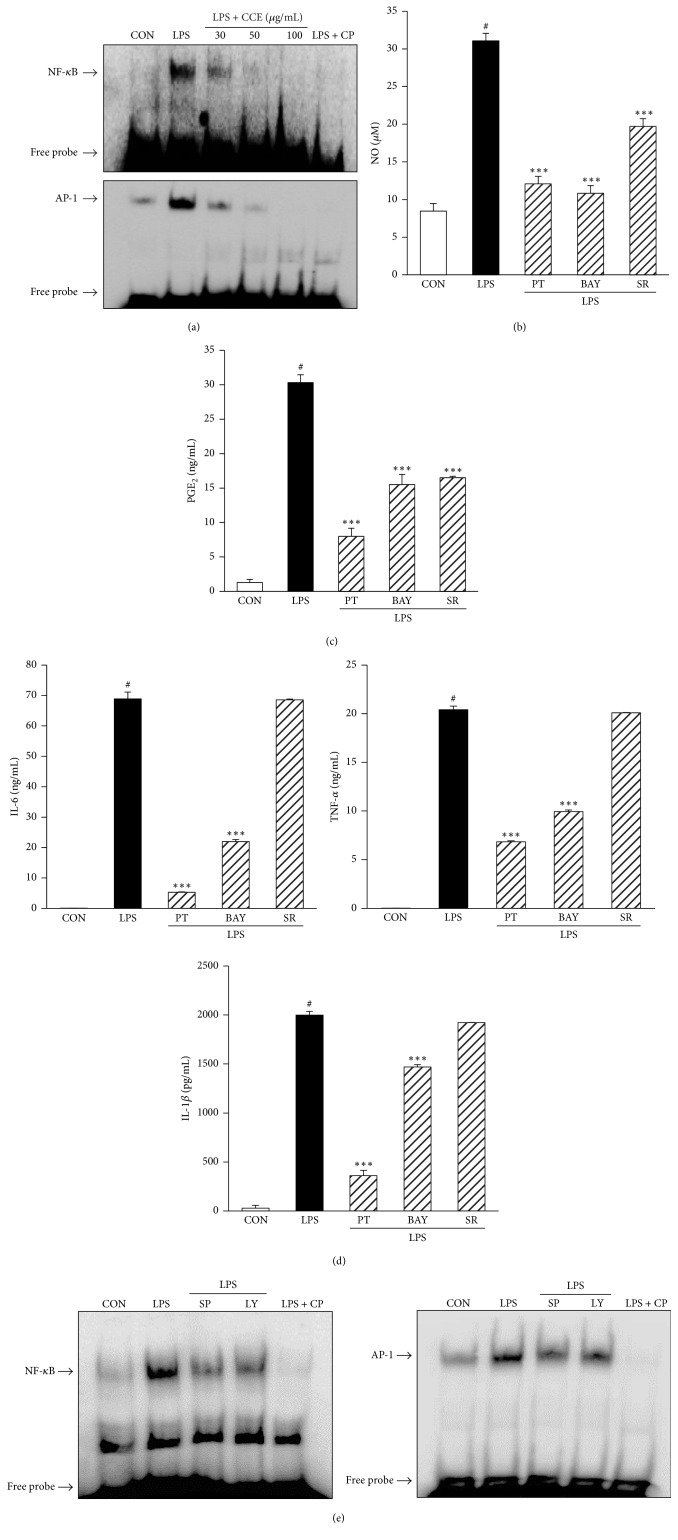
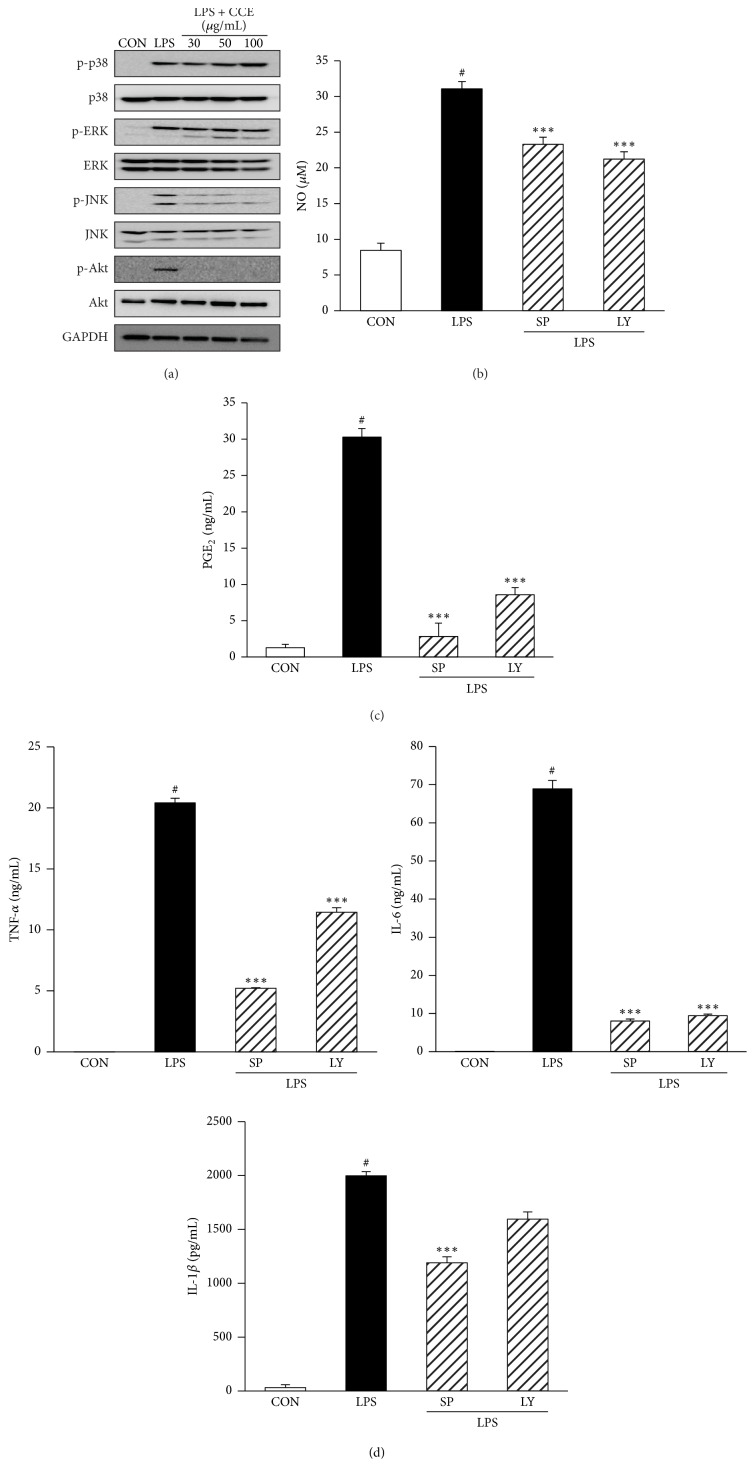
Marine algae have valuable health and dietary benefits. The present study aimed to investigate whether an ethanol extract of (CCE) could inhibit the inflammatory response to LPS. CCE attenuated the production of proinflammatory mediators, such as prostaglandin E (PGE) and nitric oxide (NO), by inhibiting inducible nitric oxide synthase (iNOS) and cyclooxygenase-2 (COX-2) expression in LPS-induced RAW264.7 macrophages. CCE also inhibited the expression of proinflammatory cytokines such as IL-1, TNF-, and IL-6. CCE suppressed the LPS-induced DNA-binding activity of (NF-B) and activator protein-1 (AP-1). In addition, CCE attenuated the LPS-stimulated phosphorylation of c-Jun N-terminal kinase/stress-activated protein kinase (JNK) and phosphatidylinositol 3'-kinase/Akt (PI3K/Akt). Functional aspects of the JNK and Akt signaling pathways were analyzed using specific inhibitors, which attenuated the LPS-induced production of proinflammatory cytokines, and NO and PGE expression by suppressing AP-1 and NF-B activity. In particular, the AP-1 signaling pathway is not involved in the production of inflammatory cytokines, such as IL-6, TNF-, and IL-1. These results suggested that CCE might exert its anti-inflammatory action by downregulating transcriptional factors (NF-B and AP-1) through JNK and Akt signaling pathways. The current study suggested that CCE might be a valuable candidate for the treatment of inflammatory disorders.
海藻具有宝贵的健康和饮食益处。本研究旨在调查[此处原文缺失具体藻类名称]的乙醇提取物(CCE)是否能抑制对脂多糖(LPS)的炎症反应。CCE通过抑制LPS诱导的RAW264.7巨噬细胞中诱导型一氧化氮合酶(iNOS)和环氧化酶-2(COX-2)的表达,减轻了前列腺素E(PGE)和一氧化氮(NO)等促炎介质的产生。CCE还抑制了白细胞介素-1(IL-1)、肿瘤坏死因子-α(TNF-α)和白细胞介素-6(IL-6)等促炎细胞因子的表达。CCE抑制了LPS诱导的核因子-κB(NF-κB)和活化蛋白-1(AP-1)的DNA结合活性。此外,CCE减轻了LPS刺激的c-Jun氨基末端激酶/应激激活蛋白激酶(JNK)和磷脂酰肌醇3'-激酶/蛋白激酶B(PI3K/Akt)的磷酸化。使用特异性抑制剂分析了JNK和Akt信号通路的功能方面,这些抑制剂通过抑制AP-1和NF-κB活性,减轻了LPS诱导的促炎细胞因子的产生以及NO和PGE的表达。特别是,AP-1信号通路不参与IL-6、TNF-α和IL-1等炎性细胞因子的产生。这些结果表明,CCE可能通过JNK和Akt信号通路下调转录因子(NF-κB和AP-1)来发挥其抗炎作用。当前研究表明,CCE可能是治疗炎症性疾病的有价值候选物。