Unit of Infections and Cancer (UNIC-I&I), Cancer Epidemiology Research Programme (CERP), Institut Català d'Oncologia (ICO)-IDIBELL, L'Hospitalet de Llobregat, Barcelona, Spain.
CIBERONC, Barcelona, Spain.
Eur J Public Health. 2018 Dec 1;28(6):1132-1138. doi: 10.1093/eurpub/cky061.
HPV screening has been shown to be more cost-effective than cytology screening under most scenarios. Furthermore, it should be offered only in organized programmes with good quality assurance mechanisms. This study analyses the comparative cost of the current policy of opportunistic cytology screening vs. a hypothetical organized programme based on primary HPV screening.
Total cervical cancer expenditure was defined as the sum of three cost elements: (i) direct (medical and non-medical) costs, obtained from a calibrated Markov model of the natural history of HPV and cervical cancer; (ii) programmatic costs, estimated based on other organized screening programmes; and (iii) indirect costs, extrapolated from previously published data.
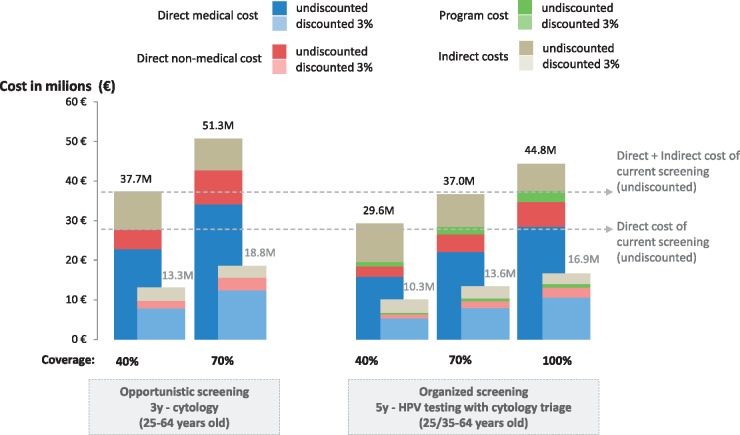
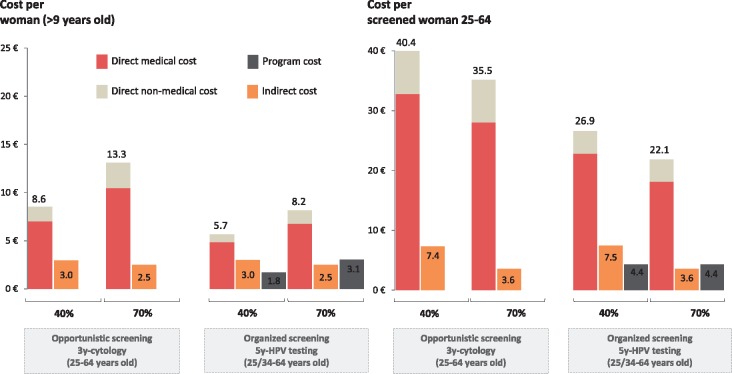
Organized HPV screening at 5-year intervals costs consistently less across all coverage levels than opportunistic cytology screening at 3-year intervals. The current annual direct medical cost to the public health system of the opportunistic cytology at 40% coverage is estimated at €33.2 per woman screened aged 25-64. Under an organized programme of primary HPV screening at 70% coverage, the cost is estimated to be €18.4 per woman screened aged 25-64.
Our study concludes that the economic resources currently devoted to providing opportunistic cytology screening to 40% of the target population at 3-year intervals could be more effectively used to screen 70% of the target population at 5-year intervals by switching to an organized programme based on primary HPV screening. This finding is of relevance to other European countries or regions with similar screening policies and health infrastructures.
在大多数情况下,HPV 筛查比细胞学筛查更具成本效益。此外,它只应在具有良好质量保证机制的有组织计划中提供。本研究分析了现行机会性细胞学筛查政策与基于初级 HPV 筛查的假设有组织计划的比较成本。
总宫颈癌支出被定义为三个成本要素的总和:(i)直接(医疗和非医疗)成本,从 HPV 和宫颈癌自然史的校准马尔可夫模型中获得;(ii)计划成本,根据其他有组织的筛查计划估算;(iii)间接成本,从以前发表的数据推断得出。
在所有覆盖水平下,每 5 年进行一次有组织的 HPV 筛查的成本始终低于每 3 年进行一次机会性细胞学筛查。目前,在 40%的覆盖率下,公共卫生系统对机会性细胞学筛查的年度直接医疗成本估计为每筛查一位 25-64 岁的女性 33.2 欧元。在 70%的覆盖率下,采用基于初级 HPV 筛查的有组织计划,每筛查一位 25-64 岁的女性的成本估计为 18.4 欧元。
我们的研究得出结论,目前用于在 3 年间隔为 40%的目标人群提供机会性细胞学筛查的经济资源,可以通过切换到基于初级 HPV 筛查的有组织计划,更有效地用于在 5 年间隔为 70%的目标人群进行筛查。这一发现对其他具有类似筛查政策和卫生基础设施的欧洲国家或地区具有重要意义。