Heston Jonathan B, Simon Joseph, Day Nancy F, Coleman Melissa J, White Stephanie A
Interdepartmental Program in Neuroscience, University of California, Los Angeles, California.
Undergraduate Interdepartmental Program for Neuroscience, University of California, Los Angeles, California.
Physiol Rep. 2018 Apr;6(8):e13638. doi: 10.14814/phy2.13638.
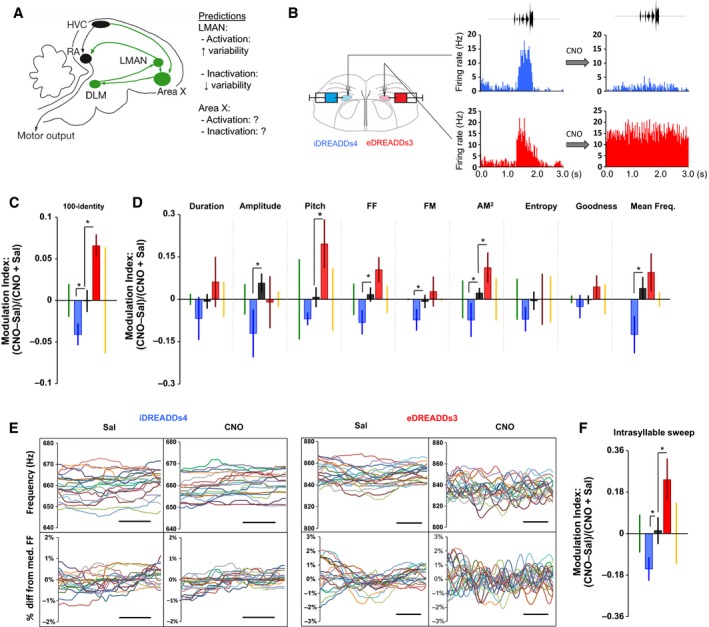
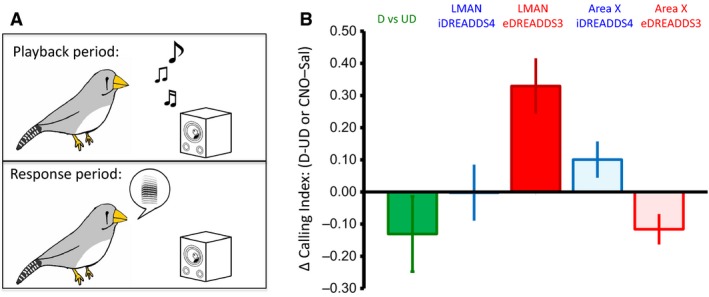
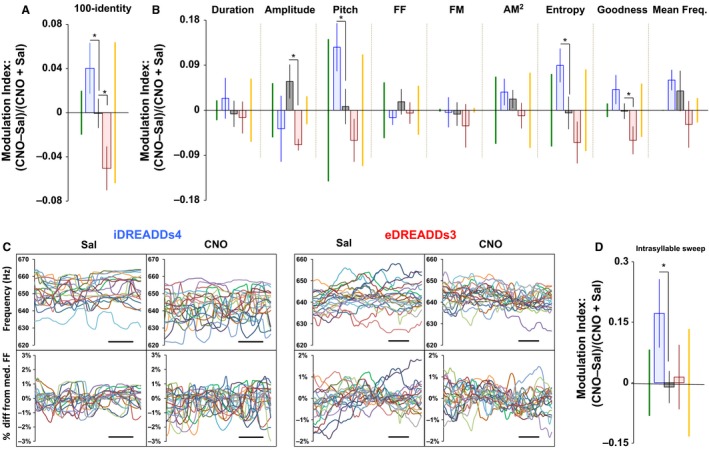
Behavioral variability is thought to be critical for trial and error learning, but where such motor exploration is generated in the central nervous system is unclear. The zebra finch songbird species offers a highly appropriate model in which to address this question. The male song is amenable to detailed measurements of variability, while the brain contains an identified cortico-basal ganglia loop that underlies this behavior. We used pharmacogenetic interventions to separately interrogate cortical and basal ganglia nodes of zebra finch song control circuitry. We show that bidirectional manipulations of each node produce near mirror image changes in vocal control: Cortical activity promotes song variability, whereas basal ganglia activity promotes song stability. Furthermore, female conspecifics can detect these pharmacogenetically elicited changes in song quality. Our results indicate that cortex and striatopallidum can jointly and reciprocally affect behaviorally relevant levels of vocal variability, and point to endogenous mechanisms for its control.
行为变异性被认为对试错学习至关重要,但这种运动探索在中枢神经系统中的产生位置尚不清楚。斑胸草雀这种鸣禽提供了一个非常合适的模型来解决这个问题。雄鸟鸣声易于进行变异性的详细测量,而其大脑包含一个已确定的皮质-基底神经节环路,该环路是这种行为的基础。我们使用药物遗传学干预分别探究斑胸草雀鸣叫控制回路的皮层和基底神经节节点。我们发现对每个节点的双向操纵会在发声控制中产生近乎镜像的变化:皮层活动促进鸣声变异性,而基底神经节活动促进鸣声稳定性。此外,同种雌性能够检测到这些药物遗传学引发的鸣声质量变化。我们的结果表明,皮层和纹状体苍白球可以共同且相互影响与行为相关的发声变异性水平,并指出了其控制的内源性机制。