
未来的维生素 D 需求——经验教训和前进道路。
Vitamin D Requirements for the Future-Lessons Learned and Charting a Path Forward.
机构信息
Cork Centre for Vitamin D and Nutrition Research, School of Food and Nutritional Sciences, University College Cork, T12 Y337 Cork, Ireland.
出版信息
Nutrients. 2018 Apr 25;10(5):533. doi: 10.3390/nu10050533.
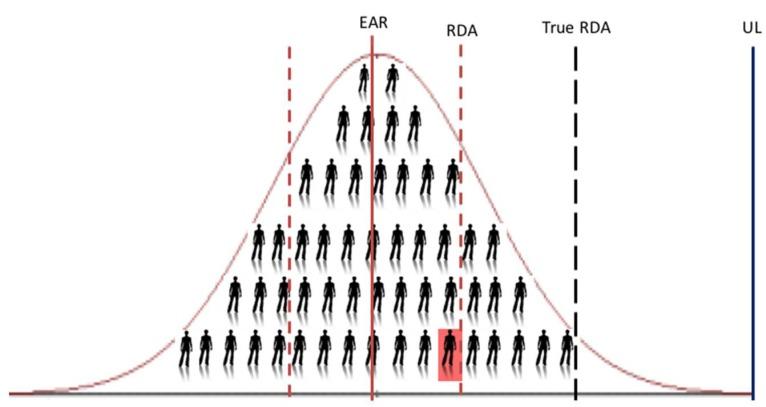
Estimates of dietary requirements for vitamin D or Dietary Reference Values (DRV) are crucial from a public health perspective in providing a framework for prevention of vitamin D deficiency and optimizing vitamin D status of individuals. While these important public health policy instruments were developed with the evidence-base and data available at the time, there are some issues that need to be clarified or considered in future iterations of DRV for vitamin D. This is important as it will allow for more fine-tuned and truer estimates of the dietary requirements for vitamin D and thus provide for more population protection. The present review will overview some of the confusion that has arisen in relation to the application and/or interpretation of the definitions of the Estimated Average Requirement (EAR) and Recommended Dietary Allowance (RDA). It will also highlight some of the clarifications needed and, in particular, how utilization of a new approach in terms of using individual participant-level data (IPD), over and beyond aggregated data, from randomised controlled trials with vitamin D may have a key role in generating these more fine-tuned and truer estimates, which is of importance as we move towards the next iteration of vitamin D DRVs.
从公共卫生的角度来看,估计维生素 D 的膳食需求或膳食参考值(DRV)对于预防维生素 D 缺乏症和优化个体的维生素 D 状态至关重要。虽然这些重要的公共卫生政策工具是在当时的证据基础和可用数据的基础上制定的,但在未来的维生素 D DRV 迭代中,仍有一些问题需要澄清或考虑。这很重要,因为这将允许对维生素 D 的膳食需求进行更精细和更真实的估计,从而为更多人群提供保护。本综述将概述在应用和/或解释估计平均需求量(EAR)和推荐膳食摄入量(RDA)的定义方面出现的一些混淆。它还将强调需要澄清的一些问题,特别是如何利用一种新方法,即使用来自维生素 D 的随机对照试验的个体参与者水平数据(IPD),而不仅仅是汇总数据,在生成这些更精细和更真实的估计方面发挥关键作用,因为我们正在朝着下一个维生素 D DRV 迭代迈进。


 Zotero 插件