Department of Biological Sciences, The University of Tokyo, Tokyo, Japan.
Department of Biological Sciences, State University of New York at Buffalo, Buffalo, USA.
BMC Genomics. 2018 Apr 25;19(1):293. doi: 10.1186/s12864-018-4676-z.
The common deletion of the glutathione S-transferase Mu 1 (GSTM1) gene in humans has been shown to be involved in xenobiotic metabolism and associated with bladder cancer. However, the evolution of this deletion has not been investigated.
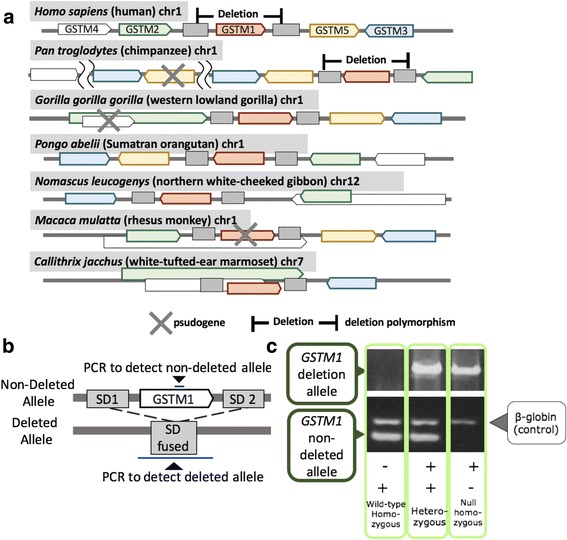
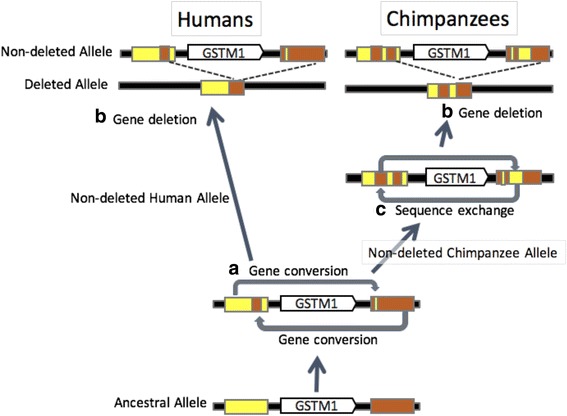
In this study, we conducted comparative analyses of primate genomes. We demonstrated that the GSTM gene family has evolved through multiple structural variations, involving gene duplications, losses, large inversions and gene conversions. We further showed experimentally that the GSTM1 was polymorphically deleted in both humans and also in chimpanzees, through independent deletion events. To generalize our results, we searched for genic deletions that are polymorphic in both humans and chimpanzees. Consequently, we found only two such deletions among the thousands that we have searched, one of them being the GSTM1 deletion and the other surprisingly being another metabolizing gene, the UGT2B17.
Overall, our results support the emerging notion that metabolizing gene families, such as the GSTM, NAT, UGT and CYP, have been evolving rapidly through gene duplication and deletion events in primates, leading to complex structural variation within and among species with unknown evolutionary consequences.
人类谷胱甘肽 S-转移酶 Mu1(GSTM1)基因的常见缺失已被证明与外源性代谢物有关,并与膀胱癌相关。然而,尚未研究该缺失的进化。
在这项研究中,我们对灵长类动物基因组进行了比较分析。我们证明了 GSTM 基因家族通过多种结构变异进化而来,包括基因复制、缺失、大片段倒位和基因转换。我们进一步通过独立的缺失事件实验表明,GSTM1 在人类和黑猩猩中都存在多态性缺失。为了推广我们的结果,我们搜索了在人类和黑猩猩中都存在多态性的基因缺失。结果,我们在数千个搜索到的基因中仅发现了两个这样的缺失,其中之一是 GSTM1 缺失,另一个令人惊讶的是另一个代谢基因 UGT2B17。
总的来说,我们的结果支持了这样一种观点,即代谢基因家族,如 GSTM、NAT、UGT 和 CYP,在灵长类动物中通过基因复制和缺失事件快速进化,导致物种内和物种间的复杂结构变异,其未知的进化后果。