Ghalandari Hamid, Kamalpour Mahdieh, Alimadadi Ashraf, Nasrollahzadeh Javad
MSc, Department of Clinical Nutrition and Dietetics, National Nutrition, and Food Technology Research Institute, Faculty of Nutrition Sciences and Food Technology, Shahid Beheshti University of Medical Sciences, Tehran, IR Iran.
MD, Department of Internal Medicine, Shahid Modarres Hospital, Shahid Beheshti University of Medical Sciences, Tehran, IR Iran.
Int J Endocrinol Metab. 2017 Dec 30;16(1):e12089. doi: 10.5812/ijem.12089. eCollection 2018 Jan.
The aim of this study was to compare the effect of a simple dietary advice with two energy-restricted diets with different carbohydrate and fiber contents on anthropometric, biochemical, and inflammatory markers over an 8-wk intervention period in individuals with diabetes.
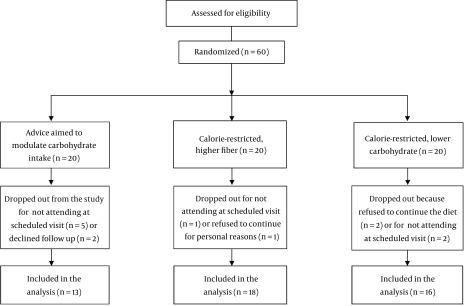
Forty-seven patients with type 2 diabetes (31 women and 16 men; age: 52.9 ± 8.0 years, body mass index: 29.5 ± 4.9 kg.m) completed an 8-wk randomized intervention trial that compared a simple dietary advice aimed to modulate carbohydrate intake (n = 13) with the two calorie-restricted (CR) diets (25% caloric restriction from total energy requirements) differing with regard to carbohydrate and fiber content, one with higher fiber (CRHF) containing 55% energy from carbohydrate plus a tablespoon of psyllium powder (n = 18) and the other with lower carbohydrate (CRLC) containing 40% energy from carbohydrate plus placebo powder (n = 16). Weight, plasma concentrations of glucose, insulin, lipids, interleukin-6 (IL-6), and tumor necrosis factor alpha (TNF-α) were determined at baseline and after 8 weeks.
The mean change of body weight and plasma lipids were not different between the groups. Fasting plasma insulin and the homeostasis model assessment of insulin resistance (HOMA-IR) were significantly lower in the CRHF group (changes from baseline values in simple advice, CRHF, and CRLC were 1.3 ± 1.9, -1.0 ± 1.2, and 0.3 ± 3.1 µIL/mL for insulin and 0.5 ± 0.7, -0.3 ± 0.6, and 0.2 ± 0.9 for HOMA-IR, respectively). The levels of IL-6 significantly decreased in the CRHF and CRLC groups (changes from baseline values in simple advice, CRHF, and CRLC were 7.5 ± 6.8, -1.2 ± 4.7, and -4.2 ± 5.6 pg/mL, respectively). TNF-α levels were significantly lower only in the CRHF compared to the advice group (P < 0.05).
Our results suggest that in comparison with simple advice to modify carbohydrate intake, a calorie-restricted, moderate carbohydrate diet supplemented with psyllium has better effects on plasma insulin and pro-inflammatory cytokines in patients with type 2 diabetes.
本研究旨在比较在8周干预期内,单纯饮食建议与两种不同碳水化合物和纤维含量的能量限制饮食对糖尿病患者人体测量学、生化指标及炎症标志物的影响。
47例2型糖尿病患者(31例女性和16例男性;年龄:52.9±8.0岁,体重指数:29.5±4.9kg/m²)完成了一项为期8周的随机干预试验,该试验比较了旨在调节碳水化合物摄入量的单纯饮食建议(n = 13)与两种热量限制(CR)饮食(总能量需求的25%热量限制),这两种饮食在碳水化合物和纤维含量方面有所不同,一种是高纤维(CRHF)饮食,含55%的碳水化合物能量加一汤匙车前子粉(n = 18),另一种是低碳水化合物(CRLC)饮食,含40%的碳水化合物能量加安慰剂粉(n = 16)。在基线和8周后测定体重、血浆葡萄糖、胰岛素、脂质、白细胞介素-6(IL-6)和肿瘤坏死因子α(TNF-α)的浓度。
各组间体重和血浆脂质的平均变化无差异。CRHF组的空腹血浆胰岛素和胰岛素抵抗稳态模型评估(HOMA-IR)显著更低(单纯饮食建议组、CRHF组和CRLC组胰岛素相对于基线值的变化分别为1.3±1.9、-1.0±1.2和0.3±3.1μIL/mL,HOMA-IR分别为0.5±0.7、-0.3±0.6和0.2±0.9)。CRHF组和CRLC组的IL-6水平显著降低(单纯饮食建议组、CRHF组和CRLC组相对于基线值的变化分别为7.5±6.8、-1.2±4.7和-4.2±5.6pg/mL)。与单纯饮食建议组相比,仅CRHF组的TNF-α水平显著更低(P < 0.05)。
我们的结果表明,与单纯的碳水化合物摄入调整建议相比,限制热量、适度碳水化合物并补充车前子的饮食对2型糖尿病患者的血浆胰岛素和促炎细胞因子有更好的影响。