Physicians Committee for Responsible Medicine, 5100 Wisconsin Ave, N.W. Ste.400, Washington, DC 20016, USA.
School of Medicine, University of Utah, Salt Lake City, UT 84132, USA.
Nutrients. 2018 Sep 14;10(9):1302. doi: 10.3390/nu10091302.
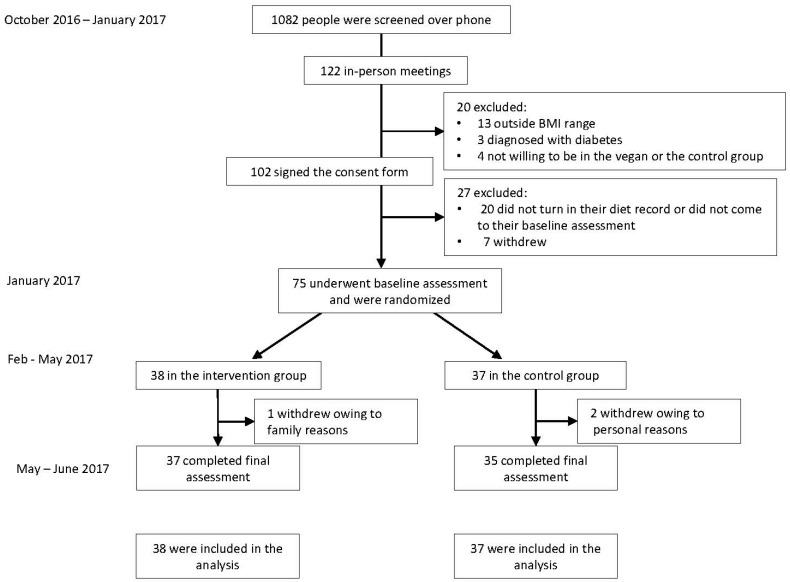
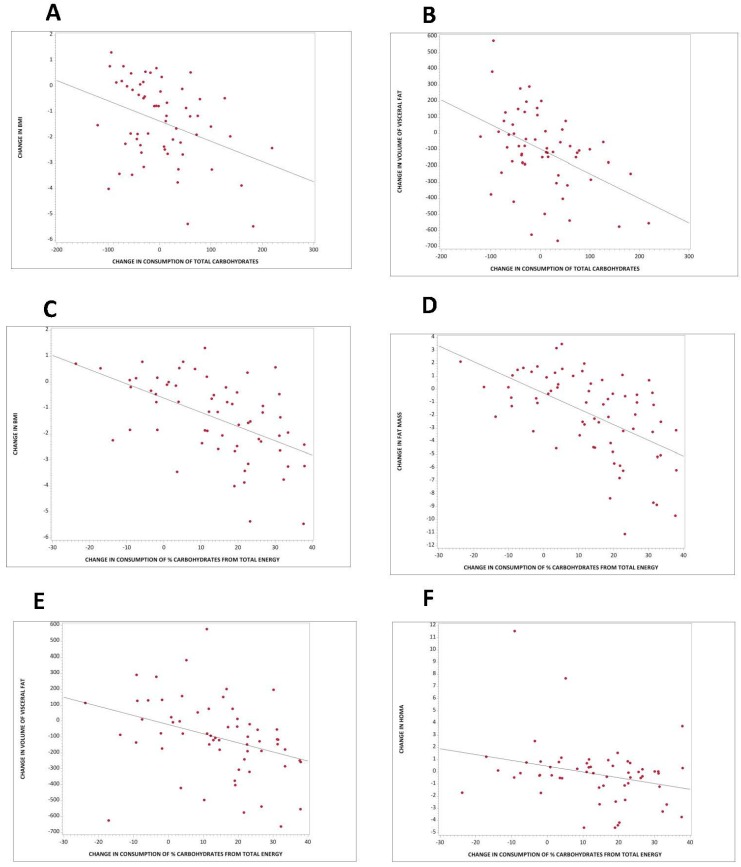
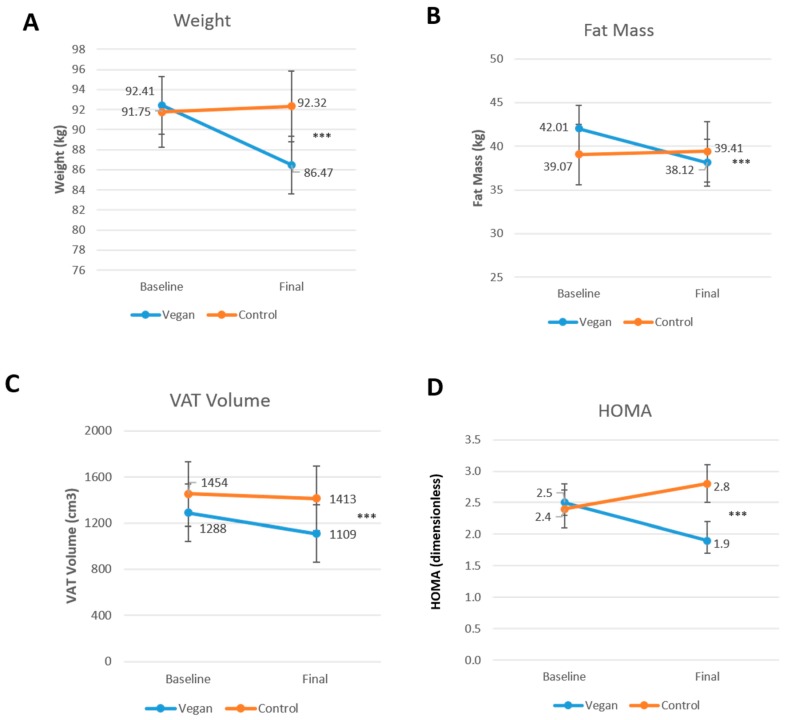
The effects of carbohydrates on body weight and insulin sensitivity are controversial. In this 16-week randomized clinical trial, we tested the role of a low-fat, plant-based diet on body weight, body composition and insulin resistance. As a part of this trial, we investigated the role of changes in carbohydrate intake on body composition and insulin resistance. Participants ( = 75) were randomized to follow a plant-based high-carbohydrate, low-fat (vegan) diet ( = 38) or to maintain their current diet ( = 37). Dual-energy X-ray absorptiometry was used to measure body composition. Insulin resistance was assessed with the Homeostasis Model Assessment (HOMA-IR) index. A repeated measure ANOVA model was used to test the between-group differences from baseline to 16 weeks. A linear regression model was used to test the relationship between carbohydrate intake, and body composition and insulin resistance. Weight decreased significantly in the vegan group (treatment effect -6.5 [95% CI -8.9 to -4.1] kg; Gxt, < 0.001). Fat mass was reduced in the vegan group (treatment effect -4.3 [95% CI -5.4 to -3.2] kg; Gxt, < 0.001). HOMA-IR was reduced significantly in the vegan group (treatment effect -1.0 [95% CI -1.2 to -0.8]; Gxt, = 0.004). Changes in consumption of carbohydrate, as a percentage of energy, correlated negatively with changes in BMI ( = -0.53, < 0.001), fat mass ( = -0.55, < 0.001), volume of visceral fat ( = -0.35, = 0.006), and HOMA ( = -0.27, = 0.04). These associations remained significant after adjustment for energy intake. Changes in consumption of total and insoluble fiber correlated negatively with changes in BMI ( = -0.43, < 0.001; and = -0.46, < 0.001, respectively), fat mass ( = -0.42, < 0.001; and = -0.46, < 0.001, respectively), and volume of visceral fat ( = -0.29, = 0.03; and = -0.32, = 0.01, respectively). The associations between total and insoluble fiber and changes in BMI and fat mass remained significant even after adjustment for energy intake. Increased carbohydrate and fiber intake, as part of a plant-based high-carbohydrate, low-fat diet, are associated with beneficial effects on weight, body composition, and insulin resistance.
碳水化合物对体重和胰岛素敏感性的影响存在争议。在这项为期 16 周的随机临床试验中,我们测试了低脂、植物性饮食对体重、身体成分和胰岛素抵抗的作用。作为该试验的一部分,我们研究了碳水化合物摄入量变化对身体成分和胰岛素抵抗的作用。参与者(n=75)被随机分配到遵循高碳水化合物、低脂植物性饮食(n=38)或维持当前饮食(n=37)。双能 X 射线吸收法用于测量身体成分。使用稳态模型评估(HOMA-IR)指数评估胰岛素抵抗。重复测量方差分析模型用于测试从基线到 16 周的组间差异。线性回归模型用于测试碳水化合物摄入量与身体成分和胰岛素抵抗之间的关系。素食组体重显著下降(治疗效果-6.5[95%置信区间-8.9 至-4.1]kg;Gxt,<0.001)。素食组脂肪量减少(治疗效果-4.3[95%置信区间-5.4 至-3.2]kg;Gxt,<0.001)。素食组 HOMA-IR 显著降低(治疗效果-1.0[95%置信区间-1.2 至-0.8];Gxt,=0.004)。碳水化合物作为能量的百分比的消耗变化与 BMI(=-0.53,<0.001)、脂肪量(=-0.55,<0.001)、内脏脂肪量(=-0.35,=0.006)和 HOMA(=-0.27,=0.04)的变化呈负相关。这些关联在调整能量摄入后仍然显著。总纤维和不溶性纤维消耗的变化与 BMI(=-0.43,<0.001;=-0.46,<0.001)、脂肪量(=-0.42,<0.001;=-0.46,<0.001)和内脏脂肪量(=-0.29,=0.03;=-0.32,=0.01)的变化呈负相关。即使在调整能量摄入后,总纤维和不溶性纤维与 BMI 和脂肪量变化之间的关联仍然显著。增加碳水化合物和纤维的摄入,作为低脂、高碳水化合物植物性饮食的一部分,与体重、身体成分和胰岛素抵抗的有益影响有关。