J Twisk, L Bosman, T Hoekstra, J Rijnhart, M Welten, M Heymans
Department of Epidemiology and Biostatistics, VU Medical Centre, Amsterdam, the Netherlands.
Department of Health Science, Faculty of Earth and Life Sciences, VU University, Amsterdam, The Netherlands.
Contemp Clin Trials Commun. 2018 Mar 28;10:80-85. doi: 10.1016/j.conctc.2018.03.008. eCollection 2018 Jun.
Regarding the analysis of RCT data there is a debate going on whether an adjustment for the baseline value of the outcome variable should be made. When an adjustment is made, there is a lot of misunderstanding regarding the way this should be done. Therefore, the aims of this educational paper are: 1) to explain different methods used to estimate treatment effects in RCTs, 2) to illustrate the different methods with a real life example and 3) to give an advise on how to analyse RCT data.
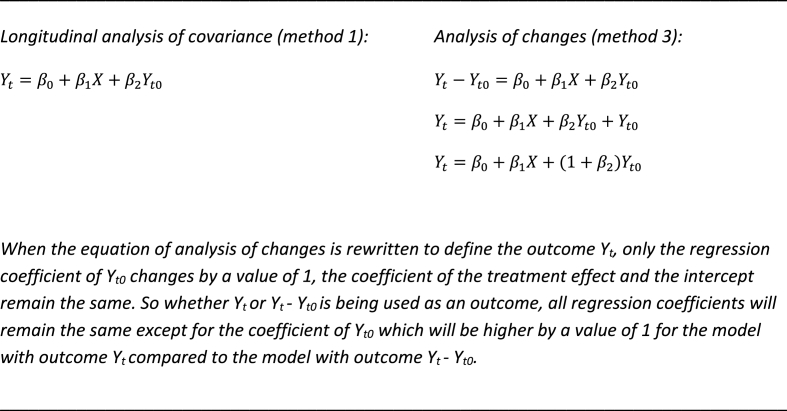
Longitudinal analysis of covariance, repeated measures analysis in which also the baseline value is used as outcome and the analysis of changes were theoretically explained and applied to an example dataset investigating a systolic blood pressure lowering treatment.
It was shown that differences at baseline should be taken into account and that regular repeated measures analysis and regular analysis of changes did not adjust for the baseline differences between the groups and therefore lead to biased estimates of the treatment effect. In the real life example, due to the differences at baseline between the treatment and control group, the different methods lead to different estimates of the treatment effect.
Regarding the analysis of RCT data, it is advised to use longitudinal analysis of covariance or a repeated measures analysis without the treatment variable, but with the interaction between treatment and time in the model.
关于随机对照试验(RCT)数据的分析,目前正在进行一场关于是否应对结果变量的基线值进行调整的辩论。当进行调整时,对于应该如何进行调整存在很多误解。因此,这篇教育性论文的目的是:1)解释用于估计随机对照试验中治疗效果的不同方法,2)用一个实际例子说明不同方法,3)就如何分析随机对照试验数据给出建议。
从理论上解释了协方差的纵向分析、将基线值也用作结果的重复测量分析以及变化分析,并将其应用于一个研究收缩压降低治疗的示例数据集。
结果表明,应考虑基线差异,常规的重复测量分析和常规的变化分析并未对组间基线差异进行调整,因此会导致对治疗效果的估计有偏差。在实际例子中,由于治疗组和对照组之间的基线差异,不同方法导致了对治疗效果的不同估计。
关于随机对照试验数据的分析,建议使用协方差的纵向分析或不包含治疗变量但在模型中包含治疗与时间交互作用的重复测量分析。