Department of Population Medicine, Ontario Veterinary College, University of Guelph, Guelph, Ontario, Canada.
School of Environmental Sciences, University of Guelph, Guelph, Ontario, Canada.
PLoS One. 2018 Apr 26;13(4):e0196573. doi: 10.1371/journal.pone.0196573. eCollection 2018.
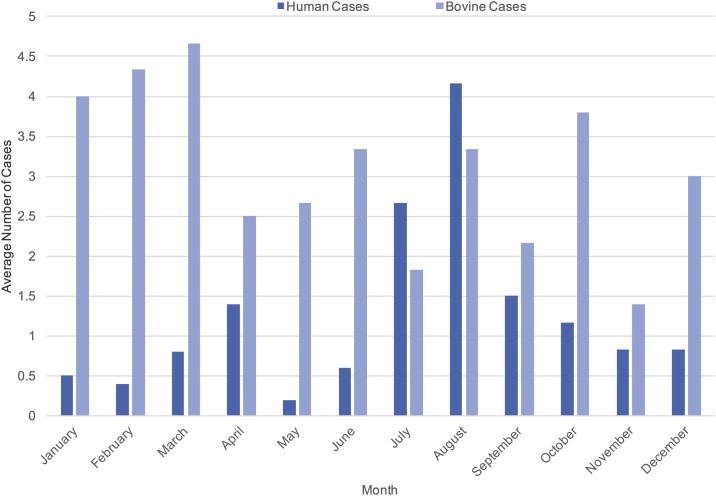
Cryptosporidium is a waterborne parasite that causes diarrheal disease in humans and in cattle. Risk factors for human illness include contact with surface water such as lakes and rivers, exposure to contaminated municipal drinking water, as well as zoonotic transmission from livestock and agriculture. The objectives of this study are twofold: 1) to describe the temporal distribution of cryptosporidiosis in Southwestern Ontario; and 2) to determine the distribution of human cryptosporidiosis, in relation to exposures such as cryptosporidium positive cattle farms, weather events, and hydrological factors. Seasonal trends in 214 bovine and 87 human cases were assessed using regression models that predicted monthly case counts in relation to observed monthly case counts. A case-crossover approach was used to evaluate acute associations between daily environmental exposures, such as weather, hydrology, the presence of Cryptosporidium positive cattle farms within the region, and the risk of human Cryptosporidium infection. Annual seasonality was found for both human cases and bovine cases with human cases peaking in mid-summer and bovine cases peaking in late winter to early spring. Bovine cases that occurred 21 days prior to human cases were associated with a three-fold increase in the odds of human case occurrence. At both 9 and 14 days prior to human case onset, the odds of a human case increased twofold per 10-degree Celsius increase in air temperature. These results provide a preliminary hypothesis for the zoonotic transmission of cryptosporidiosis from cattle to humans via the environment and suggest that the timing of environmental conditions in relation to case occurrence is biologically plausible.
隐孢子虫是一种水生寄生虫,可导致人类和牛腹泻病。人类患病的危险因素包括接触湖泊和河流等地表水、暴露于受污染的市政饮用水,以及从牲畜和农业传播的人畜共患病。本研究的目的有两个:1)描述安大略省西南部隐孢子虫病的时间分布;2)确定人类隐孢子虫病的分布,与接触隐孢子虫阳性牛场、天气事件和水文因素等暴露因素有关。使用回归模型评估了 214 例牛和 87 例人类病例的季节性趋势,该模型预测了每月病例数与观察到的每月病例数的关系。采用病例交叉方法评估了日常环境暴露(如天气、水文、该地区隐孢子虫阳性牛场的存在)与人类隐孢子虫感染风险之间的急性关联。人类病例和牛病例均呈现出季节性年度变化,人类病例在仲夏达到高峰,牛病例在冬末至早春达到高峰。牛病例发生在人类病例之前 21 天,与人类病例发生的几率增加三倍相关。在人类病例发病前 9 天和 14 天,每增加 10°C 的气温,人类病例的发病几率就会增加一倍。这些结果为通过环境从牛向人类传播隐孢子虫病的人畜共患病提供了初步假设,并表明与病例发生相关的环境条件的时间安排在生物学上是合理的。