Department of Obstetrics and Gynecology, University of Inonu, Faculty of Medicine, 44280, Malatya, Turkey.
Department of Medical Pharmacology, University of Inonu, Faculty of Medicine, 44280, Malatya, Turkey.
J Ovarian Res. 2018 Apr 26;11(1):33. doi: 10.1186/s13048-018-0409-9.
In recent years, cancer rates have been rising among reproductive-age women. Thus, chemotherapy exposure has become an important cause of premature ovarian failure (POF). There has been growing interest regarding the preservation and restoration of ovarian function before and after oncological treatment because of the reproductive risk of chemotherapeutics and improved long-term survival of cancer patients. In this study, we sought to analyze the effects of curcumin (CRC) and capsaicin (CPS) on cyclophosphamide-induced POF in a rat model.
POF in rats was induced by intraperitoneal injection of 200 mg/kg cyclophosphamide on day 1 and then 8 mg/kg/day for the following 14 days. After 14 days of cyclophosphamide administration, rats were randomly divided into three groups as follows (n = 10/group): POF, POF + CRC (100 mg/kg/day), and POF + CPS (0.5 mg/kg/day) to determine the effects of CRC and CPS on the cyclophosphamide-induced POF rat model. Biochemical, hormonal, and histopathological evaluations were performed on blood and tissue samples 14 days after the CRC and CPS treatments.
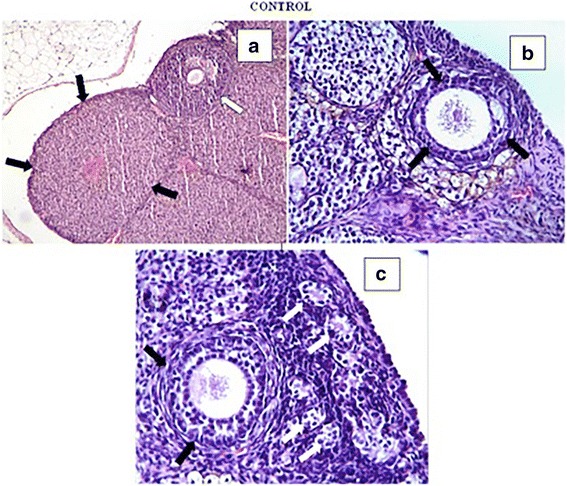
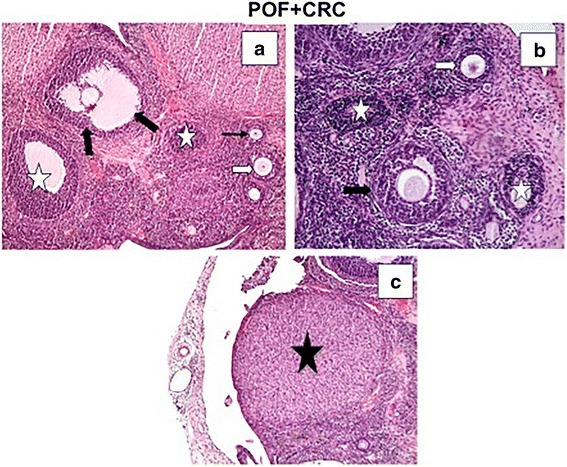
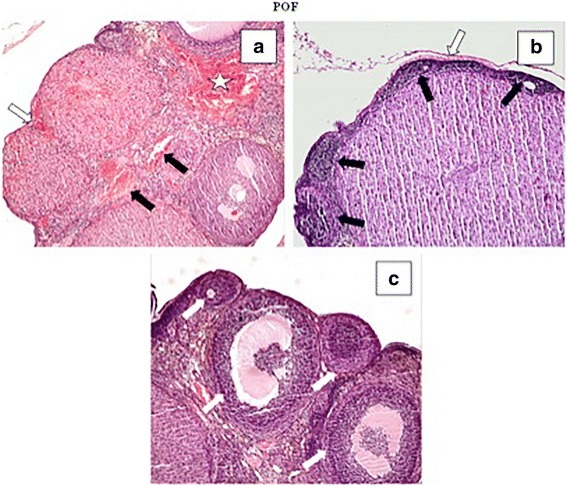
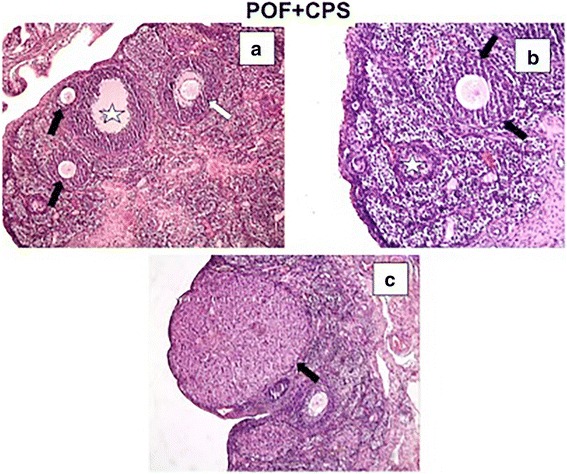
Malonaldehyde levels were significantly reduced, and glutathione levels and superoxide dismutase activity were significantly increased, in ovarian tissues in the POF + CRC and POF + CPS groups compared with the POF group. In the POF group, we observed hemorrhage and prominent mononuclear cell infiltration beneath the germinative epithelium, vascular congestion in ovarian stroma, hemorrhage around the corpus luteum, and atresia in ovarian follicles. This histopathological damage was significantly improved by treatment with CRC and CPS. There was a significant reduction in serum follicle-stimulating hormone and luteinizing hormone levels in rats treated with CRC and CPS compared with the POF group. Moreover, the levels of estradiol and anti-mullerian hormone in rats treated with CRC and CPS were significantly increased compared with the control group.
In conclusion, CRC and CPS treatment of rats with cyclophosphamide-induced POF had a beneficial effect on reducing ovarian damage by improving tissue oxidative stress marker levels, ovarian reserve marker levels, and histopathological parameters. The significant improvements in ovarian tissue histopathological damage and hormonal levels detected in this study indicate that treatment with CRC or CPS might be a conservative treatment approach for cyclophosphamide-induced POF.
近年来,生殖年龄段女性的癌症发病率呈上升趋势。因此,化疗药物暴露已成为导致卵巢早衰(POF)的重要原因。由于化疗药物的生殖风险以及癌症患者的长期生存得到改善,人们对肿瘤治疗前后卵巢功能的保存和恢复越来越感兴趣。在这项研究中,我们旨在分析姜黄素(CRC)和辣椒素(CPS)对环磷酰胺诱导的大鼠 POF 的影响。
在第 1 天通过腹腔内注射 200mg/kg 的环磷酰胺诱导大鼠 POF,然后在接下来的 14 天内每天给予 8mg/kg 的环磷酰胺。在环磷酰胺给药 14 天后,大鼠随机分为三组(每组 n=10):POF、POF+CRC(100mg/kg/天)和 POF+CPS(0.5mg/kg/天),以确定 CRC 和 CPS 对环磷酰胺诱导的 POF 大鼠模型的影响。在 CRC 和 CPS 治疗 14 天后,对血液和组织样本进行生化、激素和组织病理学评估。
与 POF 组相比,POF+CRC 和 POF+CPS 组卵巢组织中的丙二醛水平显著降低,谷胱甘肽水平和超氧化物歧化酶活性显著升高。在 POF 组,我们观察到生殖上皮下出血和明显的单核细胞浸润、卵巢间质血管充血、黄体周围出血和卵泡闭锁。CRC 和 CPS 治疗显著改善了这种组织病理学损伤。与 POF 组相比,用 CRC 和 CPS 治疗的大鼠血清卵泡刺激素和黄体生成素水平显著降低。此外,用 CRC 和 CPS 治疗的大鼠雌二醇和抗苗勒管激素水平与对照组相比显著升高。
总之,CRC 和 CPS 治疗环磷酰胺诱导的 POF 大鼠对改善组织氧化应激标志物水平、卵巢储备标志物水平和组织病理学参数具有有益作用,可减轻卵巢损伤。本研究中卵巢组织组织病理学损伤和激素水平的显著改善表明,CRC 或 CPS 的治疗可能是环磷酰胺诱导的 POF 的一种保守治疗方法。