Department of Molecular Microbiology and Immunology, Division of Biology and Medicine, Brown University, Providence, RI, 02912, USA.
Department of Molecular Microbiology and Immunology, Division of Biology and Medicine, Brown University, Providence, RI, 02912, USA.
Food Microbiol. 2018 Sep;74:171-178. doi: 10.1016/j.fm.2018.04.001. Epub 2018 Apr 3.
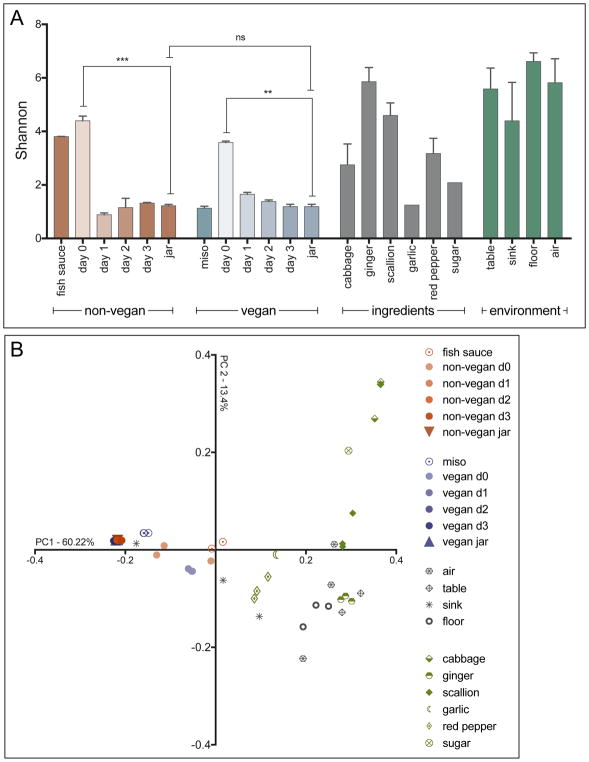
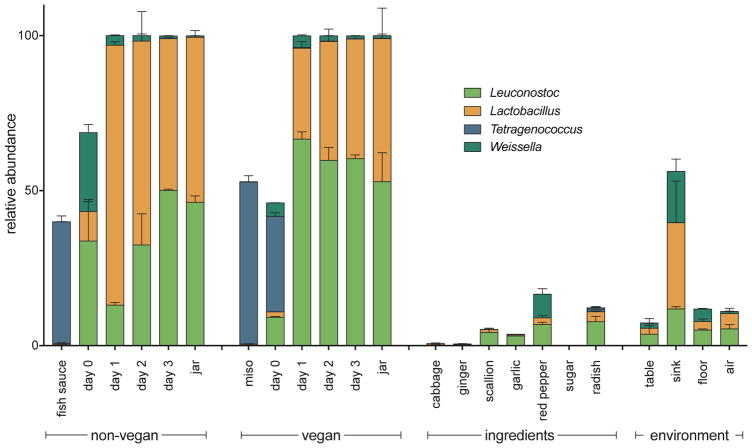
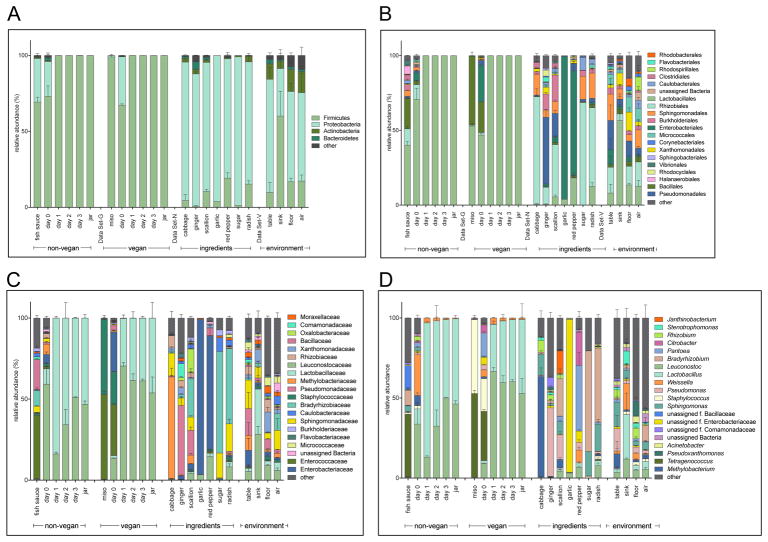
Despite previous inquiry into the fermentative bacterial community of kimchi, there has been little insight into the impacts of starting ingredients on the establishment and dynamics of the microbial community. Recently some industrial producers have begun to utilize vegan production methods that omit fermented seafood ingredients. The community-level impacts of this change are unknown. In this study, we investigated the differences in the taxonomic composition of the microbial communities of non-vegan kimchi and vegan kimchi prepared through quick fermentation at room temperature. In addition to tracking the community dynamics over the fermentation process, we looked at the impact of the constituent ingredients and the production facility environment on the microbial community of fermenting kimchi. Our results indicate that the bacterial community of the prepared vegan product closely mirrors the progression and final structure of the non-vegan final product. We also found that room temperature-fermented kimchi differs minimally from more traditional cold-fermented kimchi. Finally, we found that the bacterial community of the starting ingredients show a low relative abundance of the lactic acid bacteria in fermented kimchi, whereas the production facility is dominated by these bacteria.
尽管先前已经对泡菜发酵细菌群落进行了研究,但对于起始原料对微生物群落的建立和动态的影响却知之甚少。最近,一些工业生产者开始采用不使用发酵海鲜原料的纯素生产方法。这种变化的群落层面影响尚不清楚。在这项研究中,我们调查了通过室温快速发酵制备的非素食泡菜和纯素泡菜的微生物群落的分类组成差异。除了跟踪发酵过程中的群落动态外,我们还研究了组成成分和生产设施环境对发酵泡菜微生物群落的影响。我们的结果表明,准备的纯素产品的细菌群落与非素食最终产品的进展和最终结构非常相似。我们还发现,室温发酵的泡菜与传统的冷发酵泡菜差异很小。最后,我们发现发酵起始原料的细菌群落中泡菜中乳酸菌的相对丰度较低,而生产设施则以这些细菌为主。