Division of Gastroenterology and Hepatology, Key Laboratory of Gastroenterology and Hepatology, Ministry of Health, State Key Laboratory for Oncogenes and Related Genes, Renji Hospital, School of Medicine, Shanghai Jiao Tong University, Shanghai Institute of Digestive Disease, 200001, Shanghai, China.
Division of Rheumatology and Clinical Immunology, Humanitas Research Hospital, Rozzano, Italy.
Cell Mol Immunol. 2018 Jun;15(6):595-609. doi: 10.1038/cmi.2018.7. Epub 2018 Apr 30.
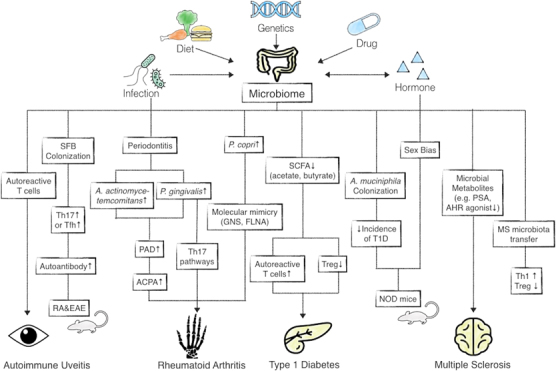
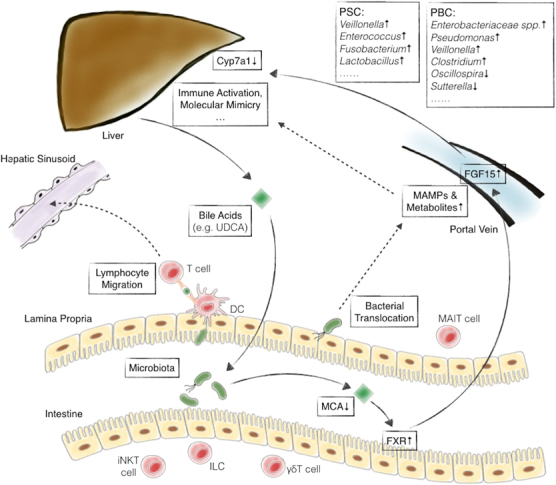
Microbial cells significantly outnumber human cells in the body, and the microbial flora at mucosal sites are shaped by environmental factors and, less intuitively, act on host immune responses, as demonstrated by experimental data in germ-free and gnotobiotic studies. Our understanding of this link stems from the established connection between infectious bacteria and immune tolerance breakdown, as observed in rheumatic fever triggered by Streptococci via molecular mimicry, epitope spread and bystander effects. The availability of high-throughput techniques has significantly advanced our capacity to sequence the microbiome and demonstrated variable degrees of dysbiosis in numerous autoimmune diseases, including rheumatoid arthritis, type 1 diabetes, multiple sclerosis and autoimmune liver disease. It remains unknown whether the observed differences are related to the disease pathogenesis or follow the therapeutic and inflammatory changes and are thus mere epiphenomena. In fact, there are only limited data on the molecular mechanisms linking the microbiota to autoimmunity, and microbial therapeutics is being investigated to prevent or halt autoimmune diseases. As a putative mechanism, it is of particular interest that the apoptosis of intestinal epithelial cells in response to microbial stimuli enables the presentation of self-antigens, giving rise to the differentiation of autoreactive Th17 cells and other T helper cells. This comprehensive review will illustrate the data demonstrating the crosstalk between intestinal microbiome and host innate and adaptive immunity, with an emphasis on how dysbiosis may influence systemic autoimmunity. In particular, a gut-liver axis involving the intestinal microbiome and hepatic autoimmunity is elucidated as a paradigm, considering its anatomic and physiological connections.
体内微生物细胞的数量远远超过人类细胞,而黏膜部位的微生物菌群则受到环境因素的影响,更直观地说,它们会影响宿主的免疫反应,这一点可以通过无菌和无特定病原体研究中的实验数据得到证明。我们对这种联系的理解源于已确立的感染细菌与免疫耐受破坏之间的联系,正如链球菌通过分子模拟、表位扩展和旁观者效应引发风湿热所观察到的那样。高通量技术的出现极大地提高了我们对微生物组进行测序的能力,并在包括类风湿关节炎、1 型糖尿病、多发性硬化症和自身免疫性肝病在内的许多自身免疫性疾病中证实了不同程度的微生态失调。目前尚不清楚观察到的差异是否与疾病发病机制有关,或者是否跟随治疗和炎症变化,因此只是一种偶然现象。事实上,关于将微生物组与自身免疫联系起来的分子机制的相关数据十分有限,目前正在研究微生物治疗以预防或阻止自身免疫性疾病。作为一种假设机制,特别有趣的是,肠道上皮细胞对微生物刺激的凋亡使自身抗原得以呈递,从而导致自身反应性 Th17 细胞和其他 T 辅助细胞的分化。这篇全面的综述将说明肠道微生物组与宿主固有和适应性免疫之间相互作用的相关数据,重点介绍微生态失调如何影响系统性自身免疫。特别是,阐明了涉及肠道微生物组和肝自身免疫的肠-肝轴作为一种范例,考虑到其解剖和生理联系。