Presentato Alessandro, Cappelletti Martina, Sansone Anna, Ferreri Carla, Piacenza Elena, Demeter Marc A, Crognale Silvia, Petruccioli Maurizio, Milazzo Giorgio, Fedi Stefano, Steinbüchel Alexander, Turner Raymond J, Zannoni Davide
Department of Pharmacy and Biotechnology, University of Bologna, Bologna, Italy.
Department of Biological Sciences, University of Calgary, Calgary, AB, Canada.
Front Microbiol. 2018 Apr 12;9:672. doi: 10.3389/fmicb.2018.00672. eCollection 2018.
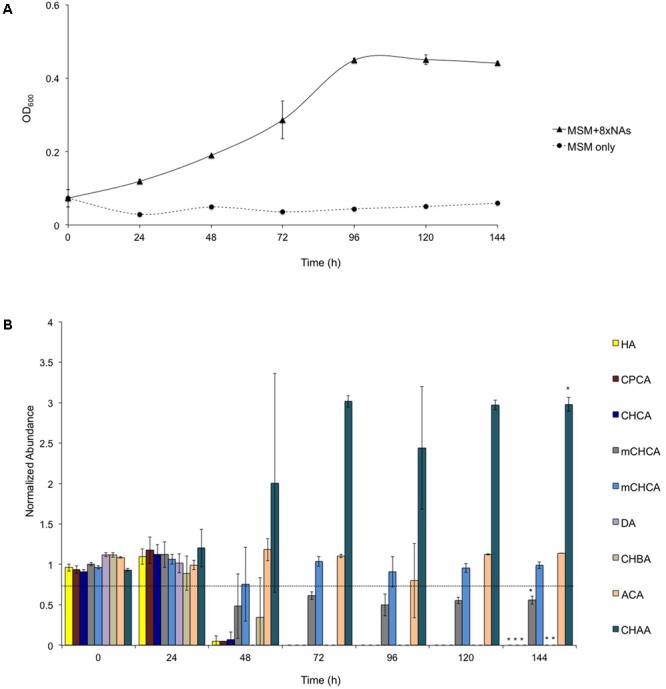
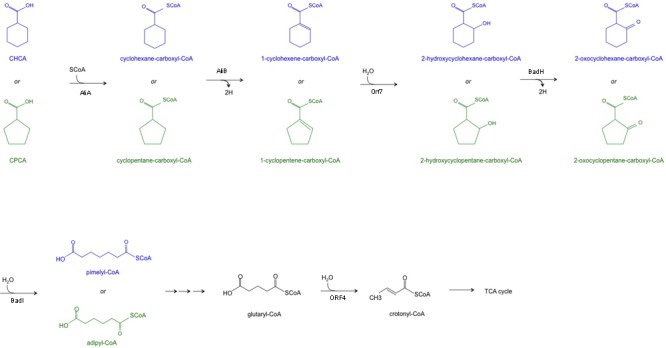
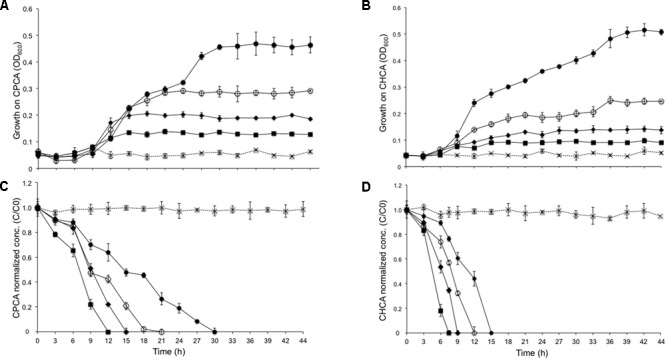
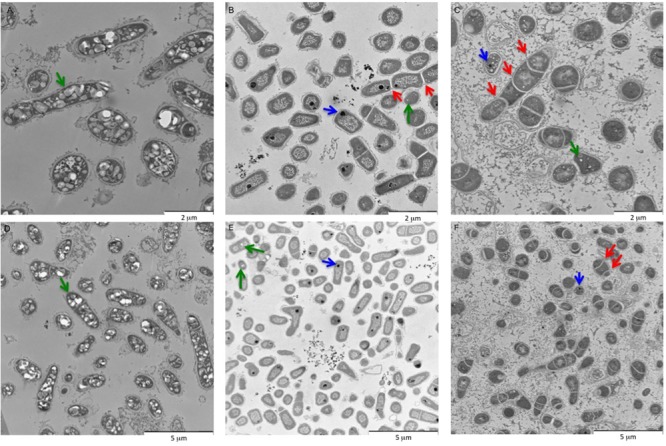
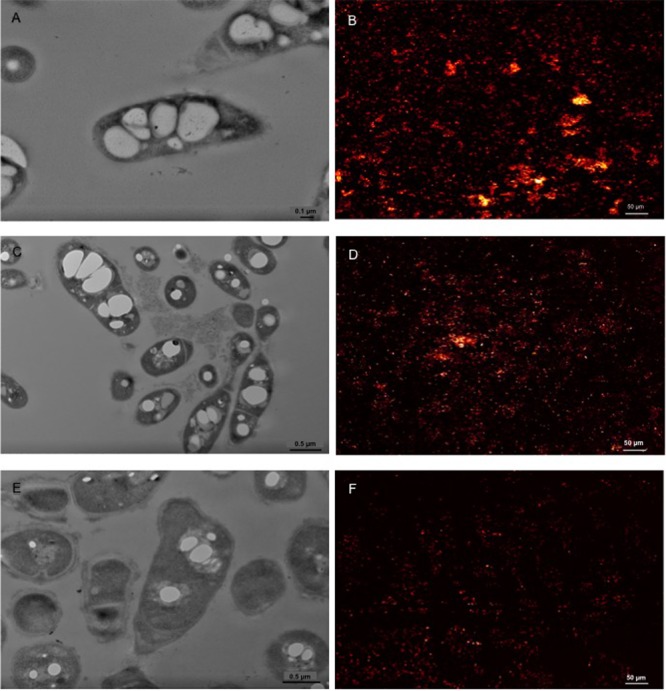
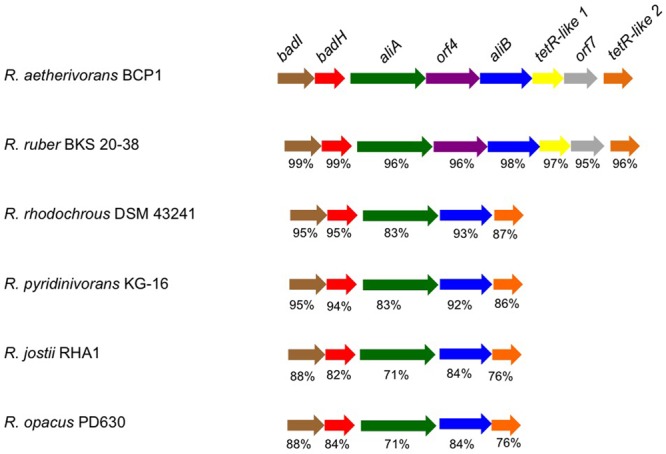
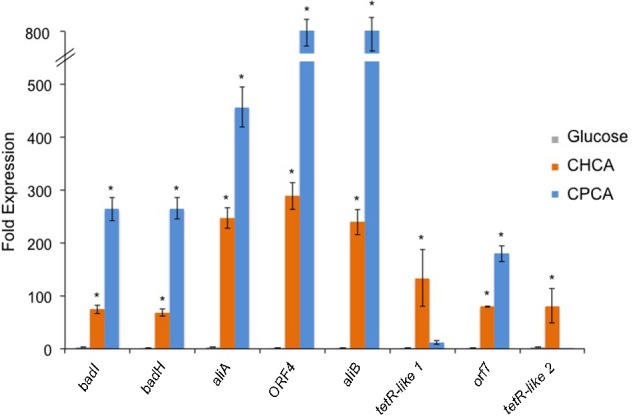
Naphthenic acids (NAs) are an important group of toxic organic compounds naturally occurring in hydrocarbon deposits. This work shows that BCP1 cells not only utilize a mixture of eight different NAs (8XNAs) for growth but they are also capable of marked degradation of two model NAs, cyclohexanecarboxylic acid (CHCA) and cyclopentanecarboxylic acid (CPCA) when supplied at concentrations from 50 to 500 mgL. The growth curves of BCP1 on 8XNAs, CHCA, and CPCA showed an initial lag phase not present in growth on glucose, which presumably was related to the toxic effects of NAs on the cell membrane permeability. BCP1 cell adaptation responses that allowed survival on NAs included changes in cell morphology, production of intracellular bodies and changes in fatty acid composition. Transmission electron microscopy (TEM) analysis of BCP1 cells grown on CHCA or CPCA showed a slight reduction in the cell size, the production of EPS-like material and intracellular electron-transparent and electron-dense inclusion bodies. The electron-transparent inclusions increased in the amount and size in NA-grown BCP1 cells under nitrogen limiting conditions and contained storage lipids as suggested by cell staining with the lipophilic Nile Blue A dye. Lipidomic analyses revealed significant changes with increases of methyl-branched (MBFA) and polyunsaturated fatty acids (PUFA) examining the fatty acid composition of NAs-growing BCP1 cells. PUFA biosynthesis is not usual in bacteria and, together with MBFA, can influence structural and functional processes with resulting effects on cell vitality. Finally, through the use of RT (Reverse Transcription)-qPCR, a gene cluster () was found to be transcriptionally induced during the growth on CHCA and CPCA. Based on the expression and bioinformatics results, the predicted products of the gene cluster are proposed to be involved in aerobic NA degradation in BCP1. This study provides first insights into the genetic and metabolic mechanisms allowing a strain to aerobically degrade NAs.
环烷酸(NAs)是天然存在于碳氢化合物矿床中的一类重要的有毒有机化合物。这项研究表明,BCP1细胞不仅能利用八种不同环烷酸的混合物(8XNAs)进行生长,而且当以50至500mg/L的浓度供应时,它们还能够显著降解两种模型环烷酸,即环己烷羧酸(CHCA)和环戊烷羧酸(CPCA)。BCP1在8XNAs、CHCA和CPCA上的生长曲线显示出一个初始滞后期,而在葡萄糖上生长时不存在这个滞后期,这可能与环烷酸对细胞膜通透性的毒性作用有关。BCP1细胞在环烷酸上存活的适应性反应包括细胞形态的变化、细胞内包涵体的产生以及脂肪酸组成的变化。对在CHCA或CPCA上生长的BCP1细胞进行透射电子显微镜(TEM)分析,结果显示细胞大小略有减小、产生了类似胞外聚合物的物质以及细胞内电子透明和电子致密的包涵体。在氮限制条件下,在环烷酸上生长的BCP1细胞中,电子透明包涵体的数量和大小增加,并且如用亲脂性尼罗蓝A染料进行细胞染色所示,这些包涵体含有储存脂质。脂质组学分析揭示了显著变化,在检测在环烷酸上生长的BCP1细胞的脂肪酸组成时,甲基支链脂肪酸(MBFA)和多不饱和脂肪酸(PUFA)增加。PUFA生物合成在细菌中并不常见,并且与MBFA一起,可以影响结构和功能过程,从而对细胞活力产生影响。最后,通过使用逆转录定量聚合酶链反应(RT-qPCR),发现一个基因簇在CHCA和CPCA上生长期间被转录诱导。基于表达和生物信息学结果,推测该基因簇的预测产物参与BCP1中需氧环烷酸的降解。这项研究首次深入了解了使一种菌株能够需氧降解环烷酸的遗传和代谢机制。