Liu Ying, Xiong Lingxin, Zhou Yan, Zheng Bingzhen, Liu Tongjun, Xie Wei
Department of General Surgery, The Second Hospital of Jilin University, Changchun, Jilin, China.
School of Pharmaceutical Sciences, Jilin University, Changchun, China.
Gastroenterol Res Pract. 2018 Mar 7;2018:7295131. doi: 10.1155/2018/7295131. eCollection 2018.
It has been found that single-nucleotide polymorphisms (SNPs) of microRNA might be involved in the development of inflammatory bowel diseases (IBDs). However, the related retrospective research has not been reported. In this work, we performed a meta-analysis to derive a more precise estimation of the associated relationship.
We searched the studies on the association of SNPs of microRNA with the hereditary susceptibility of IBD in PubMed and Embase; eligible research was selected by screening the abstract and full text. The meta-analysis was performed based on the statistical software Stata 14.0, and besides, the odds ratio and 95% confidence interval were calculated to evaluate the strength of the association.
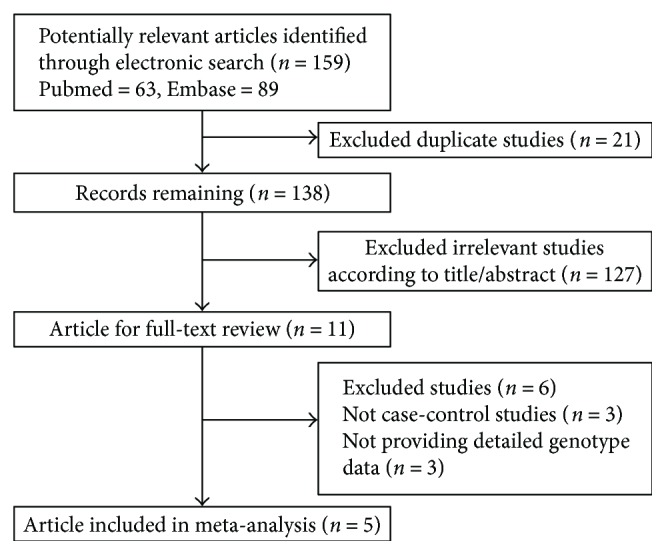
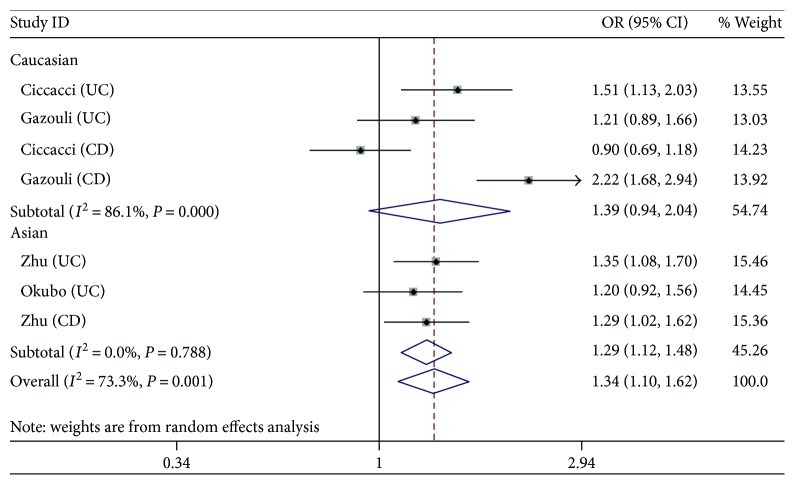
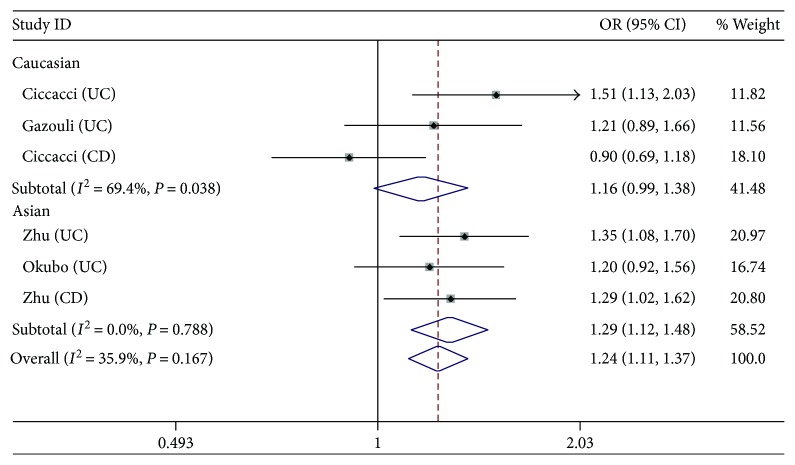
159 papers were acquired from the PubMed and Embase databases, and five eligible articles containing nine case-control studies were selected. In the study, we first found that the association between and IBD was insignificant. Then, the susceptibility of to IBD increased significantly in allelic comparison, homozygote model, heterozygote model, and dominant model. Moreover, a positive relationship between and IBD was identified in the homozygote model.
Our findings demonstrated that (G>C) polymorphism was associated with the susceptibility to IBD and (T>C) and (A>G) did not reveal an obvious relationship with the IBD susceptibility.
已发现微小RNA的单核苷酸多态性(SNP)可能与炎症性肠病(IBD)的发生发展有关。然而,相关的回顾性研究尚未见报道。在本研究中,我们进行了一项荟萃分析,以更精确地评估这种关联关系。
我们在PubMed和Embase数据库中检索了关于微小RNA的SNP与IBD遗传易感性关联的研究;通过筛选摘要和全文来选择符合条件的研究。基于统计软件Stata 14.0进行荟萃分析,此外,计算比值比和95%置信区间以评估关联强度。
从PubMed和Embase数据库中获取了159篇论文,选择了5篇符合条件的文章,其中包含9项病例对照研究。在研究中,我们首先发现[具体基因1]与IBD之间的关联不显著。然后,在等位基因比较、纯合子模型、杂合子模型和显性模型中,[具体基因2]对IBD的易感性显著增加。此外,在纯合子模型中确定了[具体基因3]与IBD之间存在正相关关系。
我们的研究结果表明,[具体基因1](G>C)多态性与IBD易感性相关,而[具体基因2](T>C)和[具体基因3](A>G)与IBD易感性未显示出明显关系。