Department of Pharmaceutical and Biochemical Technology, School of Pharmaceutical Sciences, University of São Paulo, Av. Lineu Prestes, 580, São Paulo, SP 05508-000, Brazil.
Food Research Center, University of São Paulo, Rua do Lago, 250, São Paulo, SP 05508-080, Brazil.
Int J Mol Sci. 2020 Dec 31;22(1):362. doi: 10.3390/ijms22010362.
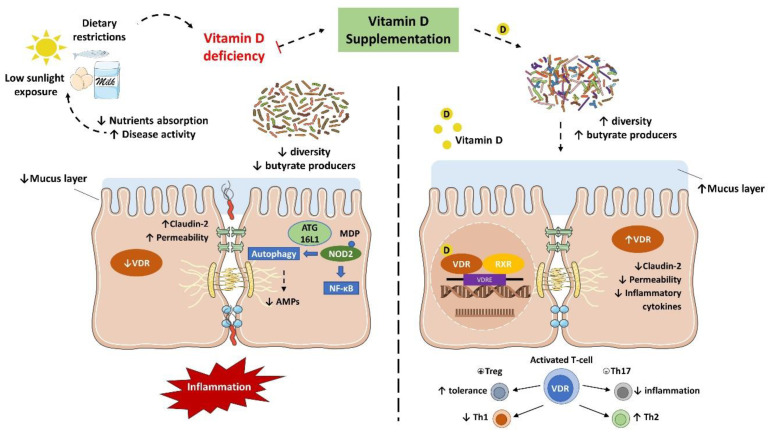
Inflammatory bowel disease (IBD) is a chronic inflammation of the gastrointestinal tract (GIT), including Crohn's disease (CD) and ulcerative colitis (UC), which differ in the location and lesion extensions. Both diseases are associated with microbiota dysbiosis, with a reduced population of butyrate-producing species, abnormal inflammatory response, and micronutrient deficiency (e.g., vitamin D hypovitaminosis). Vitamin D (VitD) is involved in immune cell differentiation, gut microbiota modulation, gene transcription, and barrier integrity. Vitamin D receptor (VDR) regulates the biological actions of the active VitD (1α,25-dihydroxyvitamin D3), and is involved in the genetic, environmental, immune, and microbial aspects of IBD. VitD deficiency is correlated with disease activity and its administration targeting a concentration of 30 ng/mL may have the potential to reduce disease activity. Moreover, VDR regulates functions of T cells and Paneth cells and modulates release of antimicrobial peptides in gut microbiota-host interactions. Meanwhile, beneficial microbial metabolites, e.g., butyrate, upregulate the VDR signaling. In this review, we summarize the clinical progress and mechanism studies on VitD/VDR related to gut microbiota modulation in IBD. We also discuss epigenetics in IBD and the probiotic regulation of VDR. Furthermore, we discuss the existing challenges and future directions. There is a lack of well-designed clinical trials exploring the appropriate dose and the influence of gender, age, ethnicity, genetics, microbiome, and metabolic disorders in IBD subtypes. To move forward, we need well-designed therapeutic studies to examine whether enhanced vitamin D will restore functions of VDR and microbiome in inhibiting chronic inflammation.
炎症性肠病(IBD)是一种胃肠道(GIT)的慢性炎症,包括克罗恩病(CD)和溃疡性结肠炎(UC),它们在病变位置和病变延伸方面有所不同。这两种疾病都与微生物失调有关,丁酸产生物种的数量减少,异常炎症反应和微量营养素缺乏(例如维生素 D 缺乏症)。维生素 D(VitD)参与免疫细胞分化,肠道微生物群调节,基因转录和屏障完整性。维生素 D 受体(VDR)调节活性 VitD(1α,25-二羟基维生素 D3)的生物学作用,并且与 IBD 的遗传,环境,免疫和微生物方面有关。VitD 缺乏与疾病活动有关,其靶向浓度为 30ng/ml 的给药可能具有降低疾病活动的潜力。此外,VDR 调节 T 细胞和 Paneth 细胞的功能,并调节肠道微生物群-宿主相互作用中抗菌肽的释放。同时,有益的微生物代谢产物,例如丁酸盐,可上调 VDR 信号。在这篇综述中,我们总结了与 IBD 中肠道微生物群调节有关的 VitD/VDR 的临床进展和机制研究。我们还讨论了 IBD 的表观遗传学和益生菌对 VDR 的调节。此外,我们还讨论了当前的挑战和未来的方向。缺乏探索适当剂量以及在 IBD 亚型中性别,年龄,种族,遗传学,微生物组和代谢紊乱影响的精心设计的临床试验。为了取得进展,我们需要精心设计的治疗研究来检查增强的维生素 D 是否会恢复 VDR 和微生物组在抑制慢性炎症中的功能。