Wildlife Conservation Society, Global Conservation Program, 2300 Southern Boulevard, Bronx, New York, NY 10460, USA.
Faculty of Natural Sciences, University of Stirling, Stirling FK9 4LA, Scotland, UK.
Sci Adv. 2018 Apr 25;4(4):eaar2964. doi: 10.1126/sciadv.aar2964. eCollection 2018 Apr.
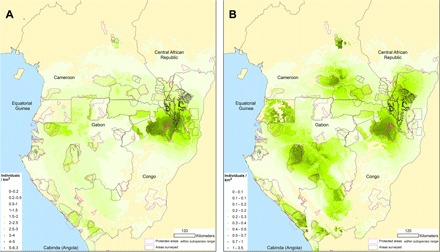
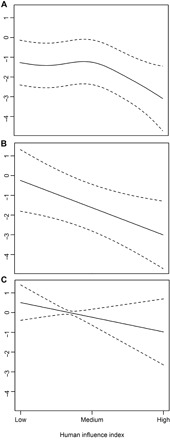
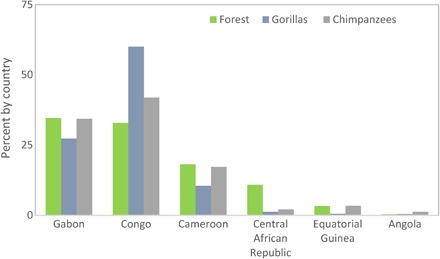
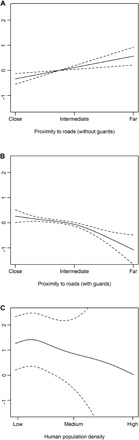
We present a range-wide assessment of sympatric western lowland gorillas and central chimpanzees using the largest survey data set ever assembled for these taxa: 59 sites in five countries surveyed between 2003 and 2013, totaling 61,000 person-days of fieldwork. We used spatial modeling to investigate major drivers of great ape distribution and population trends. We predicted density across each taxon's geographic range, allowing us to estimate overall abundance: 361,900 gorillas and 128,700 chimpanzees in Western Equatorial Africa-substantially higher than previous estimates. These two subspecies represent close to 99% of all gorillas and one-third of all chimpanzees. Annual population decline of gorillas was estimated at 2.7%, maintaining them as Critically Endangered on the International Union for Conservation of Nature and Natural Resources (IUCN) Red List. We quantified the threats to each taxon, of which the three greatest were poaching, disease, and habitat degradation. Gorillas and chimpanzees are found at higher densities where forest is intact, wildlife laws are enforced, human influence is low, and disease impacts have been low. Strategic use of the results of these analyses could conserve the majority of gorillas and chimpanzees. With around 80% of both subspecies occurring outside protected areas, their conservation requires reinforcement of anti-poaching efforts both inside and outside protected areas (particularly where habitat quality is high and human impact is low), diligent disease control measures (including training, advocacy, and research into Ebola virus disease), and the preservation of high-quality habitat through integrated land-use planning and implementation of best practices by the extractive and agricultural industries.
我们对西部低地大猩猩和中部黑猩猩进行了全范围的评估,使用了有史以来为这两个类群收集的最大调查数据集:2003 年至 2013 年间在五个国家的 59 个地点进行了调查,总计进行了 61,000 个人日的实地工作。我们使用空间建模来研究大型类人猿分布和种群趋势的主要驱动因素。我们预测了每个分类单元地理范围内的密度,从而能够估计总体丰度:西非的大猩猩有 361,900 只,中非的黑猩猩有 128,700 只,这大大高于以前的估计。这两个亚种代表了近 99%的大猩猩和三分之一的黑猩猩。大猩猩的年种群下降估计为 2.7%,使它们在国际自然保护联盟(IUCN)红色名录上仍然处于极危状态。我们量化了每个分类单元的威胁,其中最大的三个威胁是偷猎、疾病和栖息地退化。在森林完整、野生动物法得到执行、人类影响低且疾病影响低的地方,大猩猩和黑猩猩的密度更高。战略性地利用这些分析结果可以保护大多数大猩猩和黑猩猩。由于大约 80%的两个亚种都在保护区之外,因此它们的保护需要加强保护区内外的反偷猎努力(特别是在栖息地质量高且人类影响低的地方),认真实施疾病控制措施(包括培训、宣传和对埃博拉病毒病的研究),并通过综合土地利用规划和采掘业及农业部门实施最佳做法来保护高质量的栖息地。