Research Institute of Internal Medicine, Oslo University Hospital, Rikshospitalet, 0424, Oslo, Norway.
K.G. Jebsen Inflammation Research Centre, University of Oslo, 0424, Oslo, Norway.
Sci Rep. 2018 Apr 30;8(1):6725. doi: 10.1038/s41598-018-25168-3.
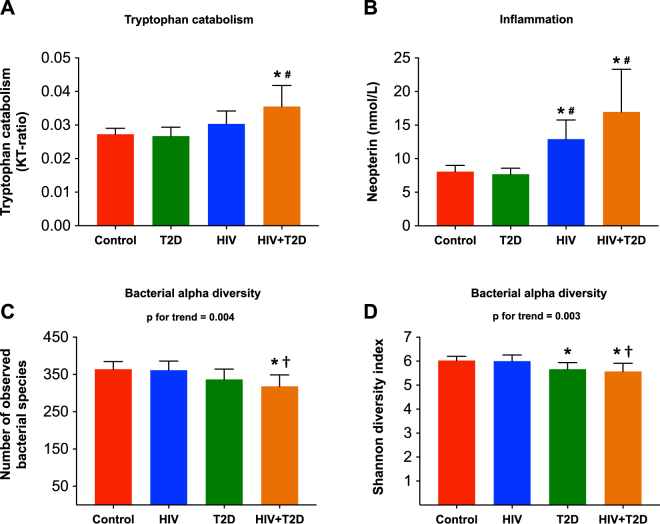
HIV infection and type 2 diabetes are associated with altered gut microbiota, chronic inflammation, and increased cardiovascular risk. We aimed to investigate the combined effect of these diseases on gut microbiota composition and related metabolites, and a potential relation to endothelial dysfunction in individuals with HIV-infection only (n = 23), diabetes only (n = 16) or both conditions (n = 21), as well as controls (n = 24). Fecal microbiota was analyzed by Illumina sequencing of the 16 S rRNA gene. Markers of endothelial dysfunction (asymmetric dimethylarginine [ADMA]), tryptophan catabolism (kynurenine/tryptophan [KT]-ratio), and inflammation (neopterin) were measured by liquid chromatography-tandem mass spectrometry. The combination of HIV and type 2 diabetes was associated with reduced gut microbiota diversity, increased plasma KT-ratio and neopterin. Microbial genes related to tryptophan metabolism correlated with KT-ratio and low alpha diversity, in particular in HIV-infected with T2D. In multivariate analyses, KT-ratio associated with ADMA (β = 4.58 [95% CI 2.53-6.63], p < 0.001), whereas microbiota composition per se was not associated with endothelial dysfunction. Our results indicate that tryptophan catabolism may be related to endothelial dysfunction, with a potentially detrimental interaction between HIV and diabetes. The potential contribution of gut microbiota and the impact for cardiovascular risk should be further explored in prospective studies powered for clinical end points.
HIV 感染和 2 型糖尿病与肠道微生物群改变、慢性炎症和心血管风险增加有关。我们旨在研究这些疾病对肠道微生物群组成和相关代谢物的综合影响,以及在仅感染 HIV(n=23)、仅患有糖尿病(n=16)或同时患有这两种疾病(n=21)的个体中,与内皮功能障碍的潜在关系,以及对照组(n=24)。通过 Illumina 16S rRNA 基因测序分析粪便微生物群。通过液相色谱-串联质谱法测量内皮功能障碍标志物(不对称二甲基精氨酸 [ADMA])、色氨酸分解代谢(犬尿氨酸/色氨酸 [KT] 比)和炎症标志物(新蝶呤)。HIV 和 2 型糖尿病的联合与肠道微生物多样性降低、血浆 KT 比和新蝶呤升高有关。与色氨酸代谢相关的微生物基因与 KT 比和低 alpha 多样性相关,特别是在感染 HIV 的 T2D 患者中。在多变量分析中,KT 比与 ADMA 相关(β=4.58[95%CI 2.53-6.63],p<0.001),而微生物组成本身与内皮功能障碍无关。我们的研究结果表明,色氨酸分解代谢可能与内皮功能障碍有关,HIV 和糖尿病之间存在潜在的有害相互作用。应在具有临床终点的前瞻性研究中进一步探索肠道微生物群的潜在贡献及其对心血管风险的影响。