
汉斯·阿斯伯格、纳粹德国时期的国家社会主义与维也纳的“种族卫生学”。
Hans Asperger, National Socialism, and "race hygiene" in Nazi-era Vienna.
机构信息
Ethics, Collections, and History of Medicine, Medical University of Vienna, Währinger Straße 25, 1090 Vienna, Austria.
出版信息
Mol Autism. 2018 Apr 19;9:29. doi: 10.1186/s13229-018-0208-6. eCollection 2018.
BACKGROUND
Hans Asperger (1906-1980) first designated a group of children with distinct psychological characteristics as 'autistic psychopaths' in 1938, several years before Leo Kanner's famous 1943 paper on autism. In 1944, Asperger published a comprehensive study on the topic (submitted to Vienna University in 1942 as his postdoctoral thesis), which would only find international acknowledgement in the 1980s. From then on, the eponym 'Asperger's syndrome' increasingly gained currency in recognition of his outstanding contribution to the conceptualization of the condition. At the time, the fact that Asperger had spent pivotal years of his career in Nazi Vienna caused some controversy regarding his potential ties to National Socialism and its race hygiene policies. Documentary evidence was scarce, however, and over time a narrative of Asperger as an active opponent of National Socialism took hold. The main goal of this paper is to re-evaluate this narrative, which is based to a large extent on statements made by Asperger himself and on a small segment of his published work.
METHODS
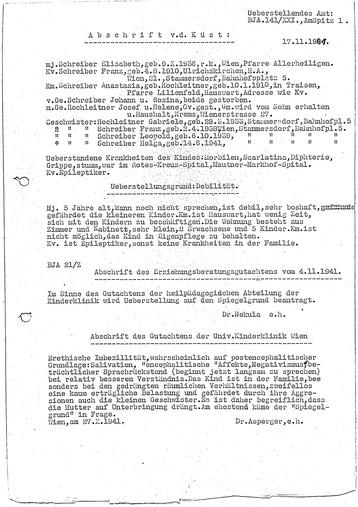
Drawing on a vast array of contemporary publications and previously unexplored archival documents (including Asperger's personnel files and the clinical assessments he wrote on his patients), this paper offers a critical examination of Asperger's life, politics, and career before and during the Nazi period in Austria.
RESULTS
Asperger managed to accommodate himself to the Nazi regime and was rewarded for his affirmations of loyalty with career opportunities. He joined several organizations affiliated with the NSDAP (although not the Nazi party itself), publicly legitimized race hygiene policies including forced sterilizations and, on several occasions, actively cooperated with the child 'euthanasia' program. The language he employed to diagnose his patients was often remarkably harsh (even in comparison with assessments written by the staff at Vienna's notorious Spiegelgrund 'euthanasia' institution), belying the notion that he tried to protect the children under his care by embellishing their diagnoses.
CONCLUSION
The narrative of Asperger as a principled opponent of National Socialism and a courageous defender of his patients against Nazi 'euthanasia' and other race hygiene measures does not hold up in the face of the historical evidence. What emerges is a much more problematic role played by this pioneer of autism research. Future use of the eponym should reflect the troubling context of its origins in Nazi-era Vienna.
背景
汉斯·阿斯伯格(1906-1980 年)于 1938 年首次将一组具有独特心理特征的儿童指定为“自闭症精神病患者”,这比利奥·坎纳(Leo Kanner)著名的 1943 年自闭症论文早了几年。1944 年,阿斯伯格发表了一篇关于该主题的综合研究(1942 年作为他的博士后论文提交给维也纳大学),直到 20 世纪 80 年代才在国际上得到认可。从那时起,以他的名字命名的“阿斯伯格综合征”越来越被人们所接受,以承认他对该病症概念化的杰出贡献。当时,阿斯伯格在纳粹维也纳度过了职业生涯的关键几年,这导致了一些关于他与纳粹主义及其种族卫生政策可能存在联系的争议。然而,没有确凿的证据,随着时间的推移,阿斯伯格作为纳粹主义的积极反对者的说法逐渐占据了主导地位。本文的主要目的是重新评估这一说法,该说法在很大程度上基于阿斯伯格本人的陈述和他发表的一小部分作品。
方法
本文利用大量当代出版物和以前未被探索的档案文件(包括阿斯伯格的人事档案和他对患者的临床评估),对他在纳粹时期之前和期间的生活、政治和职业生涯进行了批判性的考察。
结果
阿斯伯格设法适应了纳粹政权,并因其对忠诚的肯定而获得了职业机会。他加入了几个与纳粹党有关联的组织(尽管不是纳粹党本身),公开为强制绝育等种族卫生政策合法化,并在几次情况下积极配合儿童“安乐死”计划。他用来诊断患者的语言通常非常严厉(甚至与维也纳臭名昭著的 Spiegelgrund“安乐死”机构的工作人员的评估相比),这与他试图通过美化诊断来保护他照顾的孩子的说法相矛盾。
结论
阿斯伯格作为纳粹主义的有原则的反对者和他的患者对抗纳粹“安乐死”和其他种族卫生措施的勇敢捍卫者的说法,在面对历史证据时站不住脚。这位自闭症研究的先驱者扮演了一个更加复杂的角色。未来使用这个名字时应该反映其起源于纳粹时期维也纳的令人不安的背景。




 Zotero 插件