Asleh Rabea, Briasoulis Alexandros, Berinstein Elliot M, Wiener Joshua B, Palla Mohan, Kushwaha Sudhir S, Levy Andrew P
Bruce and Rappaport Faculty of Medicine, Technion Institute of Technology, Haifa, Israel.
Department of Cardiovascular Diseases, Mayo Clinic, Rochester, MN, USA.
Pharmgenomics Pers Med. 2018 Apr 23;11:71-82. doi: 10.2147/PGPM.S159454. eCollection 2018.
The objectives of the study were to compile and summarize the data from all of the clinical trials designed to examine the association between haptoglobin (Hp) genotype and incidence of cardiovascular (CV) events in patients with diabetes mellitus (DM) and to assess the impact of vitamin E treatment on CV outcomes according to the Hp genotype.
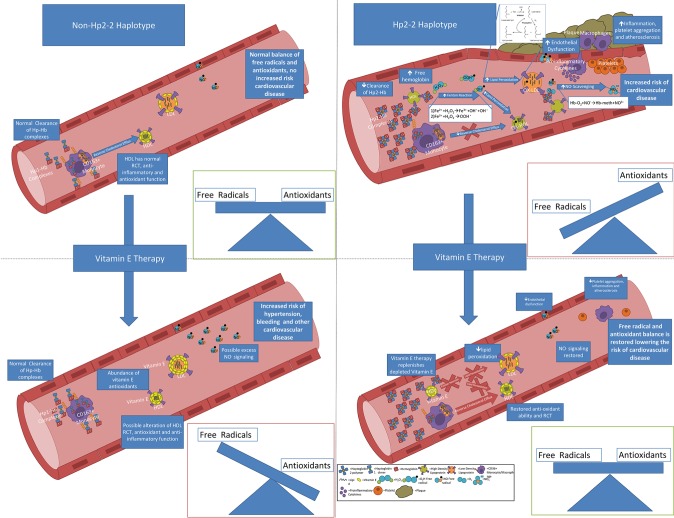
The Hp genotype could serve as a predictive biomarker to DM patients who may benefit from vitamin E therapy.
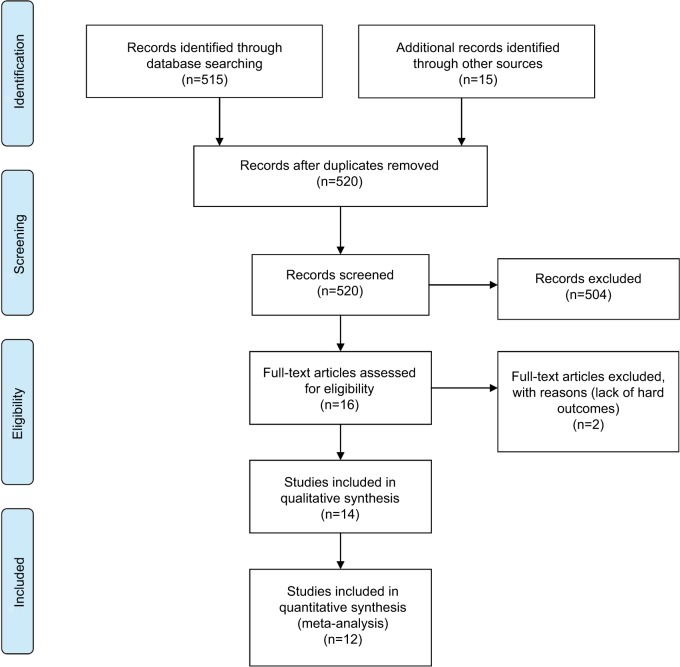
The electronic databases MEDLINE, PubMed, EMBASE and the Cochrane Library for Central Register of Clinical Trials were searched systematically using the following MESH terms: "haptoglobin genotype", "diabetes mellitus" and "cardiovascular events".
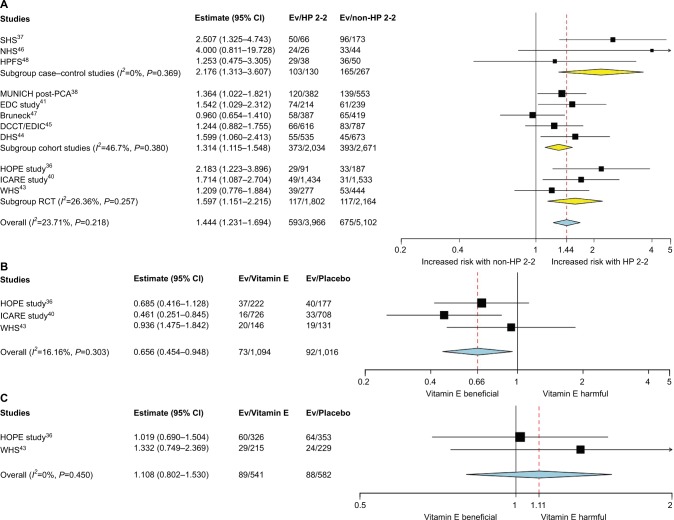
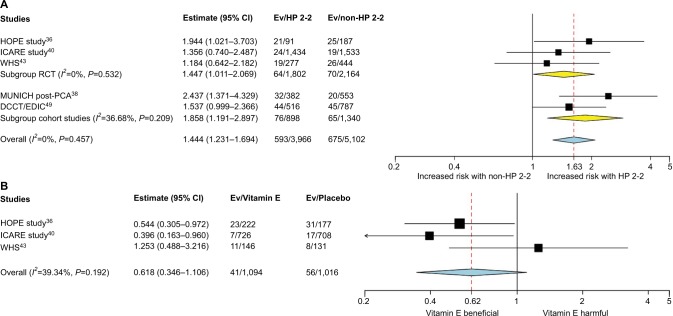
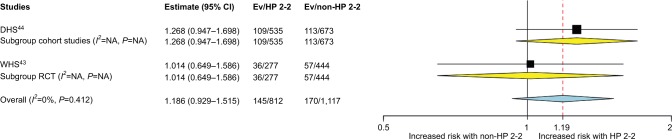
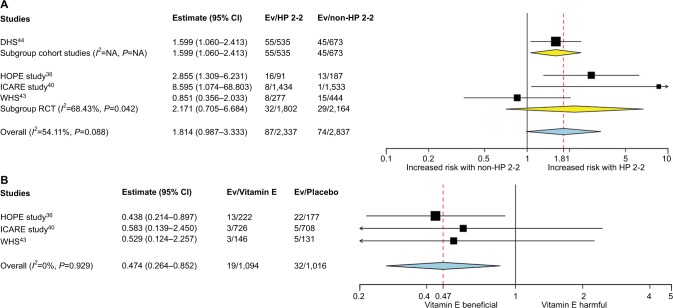
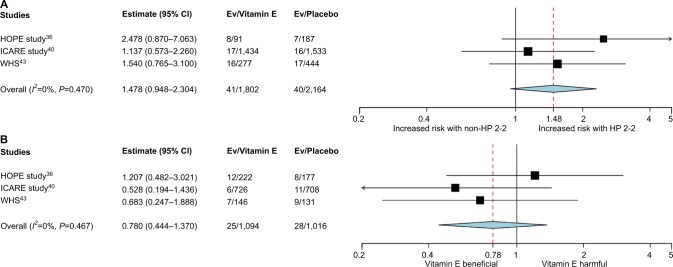
Overall, 13 studies fit the inclusion criteria for this analysis, yielding a large study population that included 6,161 patients without Hp 2-2 and 4,684 patients with Hp 2-2. The analysis of these studies showed that the incidence of CV events in DM patients with the Hp 2-2 genotype was significantly increased as compared to non-Hp 2-2 patients in all three subgroups of case-control (OR: 2.2, 95% CI: 1.3-3.6; =0.003), cohort (OR: 1.3, 95% CI: 1.2-1.5; =0.001) and randomized controlled trials (OR: 1.6, 1.2-2.2; =0.005). Among patients with the Hp 2-2 genotype, administration of vitamin E was associated with lower rates of CV events (OR: 0.66, 95% CI: 0.45-0.95; =0.025). Further investigation into the association between Hp 2-2 and myocardial infarction, stroke, mortality and end-stage renal disease was also performed.
The Hp genotype is a risk factor for CV events in patients with DM, and administration of vitamin E appears to offer a low cost and accessible means of reducing CV events and mortality in this population.
本研究的目的是汇总和总结所有旨在研究糖尿病(DM)患者中触珠蛋白(Hp)基因型与心血管(CV)事件发生率之间关联的临床试验数据,并根据Hp基因型评估维生素E治疗对CV结局的影响。
Hp基因型可作为预测生物标志物,用于判断哪些DM患者可能从维生素E治疗中获益。
使用以下医学主题词(MESH)术语系统检索电子数据库MEDLINE、PubMed、EMBASE和Cochrane临床试验中央注册库:“触珠蛋白基因型”、“糖尿病”和“心血管事件”。
总体而言,13项研究符合本分析的纳入标准,产生了一个庞大的研究人群,其中包括6161例非Hp 2-2患者和4684例Hp 2-2患者。对这些研究的分析表明,在病例对照研究的所有三个亚组(比值比[OR]:2.2,95%置信区间[CI]:1.3-3.6;P=0.003)、队列研究(OR:1.3,95%CI:1.2-1.5;P=0.001)和随机对照试验(OR:1.6,1.2-2.2;P=0.005)中,Hp 2-2基因型的DM患者发生CV事件的发生率与非Hp 2-2患者相比显著增加。在Hp 2-2基因型患者中,服用维生素E与较低的CV事件发生率相关(OR:0.66,95%CI:0.45-0.95;P=0.025)。还对Hp 2-2与心肌梗死、中风、死亡率和终末期肾病之间的关联进行了进一步研究。
Hp基因型是DM患者发生CV事件的危险因素,服用维生素E似乎为降低该人群CV事件和死亡率提供了一种低成本且可行的方法。