Hu Youjin, An Qin, Sheu Katherine, Trejo Brandon, Fan Shuxin, Guo Ying
Zhongshan Ophthalmic Center, State Key Laboratory of Ophthalmology, Sun-Ye-Sat University, Guangzhou, China.
Department of Human Genetics, David Geffen School of Medicine, UCLA, Los Angeles, CA, United States.
Front Cell Dev Biol. 2018 Apr 20;6:28. doi: 10.3389/fcell.2018.00028. eCollection 2018.
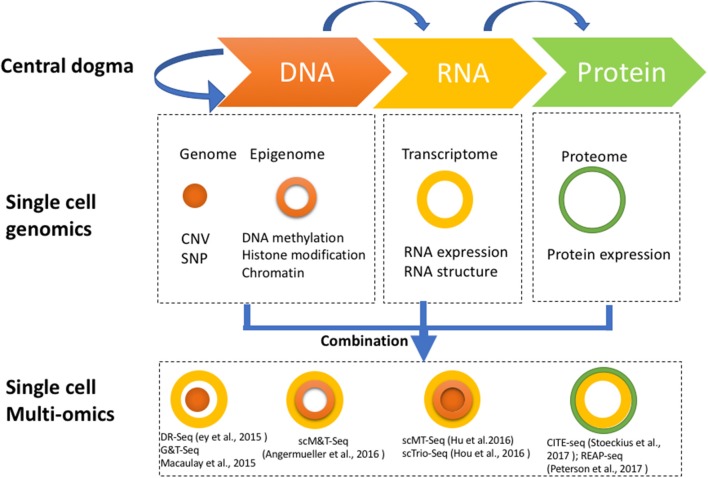
In the era of precision medicine, multi-omics approaches enable the integration of data from diverse omics platforms, providing multi-faceted insight into the interrelation of these omics layers on disease processes. Single cell sequencing technology can dissect the genotypic and phenotypic heterogeneity of bulk tissue and promises to deepen our understanding of the underlying mechanisms governing both health and disease. Through modification and combination of single cell assays available for transcriptome, genome, epigenome, and proteome profiling, single cell multi-omics approaches have been developed to simultaneously and comprehensively study not only the unique genotypic and phenotypic characteristics of single cells, but also the combined regulatory mechanisms evident only at single cell resolution. In this review, we summarize the state-of-the-art single cell multi-omics methods and discuss their applications, challenges, and future directions.
在精准医学时代,多组学方法能够整合来自不同组学平台的数据,为这些组学层面在疾病过程中的相互关系提供多方面的见解。单细胞测序技术可以剖析大块组织的基因型和表型异质性,并有望加深我们对健康和疾病潜在调控机制的理解。通过对可用于转录组、基因组、表观基因组和蛋白质组分析的单细胞检测方法进行改进和组合,已经开发出单细胞多组学方法,不仅可以同时全面地研究单细胞独特的基因型和表型特征,还能研究仅在单细胞分辨率下才明显的联合调控机制。在这篇综述中,我们总结了最先进的单细胞多组学方法,并讨论了它们的应用、挑战和未来方向。