Arthritis Research UK Primary Care Centre, Research Institute for Primary Care & Health Science, Keele University, Keele, Staffordshire, ST5 5BG, UK.
Haywood Academic Rheumatology Centre, Staffordshire and Stoke-on-Trent Partnership Trust, Stoke-on-Trent, ST6 7AG, UK.
Arch Osteoporos. 2018 May 8;13(1):55. doi: 10.1007/s11657-018-0470-4.
This systematic review identified patients have unmet information needs about the nature of osteoporosis, medication, self-management and follow-up. Clinician knowledge and attitudes appear to be of key importance in determining whether these needs are met. Unmet information needs appear to have psychosocial consequences and result in poor treatment adherence.
Patient education is an integral component of the management of osteoporosis, yet patients are dissatisfied with the information they receive and see this as an area of research priority. This study aimed to describe and summarise the specific expressed information needs of patients in previously published qualitative research.
Using terms relating to osteoporosis, fragility fracture and information needs, seven databases were searched. Articles were screened using predefined inclusion and exclusion criteria. Full-text articles selected for inclusion underwent data extraction and quality appraisal. Findings were drawn together using narrative synthesis.
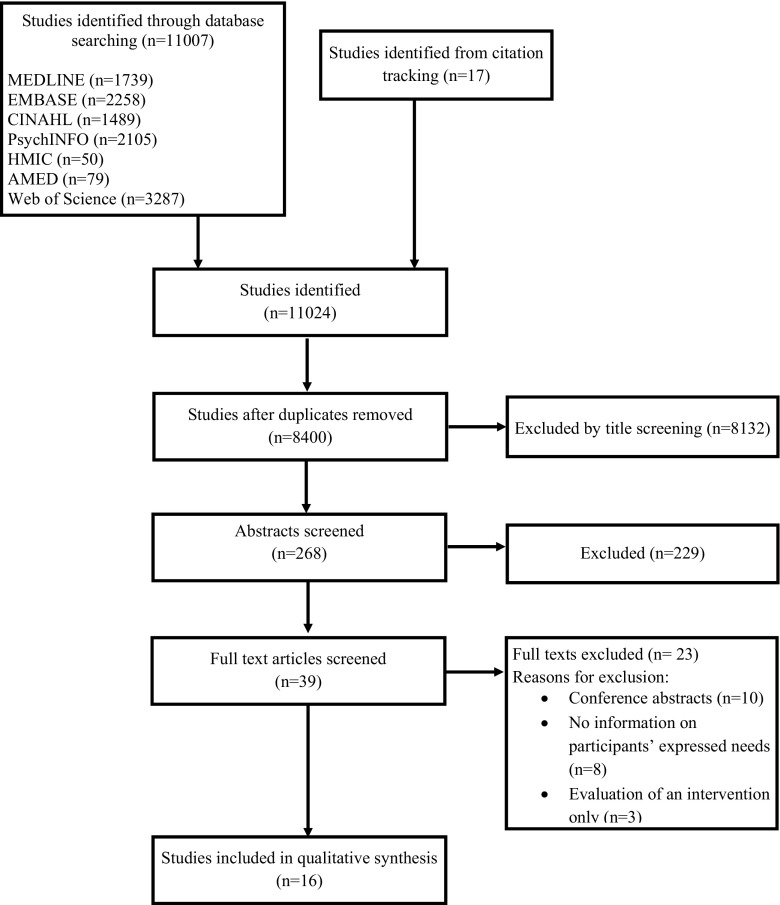
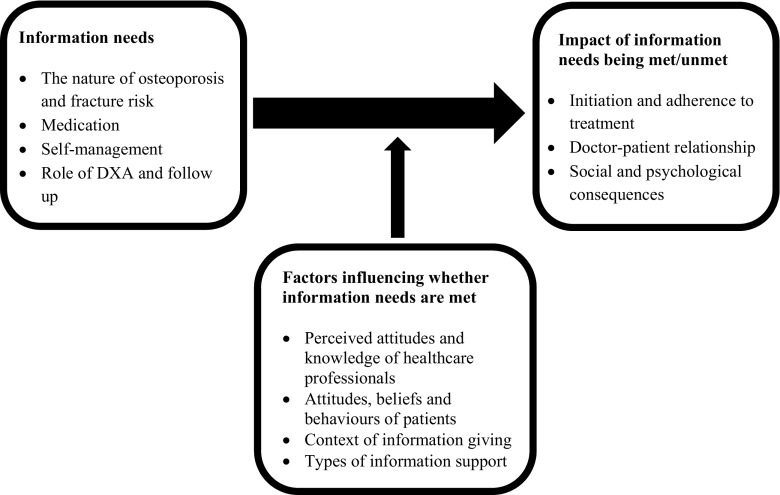
The search identified 11,024 articles. Sixteen empirical studies were included in the review. Thematic analysis revealed three overarching themes relating to specific information needs, factors influencing whether information needs are met and the impact of unmet information needs. Specific information needs identified included the following: the nature of osteoporosis/fracture risk; medication; self-management and understanding the role of dual energy x-ray absorptiometry and follow-up. Perceived physician knowledge and attitudes, and the attitudes, beliefs and behaviours of patients were important factors in influencing whether information needs were met, in addition to contextual factors and the format of educational resources. Failure to elicit and address information needs appears to be associated with poor treatment adherence, deterioration of the doctor-patient relationship and important psychosocial consequences.
This is the first study to describe the information needs of patients with osteoporosis and fracture, the impact of this information gap and possible solutions. Further research is needed to co-design and evaluate educational interventions with patients.
患者教育是骨质疏松症管理的一个组成部分,但患者对他们所收到的信息不满意,并认为这是一个研究优先事项。本研究旨在描述和总结先前发表的定性研究中患者具体表达的信息需求。
使用与骨质疏松症、脆性骨折和信息需求相关的术语,对七个数据库进行了搜索。使用预先确定的纳入和排除标准筛选文章。选择纳入的全文文章进行数据提取和质量评估。使用叙述性综合方法汇集研究结果。
这是第一项描述骨质疏松症和骨折患者信息需求、信息差距的影响以及可能的解决方案的研究。需要进一步研究,与患者共同设计和评估教育干预措施。
搜索共确定了 11024 篇文章。有 16 项实证研究纳入了综述。主题分析揭示了与特定信息需求、影响信息需求是否得到满足的因素以及未满足信息需求的影响相关的三个总体主题。确定的具体信息需求包括以下内容:骨质疏松症/骨折风险的性质;药物治疗;自我管理和理解双能 X 射线吸收法的作用以及随访。患者感知到的医生知识和态度,以及患者的态度、信念和行为是影响信息需求是否得到满足的重要因素,此外还有背景因素和教育资源的形式。未能引出和解决信息需求似乎与治疗依从性差、医患关系恶化以及重要的心理社会后果有关。
本系统评价确定患者对骨质疏松症的性质、药物、自我管理和随访有未满足的信息需求。临床医生的知识和态度似乎对满足这些需求至关重要。未满足的信息需求似乎有心理社会后果,并导致治疗依从性差。
患者教育是骨质疏松症管理的一个组成部分,但患者对他们所收到的信息不满意,并认为这是一个研究优先事项。本研究旨在描述和总结先前发表的定性研究中患者具体表达的信息需求。