Department of Physiology and Cell Biology, University of Nevada, Reno School of Medicine, Reno, NV, 89557, USA.
Center for Computational and Evolutionary Biology, Institute of Zoology, Chinese Academy of Sciences, 100101, Beijing, China.
Nat Commun. 2018 May 8;9(1):1819. doi: 10.1038/s41467-018-04155-2.
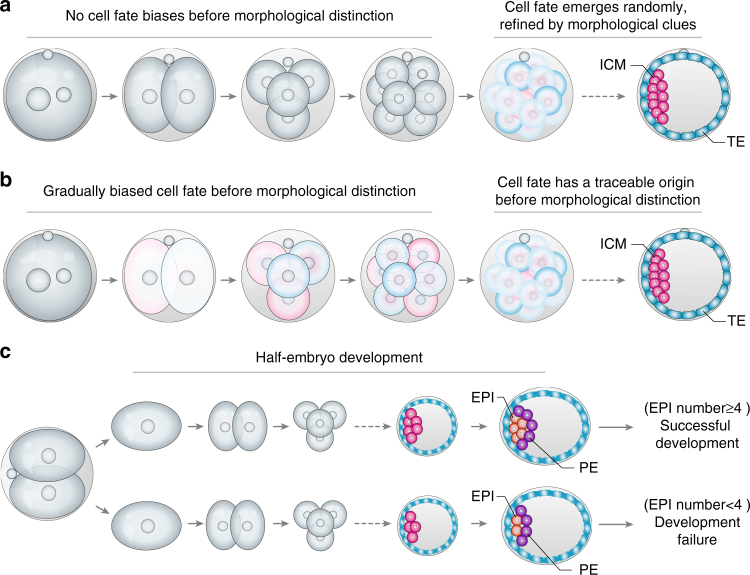
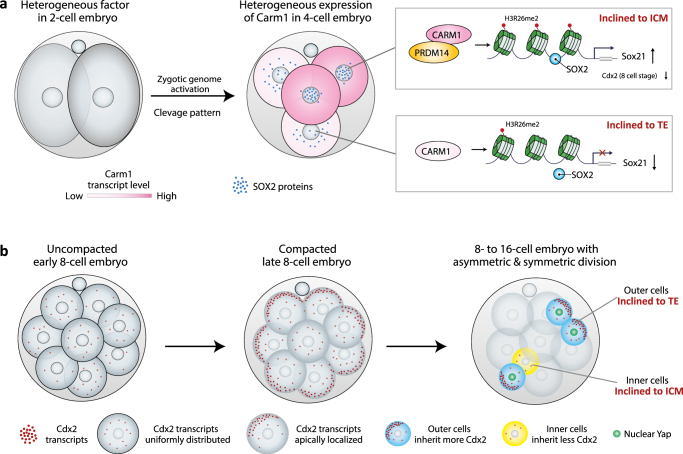
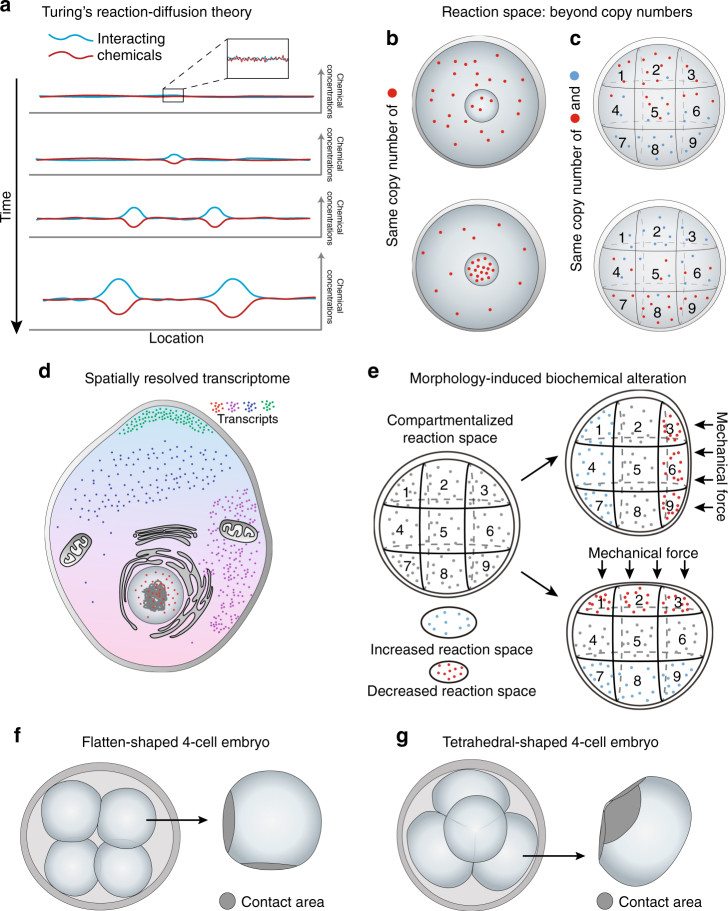
A fundamental question in developmental and stem cell biology concerns the origin and nature of signals that initiate asymmetry leading to pattern formation and self-organization. Instead of having prominent pre-patterning determinants as present in model organisms (worms, sea urchin, frog), we propose that the mammalian embryo takes advantage of more subtle cues such as compartmentalized intracellular reactions that generate micro-scale inhomogeneity, which is gradually amplified over several cellular generations to drive pattern formation while keeping developmental plasticity. It is therefore possible that by making use of compartmentalized information followed by its amplification, mammalian embryos would follow general principle of development found in other organisms in which the spatial cue is more robustly presented.
发育和干细胞生物学中的一个基本问题是,启动不对称性的信号的起源和性质,而这种不对称性导致了模式形成和自组织。与模型生物(蠕虫、海胆、青蛙)中存在的明显的预模式决定因素不同,我们提出哺乳动物胚胎利用更微妙的线索,如分隔的细胞内反应,产生微尺度的不均匀性,这种不均匀性在几个细胞世代中逐渐放大,以驱动模式形成,同时保持发育可塑性。因此,通过利用分隔的信息及其放大,哺乳动物胚胎可能遵循在其他生物体中发现的一般发育原则,其中空间线索更为突出。