National Engineering Laboratory for Digital and Material Technology of Stomatology, Peking University School and Hospital of Stomatology, 22 Zhongguancun Avenue South, Haidian District, Beijing, 100081, P. R. China.
Center of Digital Dentistry, Peking University School and Hospital of Stomatology, 22 Zhongguancun Avenue South, Haidian District, Beijing, 100081, P. R. China.
Sci Rep. 2018 May 8;8(1):7219. doi: 10.1038/s41598-018-24195-4.
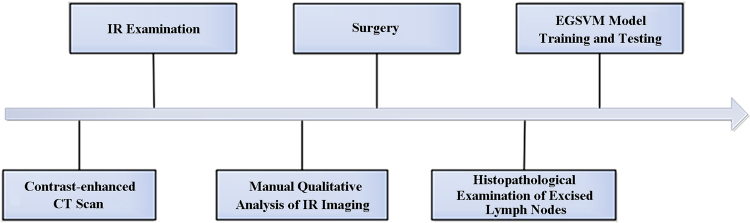
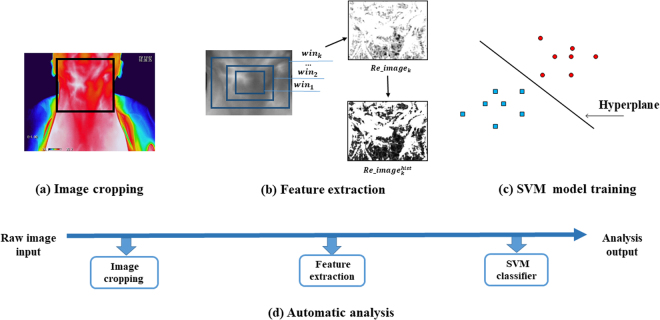
This study aimed to evaluate the diagnostic performance of a non-radiating, noninvasive infrared (IR) thermal imaging system in the detection of cervical lymph node metastasis from oral cavity cancer. In this prospective clinical trial, a total of 90 oral cavity cancer patients suspected of having cervical lymph node metastasis underwent IR imaging of the neck prior to neck dissection. Analysis of the IR images was performed by two methods: manual qualitative analysis and automatic analysis by an entropy-gradient support vector machine (EGSVM). The efficacies of the EGSVM-based infrared thermal imaging system and contrast-enhanced computed tomography (CT) were compared by using the Noninferiority Testing. Compared with manual qualitative analysis, the EGSVM-based automatic analysis had a higher sensitivity (84.8% vs. 71.7%), specificity (77.3% vs. 72.7%), accuracy (81.1% vs. 72.2%), positive predictive value (79.6% vs. 73.3%) and negative predictive value (82.9% vs. 71.1%). The EGSVM-based infrared thermal imaging system was noninferior to contrast-enhanced CT (P < 0.05). The EGSVM-based infrared thermal imaging system showed a trend of higher sensitivity, whereas contrast-enhanced CT showed a trend of higher specificity. The EGSVM-based infrared thermal imaging system is a promising non-radiating, noninvasive tool for the detection of lymph node metastasis from oral cavity cancer.
本研究旨在评估一种无辐射、无创的红外(IR)热成像系统在检测口腔癌颈部淋巴结转移中的诊断性能。在这项前瞻性临床试验中,共 90 例疑似颈部淋巴结转移的口腔癌患者在颈淋巴结清扫术前行颈部 IR 成像。通过两种方法(手动定性分析和熵梯度支持向量机(EGSVM)自动分析)对 IR 图像进行分析。通过非劣效性检验比较 EGSVM 基础红外热成像系统和增强 CT 的疗效。与手动定性分析相比,基于 EGSVM 的自动分析具有更高的灵敏度(84.8% vs. 71.7%)、特异性(77.3% vs. 72.7%)、准确性(81.1% vs. 72.2%)、阳性预测值(79.6% vs. 73.3%)和阴性预测值(82.9% vs. 71.1%)。EGSVM 基础红外热成像系统与增强 CT 相比无差异(P<0.05)。基于 EGSVM 的红外热成像系统显示出更高灵敏度的趋势,而增强 CT 则显示出更高特异性的趋势。EGSVM 基础红外热成像系统是一种有前途的无辐射、无创工具,可用于检测口腔癌的淋巴结转移。