Santos Valéria Regina Cavalcante Dos, Meis Juliana de, Savino Wilson, Andrade Jorge Alberto Azevedo, Vieira José Ricardo Dos Santos, Coura José Rodrigues, Junqueira Angela Cristina Verissimo
Secretaria de Estado de Saúde do Pará, Belém, PA, Brasil.
Laboratório de Pesquisas sobre o Timo, Instituto Oswaldo Cruz, Fundação Oswaldo Cruz-Fiocruz, Rio de Janeiro, RJ, Brasil.
Mem Inst Oswaldo Cruz. 2018;113(5):e170298. doi: 10.1590/0074-02760170298. Epub 2018 May 7.
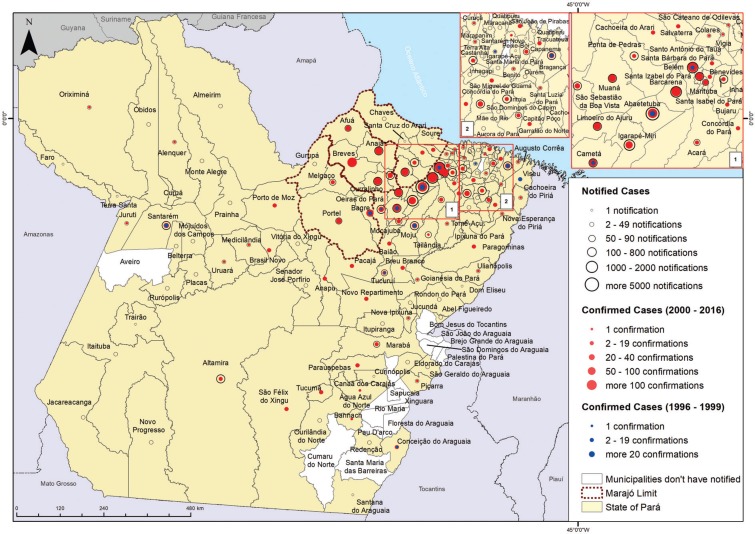
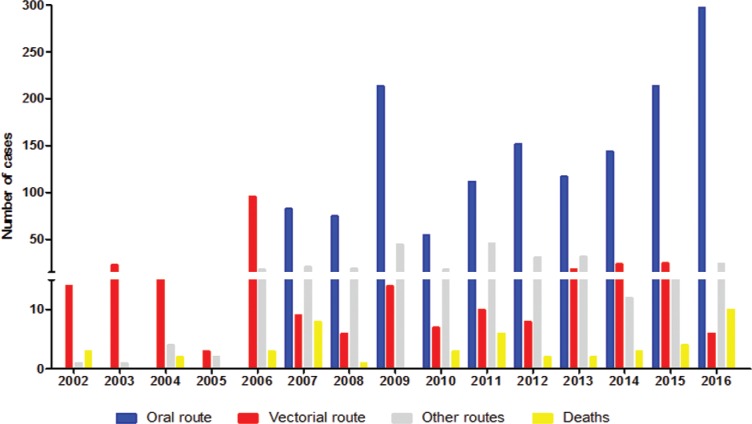
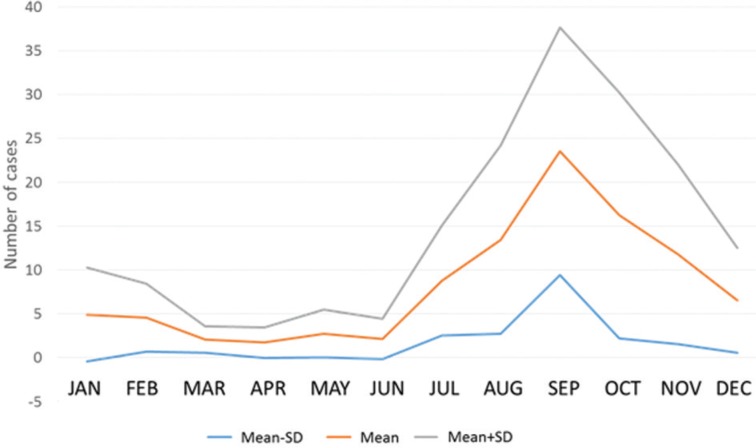
Acute Chagas disease (ACD) has a distinct epidemiological profile in the Amazon Region, with cases and outbreaks of Trypanosoma cruzi infection being possibly related to the ingestion of contaminated food. Data on ACD in the state of Pará retrieved from 2000 to 2016 from the Brazilian Notifiable Diseases Information System (SINAN) were evaluated. During this period, 2,030 of the 16,807 reported cases were confirmed, with a higher incidence between the months of August and December, thus characterising a seasonal pattern of acute infection, and coinciding with the higher production of "açaí", one fruit likely involved in the oral transmission of the disease. Evaluation of the absolute numbers of confirmed ACD cases secondary to oral infection suggests that infection through this route increased during the 2010-2016 period, differing from what was recorded in terms of vectorial or other infection routes. These findings point to the need of intensifying strategies to prevent or substantially reduce oral transmission.
急性恰加斯病(ACD)在亚马逊地区具有独特的流行病学特征,克氏锥虫感染病例及疫情可能与摄入受污染食物有关。对2000年至2016年从巴西法定传染病信息系统(SINAN)检索到的帕拉州急性恰加斯病数据进行了评估。在此期间,报告的16807例病例中有2030例得到确诊,8月至12月发病率较高,从而呈现出急性感染的季节性模式,且与“阿萨伊果”产量较高的时期相符,阿萨伊果是可能参与该病经口传播的一种水果。对经口感染继发的确诊急性恰加斯病病例绝对数的评估表明,2010 - 2016年期间通过该途径的感染有所增加,这与通过媒介或其他感染途径的记录情况不同。这些发现表明需要加强预防或大幅减少经口传播的策略。