Park Hyunsoo, Park Kyo Hoon, Kim Yu Mi, Kook Song Yi, Jeon Se Jeong, Yoo Ha-Na
Department of Obstetrics and Gynecology, Seoul National University College of Medicine, Seoul National University Bundang Hospital, 82, Gumi-ro 173 Beon-gil, Seongnamsi, Kyeonggido, 463-707, Korea.
Center for High-risk Pregnancy and Neonate, Seoul National University Bundang Hospital, Seongnam, Korea.
BMC Pregnancy Childbirth. 2018 May 9;18(1):146. doi: 10.1186/s12884-018-1780-7.
We investigated whether various inflammatory and immune proteins in plasma predict intra-amniotic infection and imminent preterm delivery in women with preterm labor and compared their predictive ability with that of amniotic fluid (AF) interleukin (IL)-6 and serum C-reactive protein (CRP).
This retrospective cohort study included 173 consecutive women with preterm labor who underwent amniocentesis for diagnosis of infection and/or inflammation in the AF. The AF was cultured, and assayed for IL-6. CRP levels and cervical length by transvaginal ultrasound were measured at the time of amniocentesis. The stored maternal plasma was assayed for IL-6, matrix metalloproteinase (MMP)-9, and complements C3a and C5a using ELISA kits. The primary and secondary outcome criteria were positive AF cultures and spontaneous preterm delivery (SPTD) within 48 h, respectively. Univariate, multivariate, and receiver operating characteristic analysis were used for the statistical analysis.
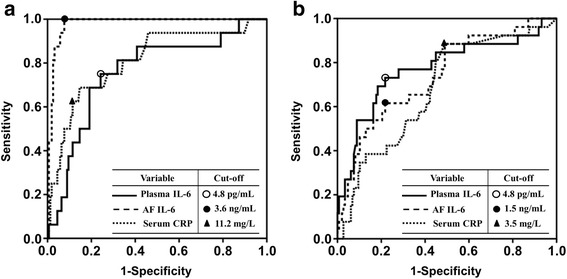
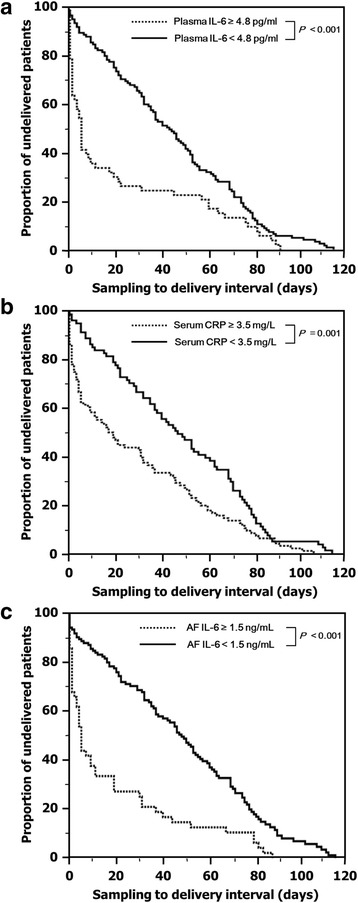
In bivariate analyses, elevated plasma IL-6 level was significantly associated with intra-amniotic infection and imminent preterm delivery, whereas elevated plasma levels of MMP-9, C3a, and C5a were not associated with these two outcomes. On multivariate analyses, an elevated plasma IL-6 level was significantly associated with intra-amniotic infection and imminent preterm delivery after adjusting for confounders, including high serum CRP levels and short cervical length. In predicting intra-amniotic infection, the area under the curve (AUC) was significantly lower for plasma IL-6 than for AF IL-6 but was similar to that for serum CRP. Differences in the AUCs between plasma IL-6, AF IL-6, and serum CRP were not statistically significant in predicting imminent preterm delivery.
Maternal plasma IL-6 independently predicts intra-amniotic infection in women with preterm labor; however, it has worse diagnostic performance than that of AF IL-6 and similar performance to that of serum CRP. To predict imminent preterm delivery, plasma IL-6 had an overall diagnostic performance similar to that of AF IL-6 and serum CRP. Plasma MMP-9, C3a, and C5a levels could not predict intra-amniotic infection or imminent preterm delivery.
我们研究了血浆中的各种炎症和免疫蛋白是否能预测早产妇女的羊膜腔内感染和即将发生的早产,并将它们的预测能力与羊水(AF)白细胞介素(IL)-6和血清C反应蛋白(CRP)的预测能力进行比较。
这项回顾性队列研究纳入了173例连续的早产妇女,她们接受了羊膜腔穿刺术以诊断羊水中的感染和/或炎症。对羊水进行培养,并检测其中IL-6的含量。在羊膜腔穿刺时,通过经阴道超声测量CRP水平和宫颈长度。使用酶联免疫吸附测定试剂盒检测储存的孕妇血浆中的IL-6、基质金属蛋白酶(MMP)-9以及补体C3a和C5a。主要和次要结局标准分别为羊水培养阳性和48小时内自发早产(SPTD)。采用单因素、多因素和受试者工作特征分析进行统计分析。
在双变量分析中,血浆IL-6水平升高与羊膜腔内感染和即将发生的早产显著相关,而血浆MMP-9、C3a和C5a水平升高与这两个结局无关。在多变量分析中,在调整包括高血清CRP水平和短宫颈长度等混杂因素后,血浆IL-6水平升高与羊膜腔内感染和即将发生的早产显著相关。在预测羊膜腔内感染方面,血浆IL-6的曲线下面积(AUC)显著低于羊水IL-6,但与血清CRP的相似。在预测即将发生的早产方面,血浆IL-6与羊水IL-6和血清CRP之间的AUC差异无统计学意义。
孕妇血浆IL-6可独立预测早产妇女的羊膜腔内感染;然而,其诊断性能比羊水IL-6差,与血清CRP相似。在预测即将发生的早产方面,血浆IL-6的总体诊断性能与羊水IL-6和血清CRP相似。血浆MMP-9、C3a和C5a水平无法预测羊膜腔内感染或即将发生的早产。