Department of Psychiatry, University of California, San Diego, 9500 Gilman Drive, La Jolla, CA, 92093-0812, USA.
Child and Adolescent Services Research Center, 3020 Children's Way MC 5033, San Diego, CA, 92123, USA.
Implement Sci. 2018 May 9;13(1):66. doi: 10.1186/s13012-018-0757-2.
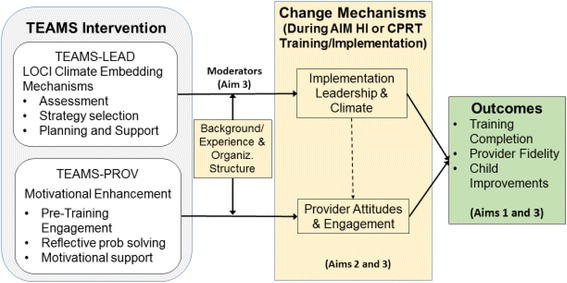
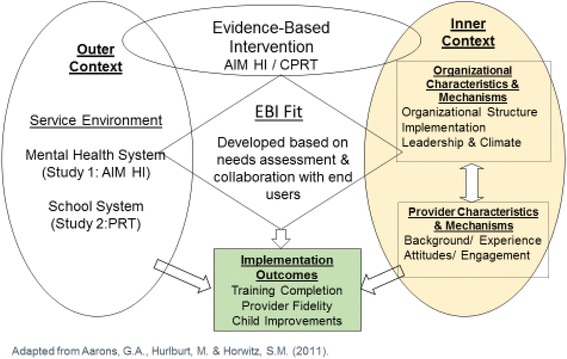
The Centers for Disease Control (2018) estimates that 1 in 59 children has autism spectrum disorder, and the annual cost of ASD in the U.S. is estimated to be $236 billion. Evidence-based interventions have been developed and demonstrate effectiveness in improving child outcomes. However, research on generalizable methods to scale up these practices in the multiple service systems caring for these children has been limited and is critical to meet this growing public health need. This project includes two, coordinated studies testing the effectiveness of the Translating Evidence-based Interventions (EBI) for ASD: Multi-Level Implementation Strategy (TEAMS) model. TEAMS focuses on improving implementation leadership, organizational climate, and provider attitudes and motivation in order to improve two key implementation outcomes-provider training completion and intervention fidelity and subsequent child outcomes. The TEAMS Leadership Institute applies implementation leadership strategies and TEAMS Individualized Provider Strategies for training applies motivational interviewing strategies to facilitate provider and organizational behavior change.
A cluster randomized implementation/effectiveness Hybrid, type 3, trial with a dismantling design will be used to understand the effectiveness of TEAMS and the mechanisms of change across settings and participants. Study #1 will test the TEAMS model with AIM HI (An Individualized Mental Health Intervention for ASD) in publicly funded mental health services. Study #2 will test TEAMS with CPRT (Classroom Pivotal Response Teaching) in education settings. Thirty-seven mental health programs and 37 school districts will be randomized, stratified by county and study, to one of four groups (Standard Provider Training Only, Standard Provider Training + Leader Training, Enhanced Provider Training, Enhanced Provider Training + Leader Training) to test the effectiveness of combining standard, EBI-specific training with the two TEAMS modules individually and together on multiple implementation outcomes. Implementation outcomes including provider training completion, fidelity (coded by observers blind to group assignment) and child behavior change will be examined for 295 mental health providers, 295 teachers, and 590 children.
This implementation intervention has the potential to increase quality of care for ASD in publicly funded settings by improving effectiveness of intervention implementation. The process and modules will be generalizable to multiple service systems, providers, and interventions, providing broad impact in community services.
This study is registered with Clinicaltrials.gov ( NCT03380078 ). Registered 20 December 2017, retrospectively registered.
疾病控制中心(2018 年)估计,每 59 名儿童中就有 1 名患有自闭症谱系障碍,美国自闭症谱系障碍的年治疗费用估计为 2360 亿美元。已经开发出循证干预措施,并证明其在改善儿童预后方面的有效性。然而,关于在照顾这些儿童的多个服务系统中推广这些实践的可推广方法的研究一直很有限,这对于满足这一日益增长的公共卫生需求至关重要。该项目包括两项协调研究,旨在测试自闭症谱系障碍的循证干预措施(EBI)的有效性:多层次实施策略(TEAMS)模型。TEAMS 专注于提高实施领导力、组织氛围以及服务提供者的态度和动机,以改善两个关键的实施结果——服务提供者培训完成率以及干预的保真度和后续儿童的结果。TEAMS 领导力学院应用实施领导力策略,而 TEAMS 个性化提供者策略则应用动机性访谈策略来促进服务提供者和组织行为的改变。
采用集群随机实施/有效性混合式、3 型、拆卸设计试验,以了解 TEAMS 在不同环境和参与者中的有效性和变化机制。研究#1 将在公共资助的心理健康服务中测试针对自闭症的个体化心理干预(AIM HI)的 TEAMS 模型。研究#2 将在教育环境中测试 TEAMS 与课堂关键反应教学(CPRT)。37 个心理健康项目和 37 个学区将按县和研究进行随机分层,分为四组之一(仅标准提供者培训、标准提供者培训+领导者培训、增强型提供者培训、增强型提供者培训+领导者培训),以测试将标准的、EBI 特定的培训与两个 TEAMS 模块单独和一起结合在多个实施结果上的效果。将对 295 名心理健康服务提供者、295 名教师和 590 名儿童进行实施结果的评估,包括提供者培训完成情况、保真度(由对分组分配不知情的观察员进行编码)和儿童行为改变。
这种实施干预措施有可能通过提高干预措施实施的有效性,增加在公共资助环境中对自闭症的护理质量。该过程和模块将可推广到多个服务系统、提供者和干预措施,从而在社区服务中产生广泛影响。
本研究在 Clinicaltrials.gov 注册(NCT03380078)。于 2017 年 12 月 20 日注册,回溯性注册。