Department of Chemical Engineering, Indian Institute of Science, Bangalore, Karnataka, India.
Centre for Biosystems Science and Engineering, Indian Institute of Science, Bangalore, Karnataka, India.
Immunol Cell Biol. 2018 Oct;96(9):969-980. doi: 10.1111/imcb.12161. Epub 2018 Jun 5.
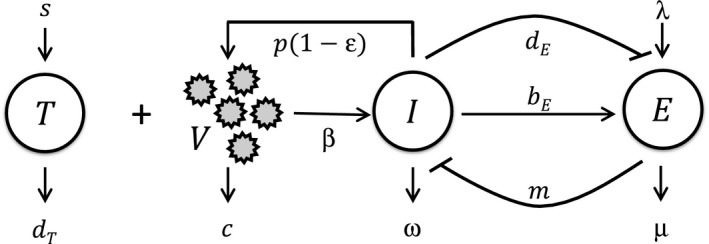
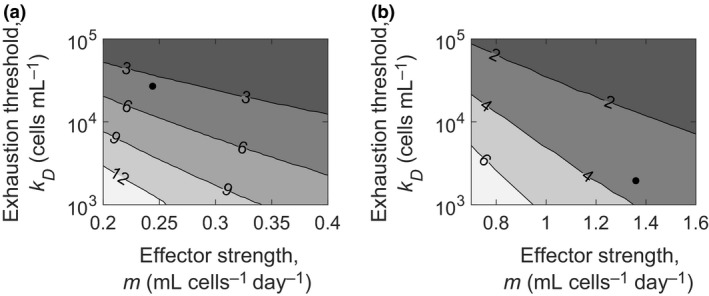
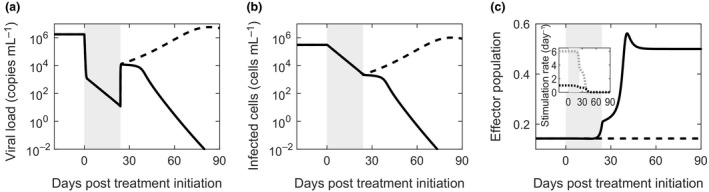
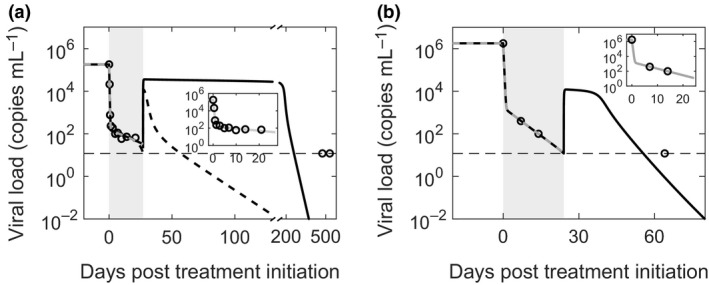
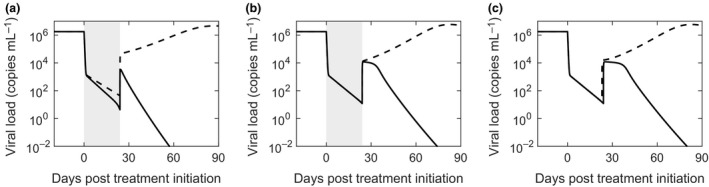
A fraction of chronic hepatitis C patients treated with direct-acting antivirals (DAAs) achieved sustained virological responses (SVR), or cure, despite having detectable viremia at the end of treatment (EOT). This observation, termed EOT /SVR, remains puzzling and precludes rational optimization of treatment durations. One hypothesis to explain EOT /SVR, the immunologic hypothesis, argues that the viral decline induced by DAAs during treatment reverses the exhaustion of cytotoxic T lymphocytes (CTLs), which then clear the infection after treatment. Whether the hypothesis is consistent with data of viral load changes in patients who experienced EOT /SVR is unknown. Here, we constructed a mathematical model of viral kinetics incorporating the immunologic hypothesis and compared its predictions with patient data. We found the predictions to be in quantitative agreement with patient data. Using the model, we unraveled an underlying bistability that gives rise to EOT /SVR and presents a new avenue to optimize treatment durations. Infected cells trigger both activation and exhaustion of CTLs. CTLs in turn kill infected cells. Due to these competing interactions, two stable steady states, chronic infection and viral clearance, emerge, separated by an unstable steady state with intermediate viremia. When treatment during chronic infection drives viremia sufficiently below the unstable state, spontaneous viral clearance results post-treatment, marking EOT /SVR. The duration to achieve this desired reduction in viremia defines the minimum treatment duration required for ensuring SVR, which our model can quantify. Estimating parameters defining the CTL response of individuals to HCV infection would enable the application of our model to personalize treatment durations.
尽管在治疗结束时(EOT)检测到病毒血症,但接受直接作用抗病毒药物(DAA)治疗的慢性丙型肝炎患者中有一部分实现了持续病毒学应答(SVR)或治愈。这种观察结果,称为 EOT/SVR,仍然令人费解,并且妨碍了治疗持续时间的合理优化。一种解释 EOT/SVR 的假设,免疫假说,认为 DAA 在治疗期间诱导的病毒下降逆转了细胞毒性 T 淋巴细胞(CTL)的耗竭,然后在治疗后清除感染。该假设是否与经历 EOT/SVR 的患者的病毒载量变化数据一致尚不清楚。在这里,我们构建了一个包含免疫假说的病毒动力学数学模型,并将其预测与患者数据进行了比较。我们发现预测与患者数据定量一致。使用该模型,我们揭示了一种潜在的双稳定性,导致 EOT/SVR,并为优化治疗持续时间提供了新的途径。受感染的细胞触发 CTL 的激活和耗竭。CTL 反过来又杀死受感染的细胞。由于这些竞争相互作用,出现了两种稳定的稳态,慢性感染和病毒清除,由具有中间病毒血症的不稳定稳态隔开。当慢性感染期间的治疗使病毒血症足够低于不稳定状态时,治疗后会自发发生病毒清除,标志着 EOT/SVR。实现这种所需病毒血症降低的持续时间定义了确保 SVR 所需的最短治疗持续时间,我们的模型可以量化该持续时间。估计定义个体对 HCV 感染的 CTL 反应的参数将使我们的模型能够个性化治疗持续时间。