School of Public Health & Zoonoses, Guru Angad Dev Veterinary and Animal Sciences University, Ludhiana, Punjab, India.
School of Health Sciences, University of Thessaly, Karditsa, Greece.
PLoS Negl Trop Dis. 2018 May 10;12(5):e0006488. doi: 10.1371/journal.pntd.0006488. eCollection 2018 May.
Brucellosis is endemic in the bovine population in India and causes a loss of US$ 3·4 billion to the livestock industry besides having a significant human health impact.
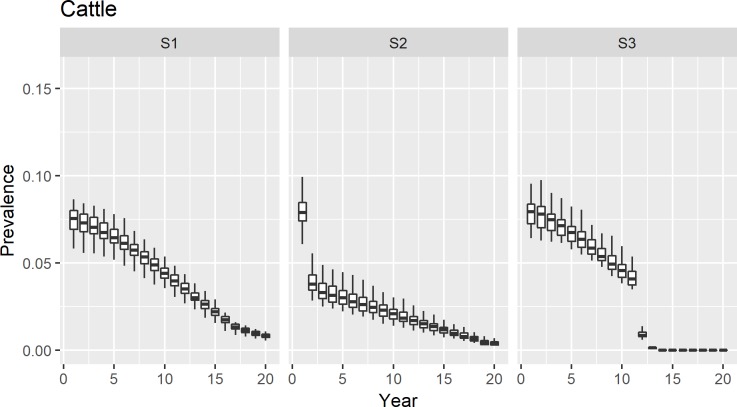
We developed a stochastic simulation model to estimate the impact of three alternative vaccination strategies on the prevalence of Brucella infection in the bovine populations in India for the next two decades: (a) annual mass vaccination only for the replacement calves and (b) vaccination of both the adult and young population at the beginning of the program followed by an annual vaccination of the replacement calves and, (c) annual mass vaccination of replacements for a decade followed by a decade of a test and slaughter strategy.
For all interventions, our results indicate that the prevalence of Brucella infection will drop below 2% in cattle and, below 3% in buffalo after 20 years of the implementation of a disease control program. For cattle, the Net Present Value (NPV) was found to be US $ 4·16 billion for intervention (a), US $ 8·31 billion for intervention (b) and, US $ 4·26 for intervention (c). For buffalo, the corresponding NPVs were US $ 8·77 billion, US $ 13·42 and, US $ 7·66, respectively. The benefit cost ratio (BCR) for the first, second and the third intervention for cattle were 7·98, 10·62 and, 3·16, respectively. Corresponding BCR estimates for buffalo were 17·81, 21·27 and, 3·79, respectively.
These results suggest that all interventions will be cost-effective with the intervention (b), i.e. the vaccination of replacements with mass vaccination at the beginning of the program, being the most cost-effective choice. Further, sensitivity analysis revealed that all interventions will be cost-effective even at the 50% of the current prevalence estimates. The results advocate for the implementation of a disease control program for brucellosis in India.
布氏杆菌病在印度牛群中流行,给畜牧业造成 34 亿美元的损失,同时对人类健康也有重大影响。
我们开发了一个随机模拟模型,以估计在未来二十年中印度牛群中三种替代疫苗接种策略对布鲁氏菌感染流行率的影响:(a)仅对替代牛犊进行年度大规模接种;(b)在项目开始时对成年牛和小牛进行接种,然后每年对替代牛犊进行接种;(c)对替代牛犊进行十年的年度大规模接种,然后进行十年的检测和扑杀策略。
对于所有干预措施,我们的结果表明,在疾病控制计划实施 20 年后,牛群中布鲁氏菌感染的流行率将降至 2%以下,水牛将降至 3%以下。对于牛,干预措施(a)的净现值(NPV)为 41.6 亿美元,干预措施(b)为 83.1 亿美元,干预措施(c)为 42.6 亿美元。对于水牛,相应的 NPV 分别为 87.7 亿美元、134.2 亿美元和 76.6 亿美元。牛的第一个、第二个和第三个干预措施的效益成本比(BCR)分别为 7.98、10.62 和 3.16。水牛的相应 BCR 估计值分别为 17.81、21.27 和 3.79。
这些结果表明,所有干预措施都将具有成本效益,其中干预措施(b),即在项目开始时大规模接种替代牛犊,是最具成本效益的选择。此外,敏感性分析表明,即使在当前流行率估计值的 50%的情况下,所有干预措施都将具有成本效益。这些结果支持在印度实施布鲁氏菌病控制计划。