Department of Integrative Neurophysiology, Center for Neurogenomics and Cognitive Research (CNCR), Amsterdam Neuroscience, VU Amsterdam, HV Amsterdam, Netherlands.
Vrije Universiteit (VU) Amsterdam, Department Computer Science, Amsterdam, Netherlands.
PLoS One. 2018 May 10;13(5):e0196907. doi: 10.1371/journal.pone.0196907. eCollection 2018.
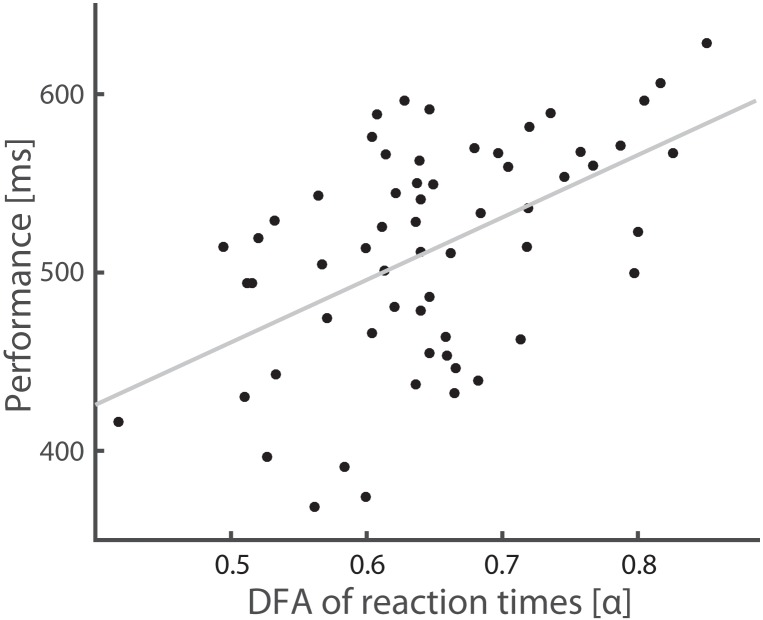
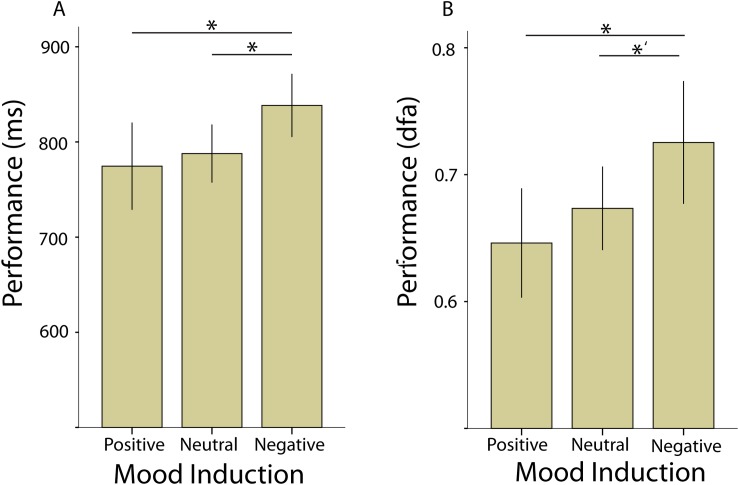
There is growing evidence that the intermittent nature of mind wandering episodes and mood have a pronounced influence on trial-to-trial variability in performance. Nevertheless, the temporal dynamics and significance of such lapses in attention remains inadequately understood. Here, we hypothesize that the dynamics of fluctuations in sustained attention between external and internal sources of information obey so-called critical-state dynamics, characterized by trial-to-trial dependencies with long-range temporal correlations. To test this, we performed behavioral investigations measuring reaction times in a visual sustained attention task and cued introspection in probe-caught reports of mind wandering. We show that trial-to-trial variability in reaction times exhibit long-range temporal correlations in agreement with the criticality hypothesis. Interestingly, we observed the fastest responses in subjects with the weakest long-range temporal correlations and show the vital effect of mind wandering and bad mood on this response variability. The implications of these results stress the importance of future research to increase focus on behavioral variability.
越来越多的证据表明,思维漫游片段的间歇性和情绪对试验间表现的可变性有显著影响。然而,注意力这种短暂丧失的时间动态和意义仍未得到充分理解。在这里,我们假设在外部和内部信息源之间的持续注意力波动的动态遵循所谓的临界状态动力学,其特征是具有长程时间相关性的试验间依赖性。为了检验这一点,我们进行了行为研究,测量了在视觉持续注意力任务中的反应时间,并在思维漫游的探测捕获报告中提示内省。我们表明,反应时间的试验间可变性与临界假设一致,表现出长程时间相关性。有趣的是,我们在具有最弱长程时间相关性的受试者中观察到最快的反应,并表明思维漫游和不良情绪对这种反应可变性的重要影响。这些结果的意义强调了未来研究增加对行为可变性的关注的重要性。