Mousleh Rama, Al Laham Shaza, Al-Manadili Ahmad
Departmentof Pharmacology and Toxicology, Faculty of Pharmacy, Damascus University, Damascus, Syria.
Departmentof Oral Histopathology, Faculty of Dentistry, Damascus University, Damascus, Syria.
Iran J Med Sci. 2018 Mar;43(2):184-194.
Acute kidney injury is the most life-threatening complication of rhabdomyolysis. Glycerol is commonly used to induce this injury. The aim was to investigate the renoprotective effects of pioglitazone and the possible advantage of administering the drug for a longer period.
Twenty-four male Albino Wistar rats were randomly divided into 4 groups (n=6/group): (A) control, (B) glycerol (50%, 10 mL/kg intramuscularly), (C) glycerol+pioglitazone (10 mg/kg orally for 3 days), and (D) glycerol+pioglitazone (for 6 days). Serum urea and creatinine levels were measured to assess the renal function. Reduced glutathione (GSH) levels and histological alterations were also measured. Statistical analysis was performed using Prism (version 6). The numerical data were evaluated by ANOVA, followed by the Tukey tests. The categorical data were evaluated by the Mann-Whitney test and the Fisher exact tests. P<0.05 was considered significant.
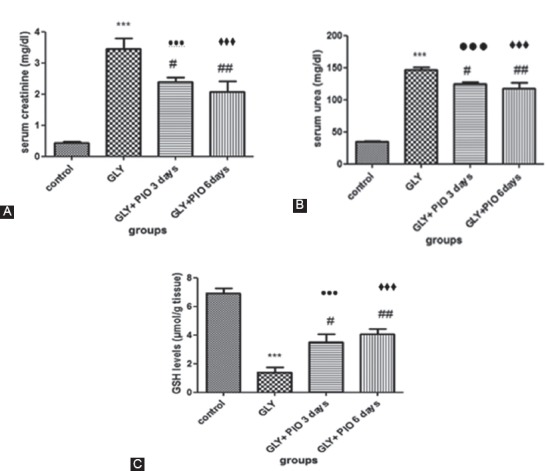
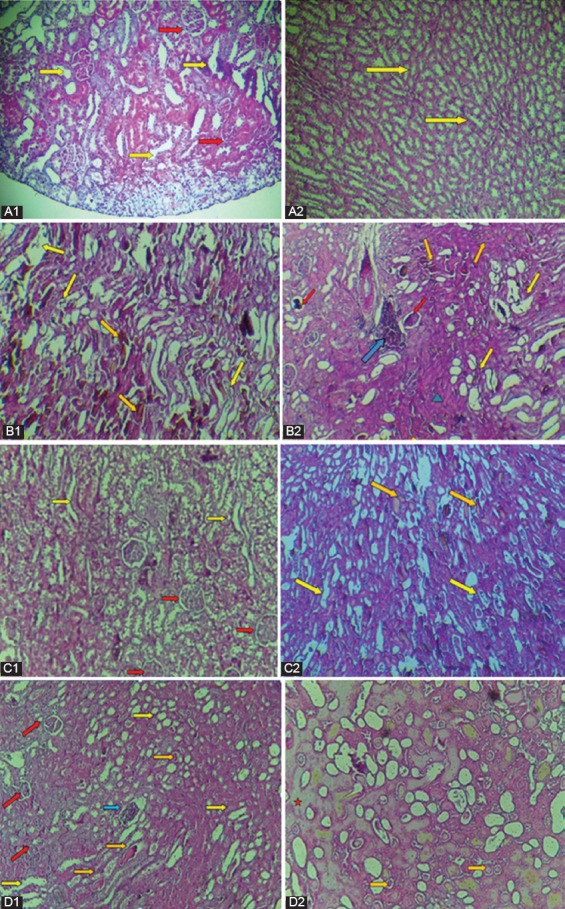
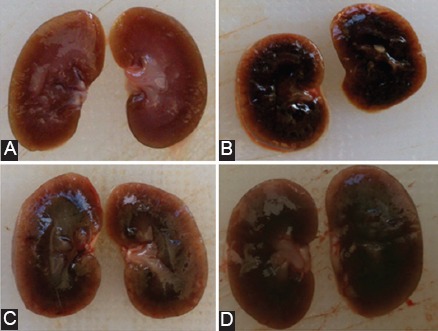
In the glycerol-injected rats, the serum urea and creatinine levels were increased (P<0.001), while the GSH levels were decreased (P<0.001) compared to Group A. The nephrotoxicity showed significant tubular (P=0.01) and glomerular (P=0.02) injuries. In the pioglitazone-treated rats, the changes in the serum biomarkers and in the GSH levels were reversed in Group C (P=0.01) and in Group D (P=0.01). The microscopic examinations of the kidneys also showed some improvement. No obvious statistically significant difference was found between these 2 preventive groups in most studied features.
These results indicate that pioglitazone might have nephroprotective effects in this injury model. Pioglitazone succeeded in producing this effect within 3 days. Doubling the drug administration period did not produce any significant superior benefit.
急性肾损伤是横纹肌溶解最危及生命的并发症。甘油常用于诱导这种损伤。本研究旨在探讨吡格列酮的肾脏保护作用以及延长给药时间的潜在优势。
将24只雄性白化Wistar大鼠随机分为4组(每组n = 6):(A)对照组,(B)甘油组(50%,10 mL/kg肌肉注射),(C)甘油+吡格列酮组(10 mg/kg口服,共3天),以及(D)甘油+吡格列酮组(共6天)。检测血清尿素和肌酐水平以评估肾功能。同时检测还原型谷胱甘肽(GSH)水平和组织学改变。使用Prism(6版)进行统计分析。数值数据采用方差分析,随后进行Tukey检验。分类数据采用Mann-Whitney检验和Fisher精确检验。P < 0.05被认为具有统计学意义。
与A组相比,注射甘油的大鼠血清尿素和肌酐水平升高(P < 0.001),而GSH水平降低(P < 0.001)。肾毒性表现为明显的肾小管损伤(P = 0.01)和肾小球损伤(P = 0.02)。在吡格列酮治疗的大鼠中,C组(P = 0.01)和D组(P = 0.01)血清生物标志物和GSH水平的变化得到逆转。肾脏的显微镜检查也显示出一定改善。在大多数研究特征方面,这两个预防组之间未发现明显的统计学显著差异。
这些结果表明吡格列酮在该损伤模型中可能具有肾脏保护作用。吡格列酮在3天内成功产生了这种效果。将药物给药时间加倍并未产生任何显著的额外益处。