Durães Fernando, Pinto Madalena, Sousa Emília
Laboratory of Organic and Pharmaceutical Chemistry, Department of Chemical Sciences, Faculty of Pharmacy, University of Porto, Rua Jorge Viterbo Ferreira, 228, 4050-313 Porto, Portugal.
CIIMAR, Interdisciplinary Center of Marine and Environmental Research, University of Porto, Terminal de Cruzeiros do Porto de Leixões, Avenida General Norton de Matos P, 4450-208 Matosinhos, Portugal.
Pharmaceuticals (Basel). 2018 May 11;11(2):44. doi: 10.3390/ph11020044.
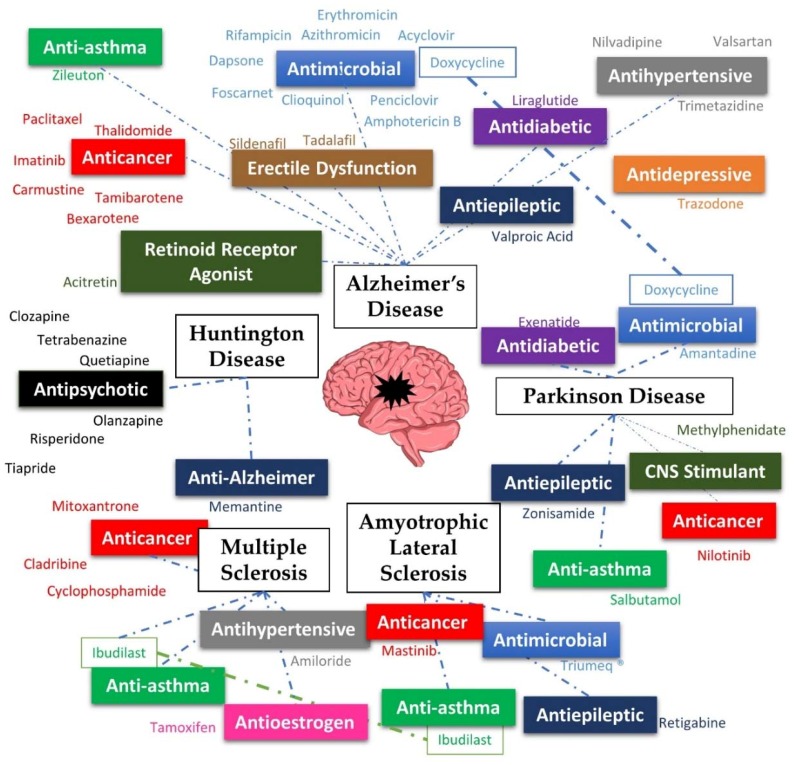
Neurodegenerative diseases are increasing in number, given that the general global population is becoming older. They manifest themselves through mechanisms that are not fully understood, in many cases, and impair memory, cognition and movement. Currently, no neurodegenerative disease is curable, and the treatments available only manage the symptoms or halt the progression of the disease. Therefore, there is an urgent need for new treatments for this kind of disease, since the World Health Organization has predicted that neurodegenerative diseases affecting motor function will become the second-most prevalent cause of death in the next 20 years. New therapies can come from three main sources: synthesis, natural products, and existing drugs. This last source is known as drug repurposing, which is the most advantageous, since the drug’s pharmacokinetic and pharmacodynamic profiles are already established, and the investment put into this strategy is not as significant as for the classic development of new drugs. There have been several studies on the potential of old drugs for the most relevant neurodegenerative diseases, including Alzheimer’s disease, Parkinson’s disease, Huntington’s disease, Multiple Sclerosis and Amyotrophic Lateral Sclerosis.
鉴于全球人口老龄化,神经退行性疾病的数量正在增加。在许多情况下,它们通过尚未完全了解的机制表现出来,并损害记忆、认知和运动能力。目前,尚无神经退行性疾病可治愈,现有的治疗方法只能控制症状或延缓疾病进展。因此,迫切需要针对这类疾病的新治疗方法,因为世界卫生组织预测,影响运动功能的神经退行性疾病将在未来20年成为第二大常见死因。新疗法主要有三个来源:合成、天然产物和现有药物。最后一个来源被称为药物重新利用,这是最具优势的,因为药物的药代动力学和药效学特征已经确定,并且投入到该策略的投资不像新药的经典开发那样巨大。已经有几项关于旧药治疗最相关神经退行性疾病潜力的研究,包括阿尔茨海默病、帕金森病、亨廷顿病、多发性硬化症和肌萎缩侧索硬化症。