Department of Biomedical Engineering, King's College London, London, United Kingdom.
Department of Biomedical Engineering, King's College London, London, United Kingdom.
Med Image Anal. 2018 Jul;47:180-190. doi: 10.1016/j.media.2018.04.001. Epub 2018 Apr 5.
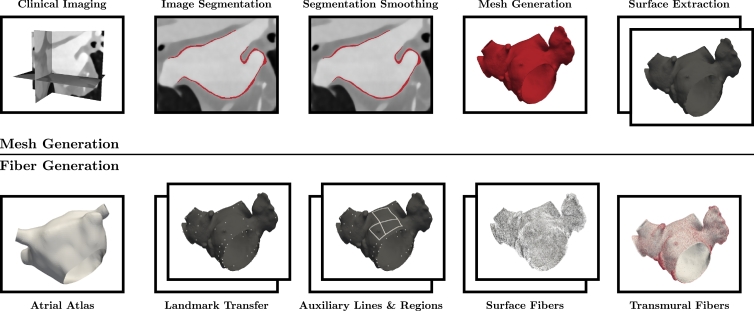
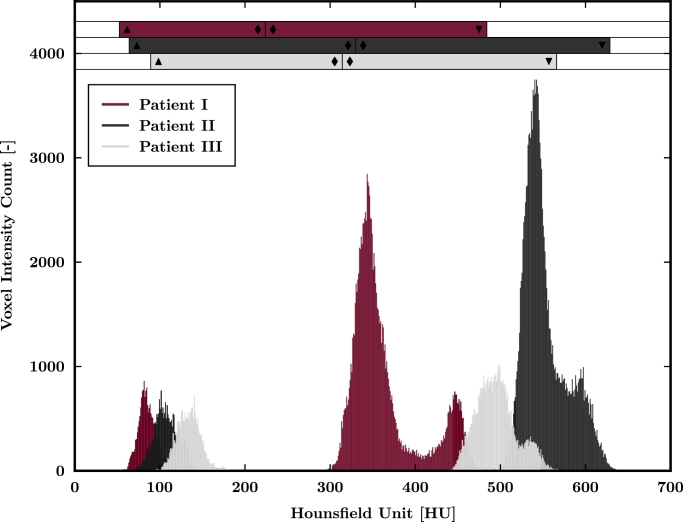
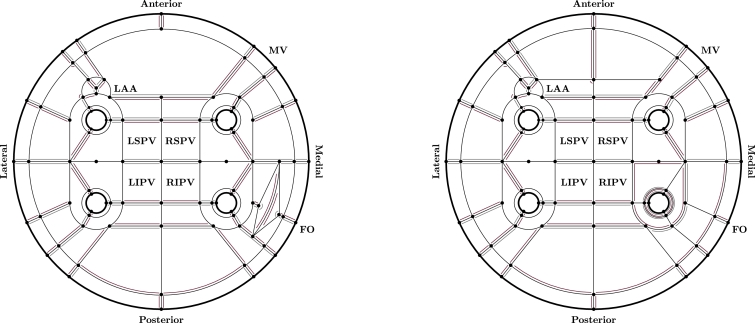
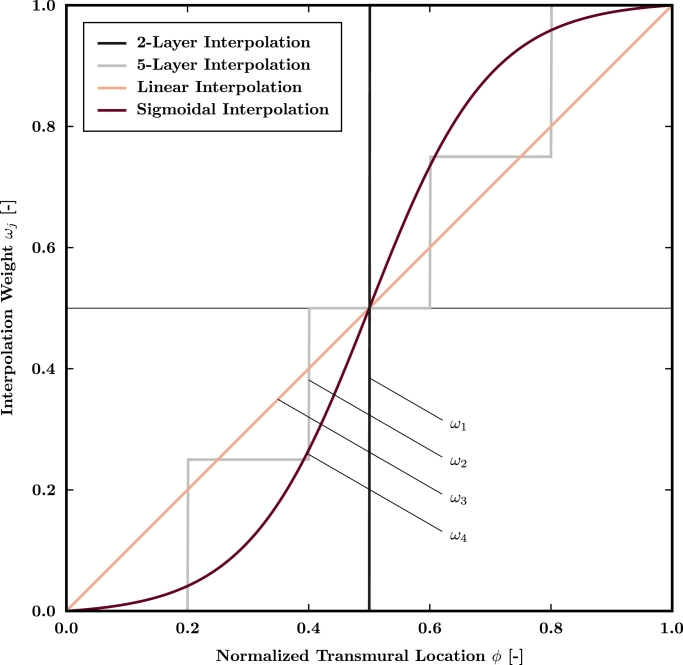
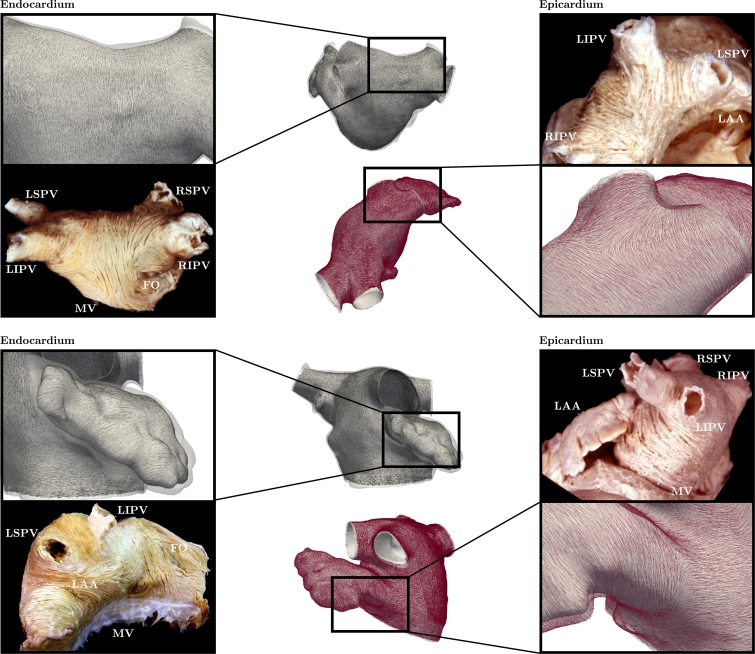
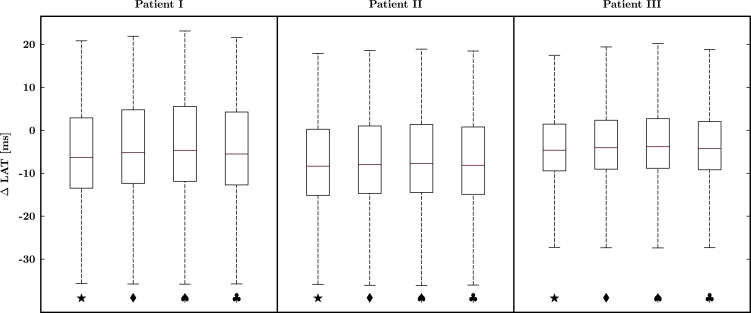
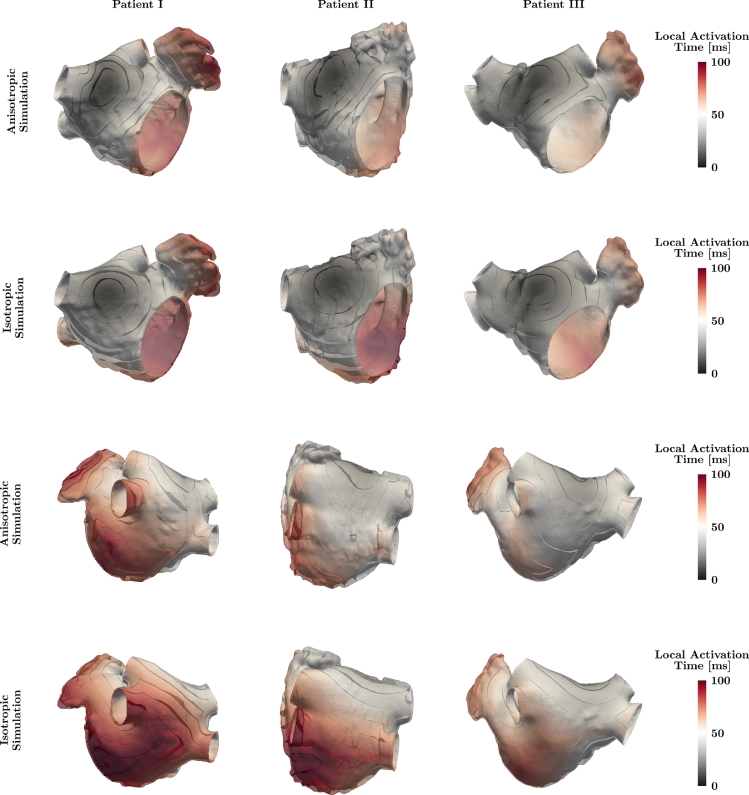
Atrial fibrillation (AF) is a supraventricular tachyarrhythmia characterized by complete absence of coordinated atrial contraction and is associated with an increased morbidity and mortality. Personalized computational modeling provides a novel framework for integrating and interpreting the role of atrial electrophysiology (EP) including the underlying anatomy and microstructure in the development and sustenance of AF. Coronary computed tomography angiography data were segmented using a statistics-based approach and the smoothed voxel representations were discretized into high-resolution tetrahedral finite element (FE) meshes. To estimate the complex left atrial myofiber architecture, individual fiber fields were generated according to morphological data on the endo- and epicardial surfaces based on local solutions of Laplace's equation and transmurally interpolated to tetrahedral elements. The influence of variable transmural microstructures was quantified through EP simulations on 3 patients using 5 different fiber interpolation functions. Personalized geometrical models included the heterogeneous thickness distribution of the left atrial myocardium and subsequent discretization led to high-fidelity tetrahedral FE meshes. The novel algorithm for automated incorporation of the left atrial fiber architecture provided a realistic estimate of the atrial microstructure and was able to qualitatively capture all important fiber bundles. Consistent maximum local activation times were predicted in EP simulations using individual transmural fiber interpolation functions for each patient suggesting a negligible effect of the transmural myofiber architecture on EP. The established modeling pipeline provides a robust framework for the rapid development of personalized model cohorts accounting for detailed anatomy and microstructure and facilitates simulations of atrial EP.
心房颤动(AF)是一种表现为完全丧失心房协调收缩的室上性心动过速,与发病率和死亡率增加有关。个性化计算建模为整合和解释心房电生理(EP)的作用提供了一个新的框架,包括 AF 发生和维持的潜在解剖结构和微观结构。采用基于统计学的方法对冠状动脉计算机断层血管造影数据进行分割,并将平滑体素表示离散化为高分辨率四面体有限元(FE)网格。为了估计复杂的左心房心肌纤维结构,根据心内膜和心外膜表面的形态数据,根据拉普拉斯方程的局部解生成个体纤维场,并穿过壁内插值到四面体元素。通过对 3 名患者使用 5 种不同的纤维插值函数进行 EP 模拟,量化了可变的壁内微观结构的影响。个性化几何模型包括左心房心肌的不均匀厚度分布,随后的离散化导致了高保真四面体 FE 网格。用于自动纳入左心房纤维结构的新算法提供了心房微观结构的真实估计,并能够定性地捕获所有重要的纤维束。使用每个患者的个体壁内纤维插值函数进行 EP 模拟预测了一致的最大局部激活时间,表明壁内心肌纤维结构对 EP 的影响可以忽略不计。所建立的建模流程为快速开发个性化模型队列提供了一个稳健的框架,该模型队列考虑了详细的解剖结构和微观结构,并有助于心房 EP 的模拟。