Fumagalli Ivan, Pagani Stefano, Vergara Christian, Dede' Luca, Adebo Dilachew A, Del Greco Maurizio, Frontera Antonio, Luciani Giovanni Battista, Pontone Gianluca, Scrofani Roberto, Quarteroni Alfio
MOX Laboratory, Department of Mathematics, Politecnico di Milano, Milan, Italy.
Laboratory of Biological Structures Mechanics (LaBS), Department of Chemistry, Materials and Chemical Engineering "Giulio Natta", Politecnico di Milano, Milan, Italy.
Transl Pediatr. 2024 Jan 29;13(1):146-163. doi: 10.21037/tp-23-184. Epub 2024 Jan 24.
Computational models of the cardiovascular system allow for a detailed and quantitative investigation of both physiological and pathological conditions, thanks to their ability to combine clinical-possibly patient-specific-data with physical knowledge of the processes underlying the heart function. These models have been increasingly employed in clinical practice to understand pathological mechanisms and their progression, design medical devices, support clinicians in improving therapies. Hinging upon a long-year experience in cardiovascular modeling, we have recently constructed a computational multi-physics and multi-scale integrated model of the heart for the investigation of its physiological function, the analysis of pathological conditions, and to support clinicians in both diagnosis and treatment planning. This narrative review aims to systematically discuss the role that such model had in addressing specific clinical questions, and how further impact of computational models on clinical practice are envisaged.
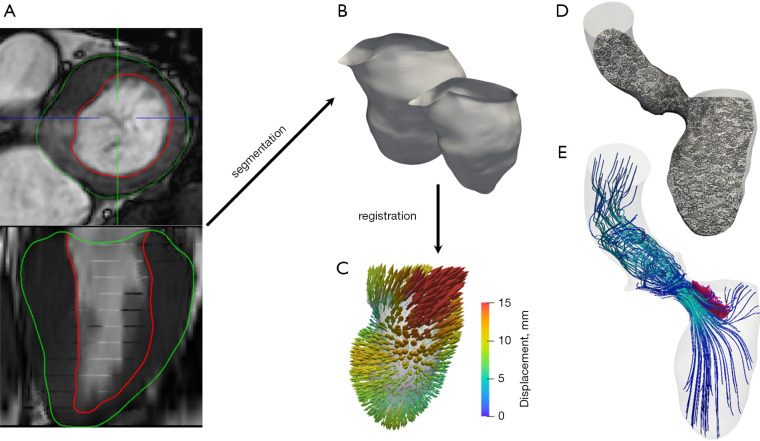
We developed computational models of the physical processes encompassed by the heart function (electrophysiology, electrical activation, force generation, mechanics, blood flow dynamics, valve dynamics, myocardial perfusion) and of their inherently strong coupling. To solve the equations of such models, we devised advanced numerical methods, implemented in a flexible and highly efficient software library. We also developed computational procedures for clinical data post-processing-like the reconstruction of the heart geometry and motion from diagnostic images-and for their integration into computational models.
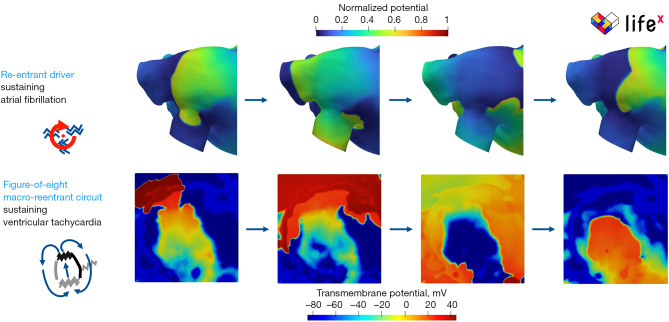
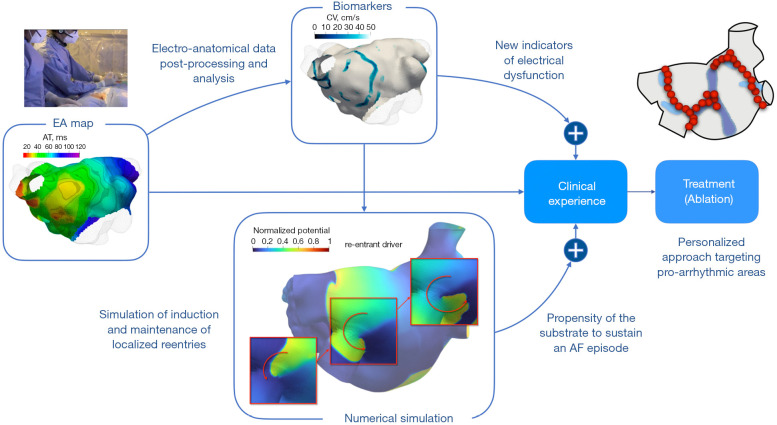
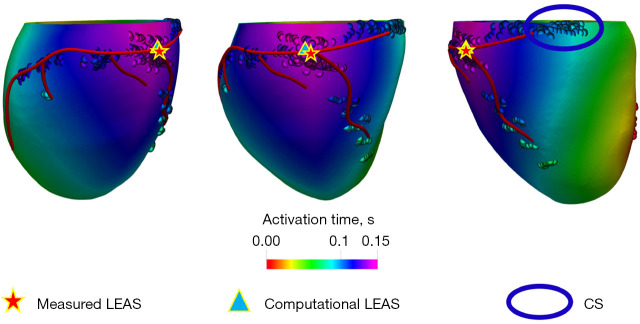
Our integrated computational model of the heart function provides non-invasive measures of indicators characterizing the heart function and dysfunctions, and sheds light on its underlying processes and their coupling. Moreover, thanks to the close collaboration with several clinical partners, we addressed specific clinical questions on pathological conditions, such as arrhythmias, ventricular dyssynchrony, hypertrophic cardiomyopathy, degeneration of prosthetic valves, and the way coronavirus disease 2019 (COVID-19) infection may affect the cardiac function. In multiple cases, we were also able to provide quantitative indications for treatment.
Computational models provide a quantitative and detailed tool to support clinicians in patient care, which can enhance the assessment of cardiac diseases, the prediction of the development of pathological conditions, and the planning of treatments and follow-up tests.
心血管系统的计算模型能够详细且定量地研究生理和病理状况,这得益于其将临床数据(可能是患者特异性数据)与心脏功能潜在过程的物理知识相结合的能力。这些模型在临床实践中越来越多地被用于理解病理机制及其进展、设计医疗设备以及辅助临床医生改进治疗方法。基于在心血管建模方面的多年经验,我们最近构建了一个心脏的计算多物理场和多尺度集成模型,用于研究其生理功能、分析病理状况,并在诊断和治疗规划方面为临床医生提供支持。本叙述性综述旨在系统地讨论该模型在解决特定临床问题中所起的作用,以及如何设想计算模型对临床实践的进一步影响。
我们开发了包含心脏功能(电生理学、电激活、力产生、力学、血流动力学、瓣膜动力学、心肌灌注)及其内在强耦合的物理过程的计算模型。为求解此类模型的方程,我们设计了先进的数值方法,并在一个灵活且高效的软件库中实现。我们还开发了用于临床数据后处理的计算程序,如从诊断图像重建心脏几何形状和运动,以及将其集成到计算模型中。
我们的心脏功能集成计算模型提供了表征心脏功能和功能障碍的指标的非侵入性测量方法,并揭示了其潜在过程及其耦合。此外,由于与多个临床合作伙伴的密切合作,我们解决了关于病理状况的特定临床问题,如心律失常、心室不同步、肥厚型心肌病、人工瓣膜退化以及2019冠状病毒病(COVID - 19)感染可能影响心脏功能的方式。在多个案例中,我们还能够为治疗提供定量指标。
计算模型为临床医生在患者护理中提供了一个定量且详细的工具,可增强对心脏病的评估、对病理状况发展的预测以及治疗和后续检查的规划。