Lin Chin-Hsien, Yang Shieh-Yueh, Horng Herng-Er, Yang Che-Chuan, Chieh Jen-Jie, Chen Hsin-Hsien, Liu Bing-Hsien, Chiu Ming-Jang
Department of Neurology, National Taiwan University Hospital, College of Medicine, National Taiwan University, Taipei, Taiwan.
MagQu Co., Ltd., New Taipei City, Taiwan.
Front Aging Neurosci. 2018 Apr 27;10:123. doi: 10.3389/fnagi.2018.00123. eCollection 2018.
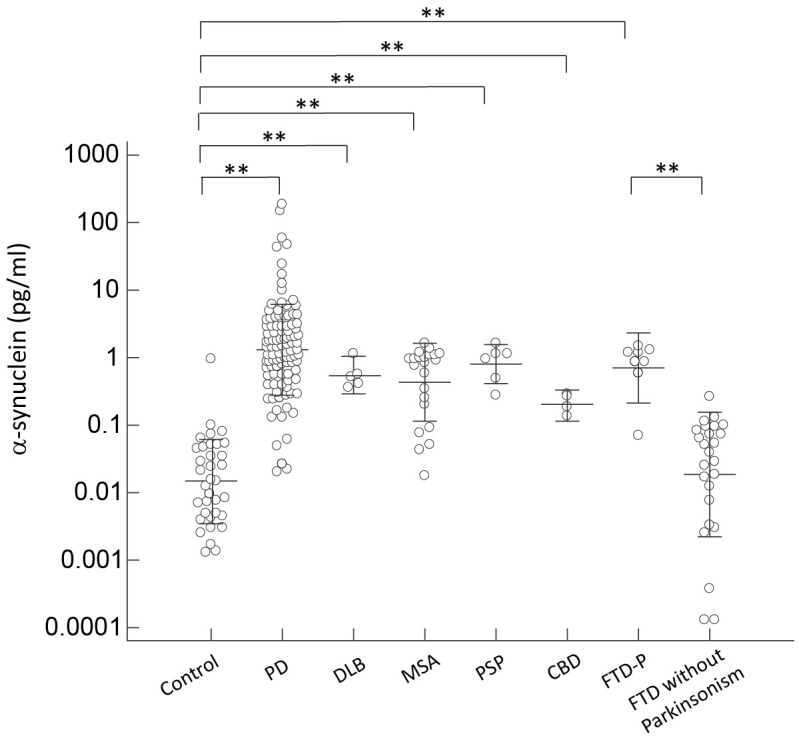
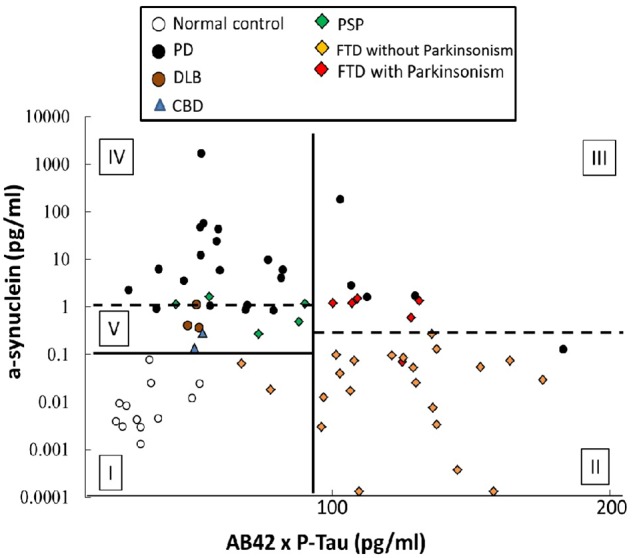
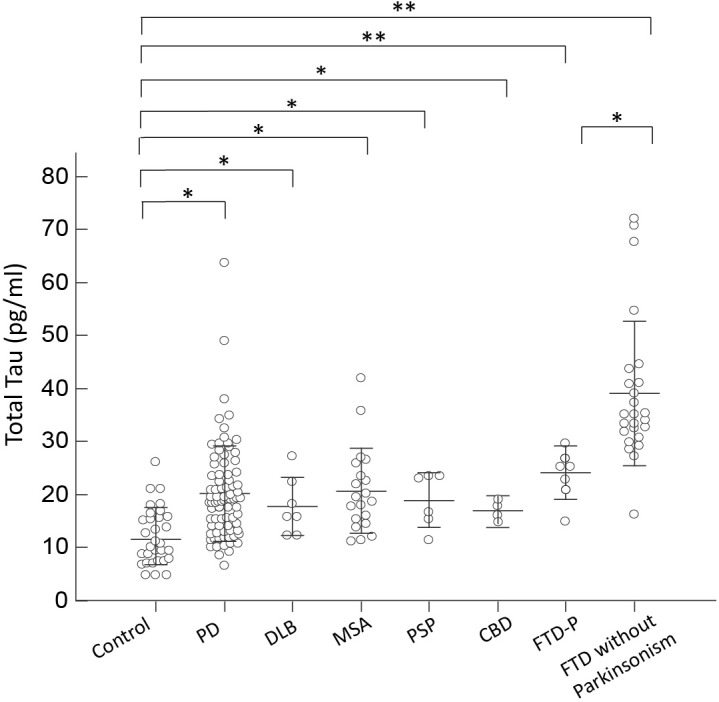
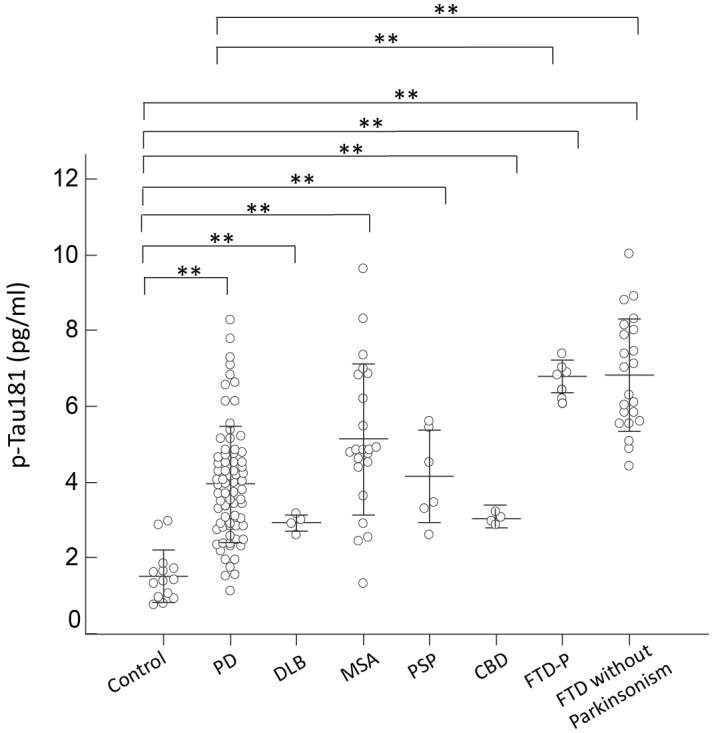
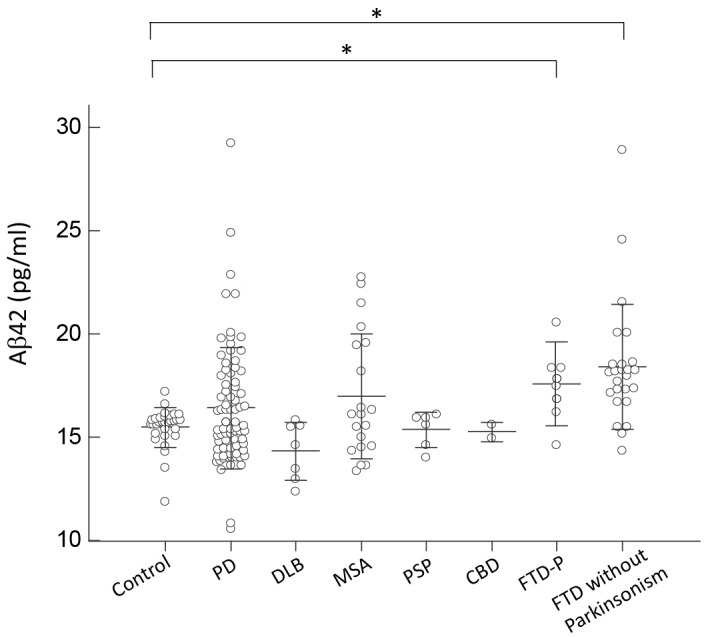
Parkinson's disease (PD) has significant clinical overlaps with atypical parkinsonism syndromes (APS), which have a poorer treatment response and a more aggressive course than PD. We aimed to identify plasma biomarkers to differentiate PD from APS. Plasma samples ( = 204) were obtained from healthy controls and from patients with PD, dementia with Lewy bodies (DLB), multiple system atrophy, progressive supranuclear palsy (PSP), corticobasal degeneration (CBD), or frontotemporal dementia (FTD) with parkinsonism (FTD-P) or without parkinsonism. We measured plasma levels of α-synuclein, total tau, p-Tau181, and amyloid beta 42 (Aβ42) by immunomagnetic reduction-based immunoassay. Plasma α-synuclein level was significantly increased in patients with PD and APS when compared with controls and FTD without parkinsonism ( < 0.01). Total tau and p-Tau181 were significantly increased in all disease groups compared to controls, especially in patients with FTD ( < 0.01). A multivariate and receiver operating characteristic curve analysis revealed that a cut-off value for Aβ42 multiplied by p-Tau181 for discriminating patients with FTD from patients with PD and APS was 92.66 (pg/ml), with an area under the curve (AUC) of 0.932. An α-synuclein cut-off of 0.1977 pg/ml could separate FTD-P from FTD without parkinsonism (AUC 0.947). In patients with predominant parkinsonism, an α-synuclein cut-off of 1.388 pg/ml differentiated patients with PD from those with APS (AUC 0.87). Our results suggest that integrated plasma biomarkers improve the differential diagnosis of PD from APS (PSP, CBD, DLB, and FTD-P).
帕金森病(PD)与非典型帕金森综合征(APS)在临床上有显著重叠,后者的治疗反应比PD更差,病程也更具侵袭性。我们旨在识别血浆生物标志物,以区分PD和APS。从健康对照以及患有PD、路易体痴呆(DLB)、多系统萎缩、进行性核上性麻痹(PSP)、皮质基底节变性(CBD)或伴帕金森综合征(FTD-P)或不伴帕金森综合征的额颞叶痴呆(FTD)的患者中获取血浆样本(n = 204)。我们通过基于免疫磁珠还原的免疫测定法测量血浆中α-突触核蛋白、总tau蛋白、磷酸化tau蛋白181(p-Tau181)和淀粉样β蛋白42(Aβ42)的水平。与对照组和不伴帕金森综合征的FTD相比,PD和APS患者的血浆α-突触核蛋白水平显著升高(P < 0.01)。与对照组相比,所有疾病组的总tau蛋白和p-Tau181均显著升高,尤其是FTD患者(P < 0.01)。多变量及受试者工作特征曲线分析显示,用于区分FTD患者与PD和APS患者的Aβ42乘以p-Tau181的截断值为92.66(pg/ml),曲线下面积(AUC)为0.932。α-突触核蛋白截断值为0.1977 pg/ml可将FTD-P与不伴帕金森综合征的FTD区分开来(AUC 0.947)。在以帕金森综合征为主的患者中,α-突触核蛋白截断值为1.388 pg/ml可区分PD患者与APS患者(AUC 0.87)。我们的结果表明,综合血浆生物标志物可改善PD与APS(PSP、CBD、DLB和FTD-P)的鉴别诊断。