Constantinides Vasilios C, Majbour Nour K, Paraskevas George P, Abdi Ilham, Safieh-Garabedian Bared, Stefanis Leonidas, El-Agnaf Omar M, Kapaki Elisabeth
Neurochemistry and Biomarkers Unit, 1st Department of Neurology, National and Kapodistrian University of Athens, 11528 Athens, Greece.
Ward of Cognitive and movement Disorders, 1st Department of Neurology, National and Kapodistrian University of Athens, 11528 Athens, Greece.
Brain Sci. 2021 Jan 17;11(1):119. doi: 10.3390/brainsci11010119.
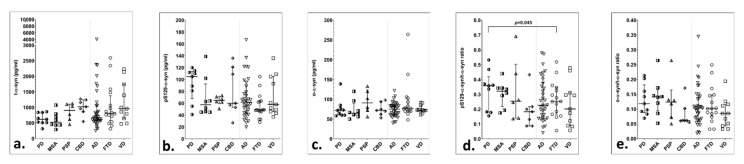
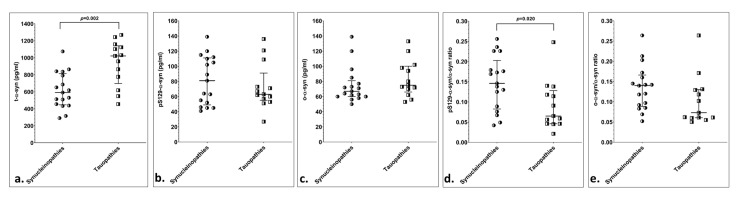
Total CSF α-synuclein (t-α-syn), phosphorylated α-syn (pS129-α-syn) and α-syn oligomers (o-α-syn) have been studied as candidate biomarkers for synucleinopathies, with suboptimal specificity and sensitivity in the differentiation from healthy controls. Studies of α-syn species in patients with other underlying pathologies are lacking. The aim of this study was to investigate possible alterations in CSF α-syn species in a cohort of patients with diverse underlying pathologies. A total of 135 patients were included, comprising Parkinson's disease (PD; = 13), multiple system atrophy (MSA; = 9), progressive supranuclear palsy (PSP; = 13), corticobasal degeneration (CBD; = 9), Alzheimer's disease (AD; = 51), frontotemporal degeneration (FTD; = 26) and vascular dementia patients (VD; = 14). PD patients exhibited higher pS129-α-syn/α-syn ratios compared to FTD ( = 0.045), after exclusion of samples with CSF blood contamination. When comparing movement disorders (i.e., MSA vs. PD vs. PSP vs. CBD), MSA patients had lower syn levels compared to CBD ( = 0.024). Patients with a synucleinopathy (PD and MSA) exhibited lower t-syn levels ( = 0.002; cut-off value: ≤865 pg/mL; sensitivity: 95%, specificity: 69%) and higher /t-syn ratios ( = 0.020; cut-off value: ≥0.122; sensitivity: 71%, specificity: 77%) compared to patients with tauopathies (PSP and CBD). There are no significant α-syn species alterations in non-synucleinopathies.
脑脊液总α-突触核蛋白(t-α-syn)、磷酸化α-突触核蛋白(pS129-α-syn)和α-突触核蛋白寡聚体(o-α-syn)已作为突触核蛋白病的候选生物标志物进行研究,但在与健康对照区分时特异性和敏感性欠佳。缺乏对其他潜在病理患者中α-突触核蛋白种类的研究。本研究的目的是调查一组患有多种潜在病理疾病患者脑脊液中α-突触核蛋白种类的可能变化。共纳入135例患者,包括帕金森病(PD;n = 13)、多系统萎缩(MSA;n = 9)、进行性核上性麻痹(PSP;n = 13)、皮质基底节变性(CBD;n = 9)、阿尔茨海默病(AD;n = 51)、额颞叶变性(FTD;n = 26)和血管性痴呆患者(VD;n = 14)。排除脑脊液有血液污染的样本后,PD患者与FTD患者相比,pS129-α-syn/α-syn比值更高(P = 0.045)。比较运动障碍患者(即MSA与PD与PSP与CBD)时,MSA患者的突触核蛋白水平低于CBD患者(P = 0.024)。与tau蛋白病(PSP和CBD)患者相比,突触核蛋白病(PD和MSA)患者的t-突触核蛋白水平更低(P = 0.002;临界值:≤865 pg/mL;敏感性:95%,特异性:69%),pS129-α-syn/t-突触核蛋白比值更高(P = 0.020;临界值:≥0.122;敏感性:71%,特异性:77%)。非突触核蛋白病患者的α-突触核蛋白种类无显著变化。