Pardini Barbara, Cordero Francesca, Naccarati Alessio, Viberti Clara, Birolo Giovanni, Oderda Marco, Di Gaetano Cornelia, Arigoni Maddalena, Martina Federica, Calogero Raffaele A, Sacerdote Carlotta, Gontero Paolo, Vineis Paolo, Matullo Giuseppe
Italian Institute for Genomic Medicine, Turin, Italy.
Department of Medical Sciences, University of Turin, Turin, Italy.
Oncotarget. 2018 Apr 17;9(29):20658-20669. doi: 10.18632/oncotarget.25057.
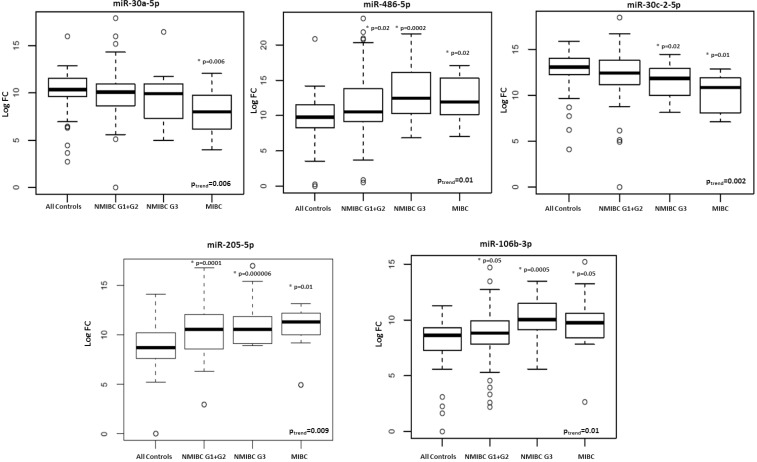
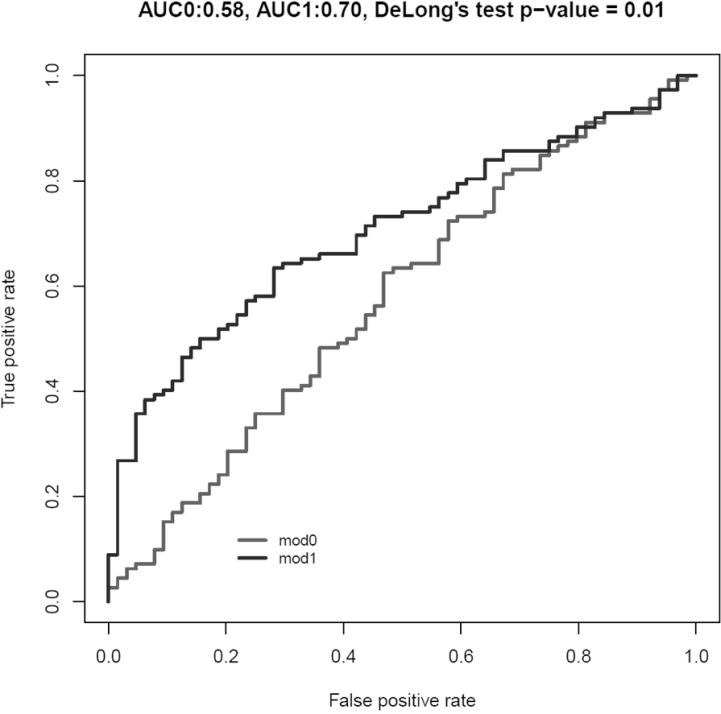
Bladder cancer (BC) is the most frequent malignancy of the urinary tract with a high incidence in men and smokers. Currently, there are no non-invasive markers useful for BC diagnosis and subtypes classification that could overcome invasive procedures such as cystoscopy. Dysregulated miRNA profiles have been associated with numerous cancers, including BC. Cell-free miRNAs are abundantly present in a variety of biofluids including urine and make them promising candidates in cancer biomarker discovery. In the present study, the identification of miRNA fingerprints associated with different BC status was performed by next-generation sequencing on urine samples from 66 BC and 48 controls. Three signatures based on dysregulated miRNAs have been identified by regression models, assessing the power to discriminate different BC subtypes. Altered miRNAs according to invasiveness and grade were validated by qPCR on 112 cases and 65 controls (among which 46 cases and 16 controls were an independent group of subjects while the rest were replica samples). The area under the curve (AUC) computed including three miRNAs (miR-30a-5p, let-7c-5p and miR-486-5p) altered in all BC subtypes showed a significantly increased accuracy in the discrimination of cases and controls (AUC model = 0.70; -value = 0.01). In conclusions, the non-invasive detection in urine of a selected number of miRNAs altered in different BC subtypes could lead to an accurate early diagnosis of cancer and stratification of patients.
膀胱癌(BC)是泌尿系统最常见的恶性肿瘤,在男性和吸烟者中发病率较高。目前,尚无可用于膀胱癌诊断和亚型分类的非侵入性标志物能够替代膀胱镜等侵入性检查。微小RNA(miRNA)表达失调与包括膀胱癌在内的多种癌症相关。游离miRNA大量存在于包括尿液在内的多种生物流体中,使其成为癌症生物标志物发现的有前景的候选物。在本研究中,通过对66例膀胱癌患者和48例对照的尿液样本进行下一代测序,鉴定了与不同膀胱癌状态相关的miRNA指纹。通过回归模型确定了基于失调miRNA的三个特征,评估了区分不同膀胱癌亚型的能力。根据侵袭性和分级改变的miRNA在112例病例和65例对照中通过定量聚合酶链反应(qPCR)进行验证(其中46例病例和16例对照为独立的受试者组,其余为重复样本)。计算包括在所有膀胱癌亚型中均发生改变的三种miRNA(miR-30a-5p、let-7c-5p和miR-486-5p)的曲线下面积(AUC),结果显示在区分病例和对照方面准确性显著提高(AUC模型 = 0.70;P值 = 0.01)。总之,在尿液中对选定数量的、在不同膀胱癌亚型中发生改变的miRNA进行非侵入性检测,可能会实现癌症的准确早期诊断和患者分层。