Clinical Institute of Urology and Renal Transplantation, 400006, Cluj-Napoca, Romania.
Iuliu Hatieganu University of Medicine and Pharmacy, 400012, Cluj-Napoca, Romania.
Mol Med. 2022 Apr 1;28(1):39. doi: 10.1186/s10020-022-00462-z.
Bladder cancer (BC) has the highest per-patient cost of all cancer types. Hence, we aim to develop a non-invasive, point-of-care tool for the diagnostic and molecular stratification of patients with BC based on combined microRNAs (miRNAs) and surface-enhanced Raman spectroscopy (SERS) profiling of urine.
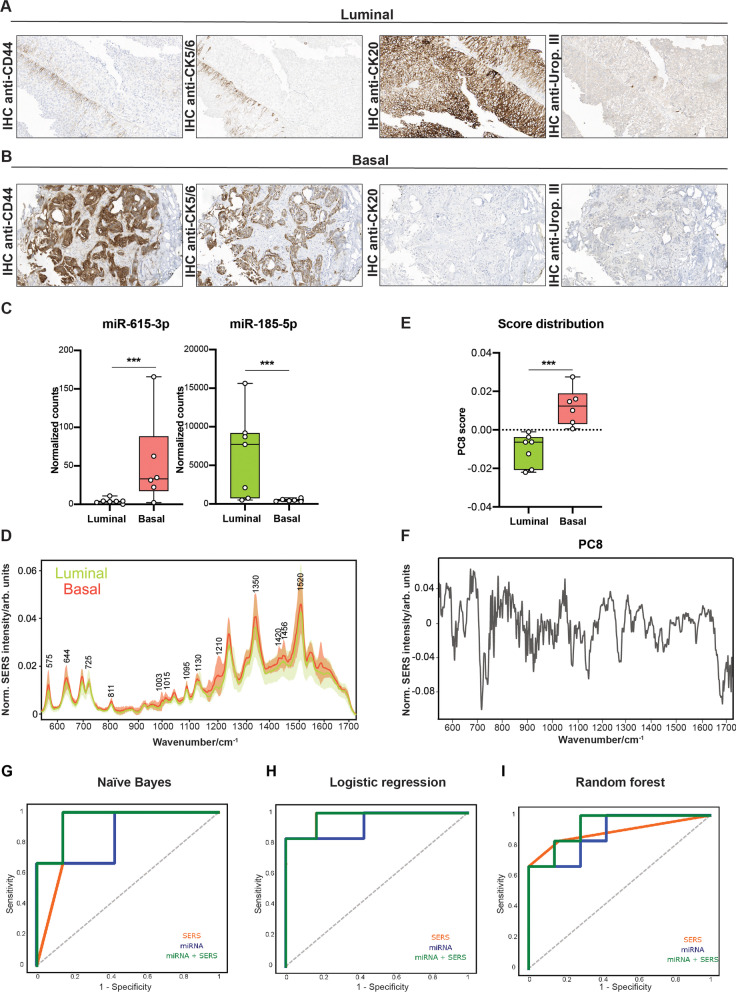
Next-generation sequencing of the whole miRNome and SERS profiling were performed on urine samples collected from 15 patients with BC and 16 control subjects (CTRLs). A retrospective cohort (BC = 66 and CTRL = 50) and RT-qPCR were used to confirm the selected differently expressed miRNAs. Diagnostic accuracy was assessed using machine learning algorithms (logistic regression, naïve Bayes, and random forest), which were trained to discriminate between BC and CTRL, using as input either miRNAs, SERS, or both. The molecular stratification of BC based on miRNA and SERS profiling was performed to discriminate between high-grade and low-grade tumors and between luminal and basal types.
Combining SERS data with three differentially expressed miRNAs (miR-34a-5p, miR-205-3p, miR-210-3p) yielded an Area Under the Curve (AUC) of 0.92 ± 0.06 in discriminating between BC and CTRL, an accuracy which was superior either to miRNAs (AUC = 0.84 ± 0.03) or SERS data (AUC = 0.84 ± 0.05) individually. When evaluating the classification accuracy for luminal and basal BC, the combination of miRNAs and SERS profiling averaged an AUC of 0.95 ± 0.03 across the three machine learning algorithms, again better than miRNA (AUC = 0.89 ± 0.04) or SERS (AUC = 0.92 ± 0.05) individually, although SERS alone performed better in terms of classification accuracy.
miRNA profiling synergizes with SERS profiling for point-of-care diagnostic and molecular stratification of BC. By combining the two liquid biopsy methods, a clinically relevant tool that can aid BC patients is envisaged.
膀胱癌(BC)是所有癌症类型中每位患者治疗费用最高的。因此,我们旨在开发一种非侵入性的即时护理工具,用于基于尿液中 microRNAs(miRNAs)和表面增强拉曼光谱(SERS)分析对 BC 患者进行诊断和分子分层。
对 15 名 BC 患者和 16 名对照(CTRL)的尿液样本进行了全 miRNome 下一代测序和 SERS 分析。使用回顾性队列(BC=66 例,CTRL=50 例)和 RT-qPCR 来验证所选差异表达的 miRNAs。使用机器学习算法(逻辑回归、朴素贝叶斯和随机森林)评估诊断准确性,这些算法被训练用于区分 BC 和 CTRL,输入为 miRNAs、SERS 或两者的组合。基于 miRNA 和 SERS 分析对 BC 进行分子分层,以区分高级别和低级别肿瘤以及 luminal 和基底类型。
将 SERS 数据与三个差异表达的 miRNAs(miR-34a-5p、miR-205-3p、miR-210-3p)结合使用,在区分 BC 和 CTRL 时,曲线下面积(AUC)为 0.92±0.06,优于 miRNAs(AUC=0.84±0.03)或 SERS 数据(AUC=0.84±0.05)单独使用的 AUC。在评估 luminal 和基底 BC 的分类准确性时,miRNAs 和 SERS 分析组合在三种机器学习算法中的平均 AUC 为 0.95±0.03,再次优于 miRNA(AUC=0.89±0.04)或 SERS(AUC=0.92±0.05)单独使用,尽管 SERS 单独在分类准确性方面表现更好。
miRNA 分析与 SERS 分析协同作用,用于即时护理诊断和 BC 的分子分层。通过结合这两种液体活检方法,设想了一种可以辅助 BC 患者的临床相关工具。