Department of Medicine, Division of Infectious Diseases, University of North Carolina, Chapel Hill, North Carolina, United States of America.
Department of Epidemiology, University of North Carolina Gillings School of Global Public Health, Chapel Hill, North Carolina, United States of America.
PLoS One. 2018 May 15;13(5):e0196410. doi: 10.1371/journal.pone.0196410. eCollection 2018.
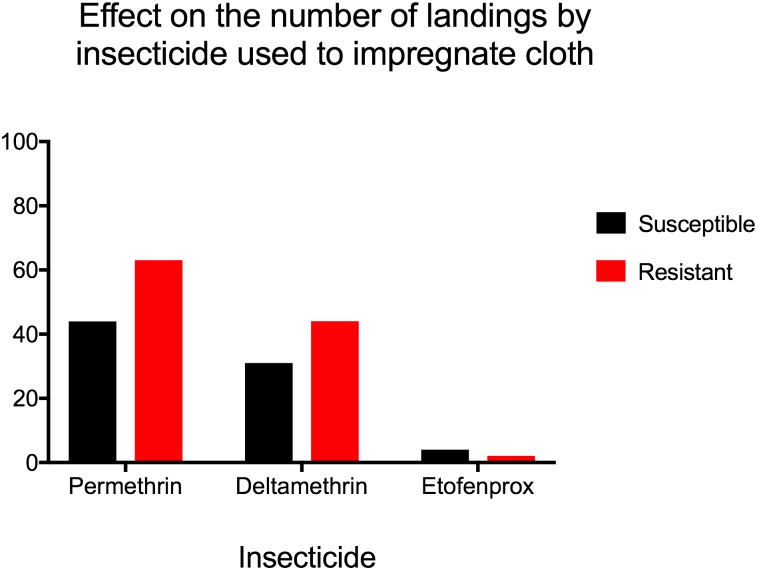
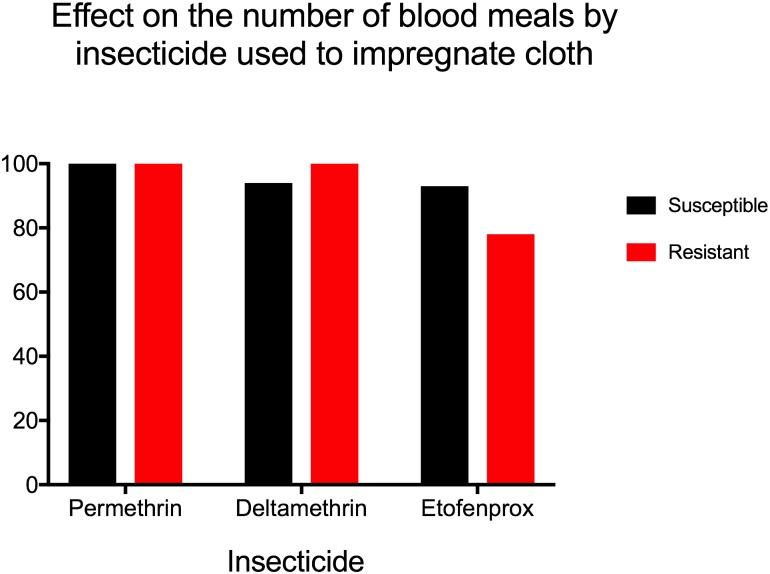
Pyrethroid-treated clothing is commonly worn for protection against mosquitoes; pyrethroids are both insecticides and repellents. Pyrethroid resistance has become increasingly common in Aedes aegypti, the vector of dengue, Zika, and other arboviruses, but it is not clear whether resistance is associated with reductions in repellency. In order to determine whether long-lasting permethrin impregnated (LLPI) clothing is protective, we used Aedes aegypti from New Orleans, LA (pyrethroid-sensitive) and San Juan, PR (resistant) to measure both lethality and repellency. PCR and Sanger sequencing were used to confirm resistance status by detecting mutations in the kdr gene at positions 1016 and 1534. Arm-in-cage trials of 100 Aedes aegypti females from both populations were performed for 10 minutes to bare arm or an arm clothed in untreated military camouflage or military camouflage impregnated with deltamethrin, permethrin, or etofenprox. Trials were repeated 4-5 times on different days. Number of landings, number of blood meals, and immediate and 24-hour mortality were recorded. Mortality was extremely low in all trials. Compared to untreated cloth, mosquitoes demonstrated a trend towards a 2%-63% reduction in landings and a statistically significant 78-100% reduction in blood feeding on pyrethroid-treated cloth for most insecticides. Effects were observed in both pyrethroid-sensitive and pyrethroid-resistant mosquito populations. Our data show that kdr mutations are associated with pyrethroid resistance but are likely not the only contributors. Pyrethroids appear to maintain repellent effect against resistant mosquitoes. This finding suggests that even in places where pyrethroid resistance is widespread, permethrin still has a role for use as a repellent on clothing to protect against mosquito bites.
拟除虫菊酯处理过的衣物通常用于防止蚊虫叮咬;拟除虫菊酯既是杀虫剂又是驱避剂。登革热、寨卡病毒和其他虫媒病毒的传播媒介埃及伊蚊对拟除虫菊酯的抗药性越来越普遍,但目前尚不清楚抗药性是否与驱避效果降低有关。为了确定长效氯菊酯浸渍(LLPI)衣物是否具有保护作用,我们使用来自新奥尔良(路易斯安那州,对拟除虫菊酯敏感)和圣胡安(波多黎各,对拟除虫菊酯具有抗性)的埃及伊蚊来测量其致死率和驱避率。通过检测 kdr 基因在位置 1016 和 1534 处的突变,使用 PCR 和 Sanger 测序来确认抗性状态。来自两个种群的 100 只埃及伊蚊雌性进行了手臂在笼内试验,时间为 10 分钟,手臂裸露或穿着未经处理的军用迷彩服或浸渍了氯菊酯、氯菊酯或乙氧呋草黄的军用迷彩服。在不同的日子重复进行了 4-5 次试验。记录着陆次数、吸血次数以及立即和 24 小时死亡率。所有试验中的死亡率都极低。与未处理的衣物相比,在大多数杀虫剂处理过的衣物上,蚊子的着陆次数减少了 2%-63%,而吸血次数则减少了统计学上显著的 78-100%,这表明蚊子对处理过的衣物有驱避作用。这一趋势在对拟除虫菊酯敏感和具有抗性的蚊群中都有观察到。我们的数据表明,kdr 突变与拟除虫菊酯抗性有关,但可能不是唯一的原因。拟除虫菊酯对具有抗性的蚊子似乎仍具有驱避作用。这一发现表明,即使在拟除虫菊酯抗性广泛存在的地方,氯菊酯仍然可以作为一种驱虫剂用于衣物上,以防止蚊虫叮咬。